Nobody asked who to involve in choosing security guard software before this owner sat through three demos alone, picked the platform that impressed him most, signed a contract, and announced the rollout at the next supervisor meeting. Two weeks later, half the field supervisors are still running paper checklists on the side “just in case,” officers are entering checkpoint scans wrong because nobody walked them through it before go-live, and the account manager who has to explain the new client-facing reports to a skeptical property manager is seeing the reporting screen for the first time on a live account.
None of that is a software problem. It’s a who to involve in choosing security guard software problem, and it’s one of the most avoidable failure modes in this whole category of purchase, because the fix costs nothing but a little humility and an extra hour of everyone’s time before the contract is signed.
Who to involve in choosing security guard software — and why owners default to deciding alone
It’s not laziness. Owners are usually the ones fielding vendor calls, comparing pricing, and thinking about the business case — margin, client retention, competitive positioning — that a field supervisor or a working officer has no visibility into and, frankly, no reason to weigh in on. It feels efficient to make the call and present the decision as done.
The problem is that “efficient” and “adopted” are two different outcomes. A platform an owner loves in a sales demo, evaluated against a slide deck and a spreadsheet of features, is being judged on criteria that don’t fully overlap with what determines whether it survives contact with a 3 a.m. shift change or a supervisor doing rounds in the rain with wet gloves trying to tap a phone screen.
The two people whose objections are cheap before signing and expensive after
The field supervisor
A field supervisor lives with the operational reality an owner sees only in reports: which accounts have spotty cell coverage that breaks a GPS-dependent check-in, which posts have officers who are not comfortable with a phone-based workflow, which shift patterns make a five-minute clock-in process an actual problem when someone’s covering two posts back to back. A supervisor sitting through even one real demo, asked to specifically try to break it the way their worst account would, surfaces objections an owner alone never will — not because the owner isn’t thoughtful, but because the owner isn’t the one standing in a parking lot at 5 a.m. trying to get a signal.
Those objections are cheap to hear during a demo. The vendor can answer them, the owner can weigh them against the alternative, and if the answer is genuinely a dealbreaker, nothing has been signed yet. The same objection raised three weeks after go-live, in front of the whole supervisor team, costs credibility the owner doesn’t get back easily.
At least one working officer
Supervisors are closer to the field than owners, but they’re still management, and a workflow that looks reasonable to a supervisor can be genuinely awkward for the officer actually executing it shift after shift — fumbling a scan with a flashlight in one hand, a login screen that times out mid-checkpoint, a report form with more fields than the situation warrants. A working officer, ideally one who’s a little skeptical rather than the most enthusiastic person on the roster, using the app for even a short trial run before rollout catches friction an owner and a supervisor both miss, because neither of them does the checkpoint scan four hundred times a month.
The account manager, for the parts the client actually sees
There’s a third person who gets skipped just as often, for a different reason: the account manager or the client-facing staff who’ll eventually have to explain the client portal, the reporting format, or the billing detail to a property manager who’s paying close attention to exactly those things. An owner focused on officer-facing workflows during evaluation can end up with a platform that’s genuinely good for the field and awkward for the account manager trying to walk a skeptical client through their monthly report for the first time — live, on a call, with no chance to practice first. Give that person a look at the client-facing side before you commit too, not just the officer app.
What “involve” actually means — not a vote, a real test
Involving a supervisor and an officer doesn’t mean turning the purchase into a committee decision or letting either veto the choice. The owner still owns the business case and the final call. What it means practically is: put the actual app, on an actual phone, in their hands before the contract is signed, and specifically ask them to try to find what breaks — not “does this look nice,” but “walk your worst shift through this and tell me where it falls apart.”
That’s a materially different exercise from watching a polished vendor demo, and it surfaces a different category of problem. A vendor demo is built to work. A field supervisor’s actual Tuesday night is not.
What this prevents
The value isn’t just catching bugs before rollout — it’s catching resistance before it calcifies into “management picked this without asking us,” which is the sentence that kills adoption on any new system regardless of how good the software actually is. A supervisor who was in the room during evaluation, who raised a real concern and watched the owner take it seriously, becomes an advocate during rollout instead of someone quietly telling the crew to keep using the old paper log as backup.
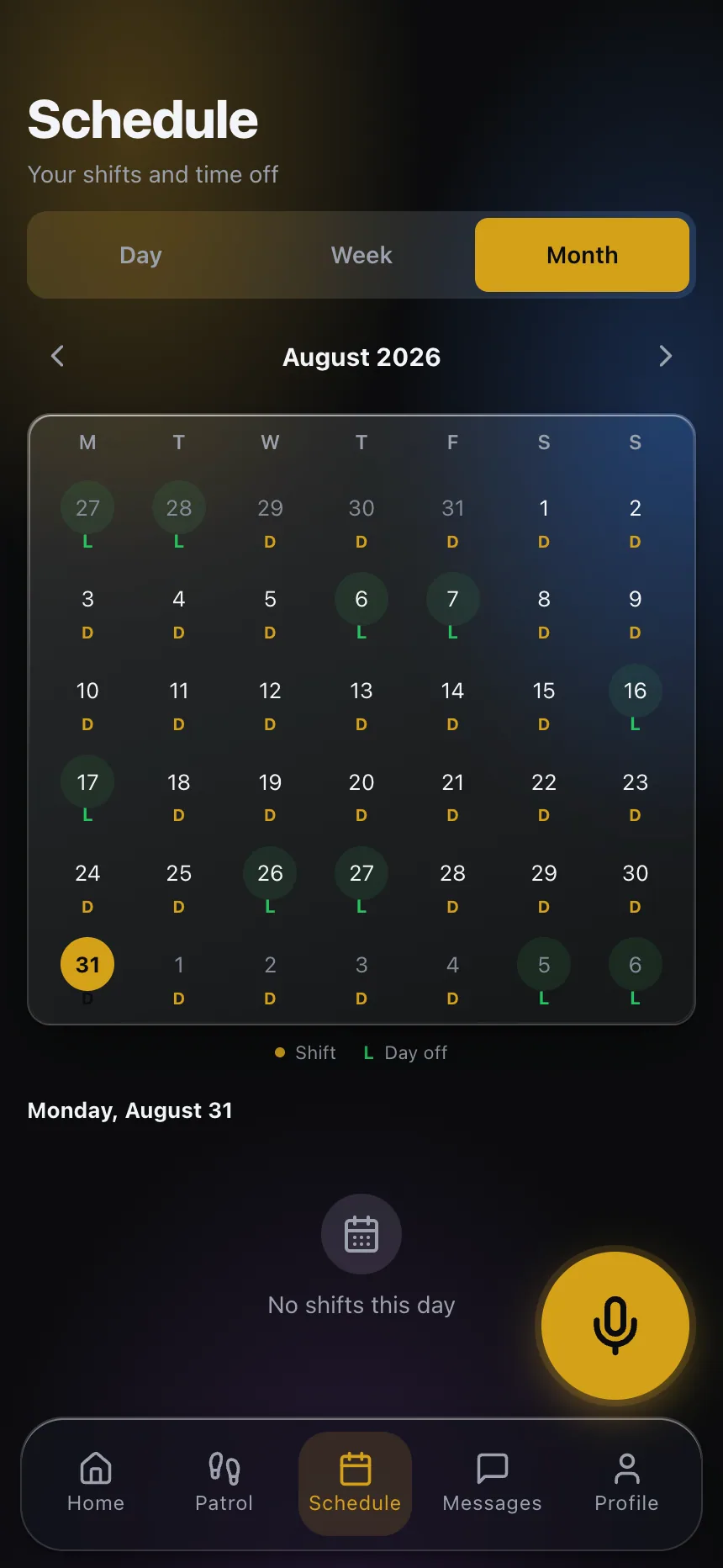
This matters most for the features officers touch every shift — scheduling they check constantly, checkpoint scans they perform every round, and time and attendance clock-ins they can’t avoid. Get buy-in on those before signing, and the features an owner mainly cares about — client-facing reporting, billing, the dispatch view — tend to land fine on their own, because the people who’ll actually be blocked by friction already had a say.
When the owner is also the field supervisor
A smaller operation often doesn’t have a separate field supervisor at all — the owner is out on rounds, handling callouts, and doing the job a supervisor would do at a bigger company, on top of running the business. In that case, “involve the field supervisor” isn’t a separate step, because the owner already has that perspective built in. What doesn’t automatically get covered is the officer’s side. An owner who is also the de facto supervisor can still be too far from the actual checkpoint scan, the actual login screen, the actual moment of fumbling a report form one-handed in the rain, because even a hands-on owner isn’t doing that specific task hundreds of times a month the way a working officer is. The officer trial run matters just as much, maybe more, precisely because there’s no separate supervisor in the room to catch what the owner misses.
The practical version of this for a smaller company
None of this requires a formal committee or a drawn-out process. It can be one supervisor and one officer, one afternoon, with the actual product in hand, before you sign. The cost is small. The alternative — finding out three weeks into a rollout that the field never bought in — is not.
If you’re evaluating your next platform and want a version your supervisors and officers can actually test before you commit, explore CGuardPro or get in touch.