NFC checkpoints
read by the officer's phone
An NFC tag survives where a printed code does not: in the rain, in the dark, under grime or behind a cover. CGuardPro reads NFC tags with the phone the officer already carries — no wands, no readers, no docking station — and lets you mix them with printed QR codes on the same route.
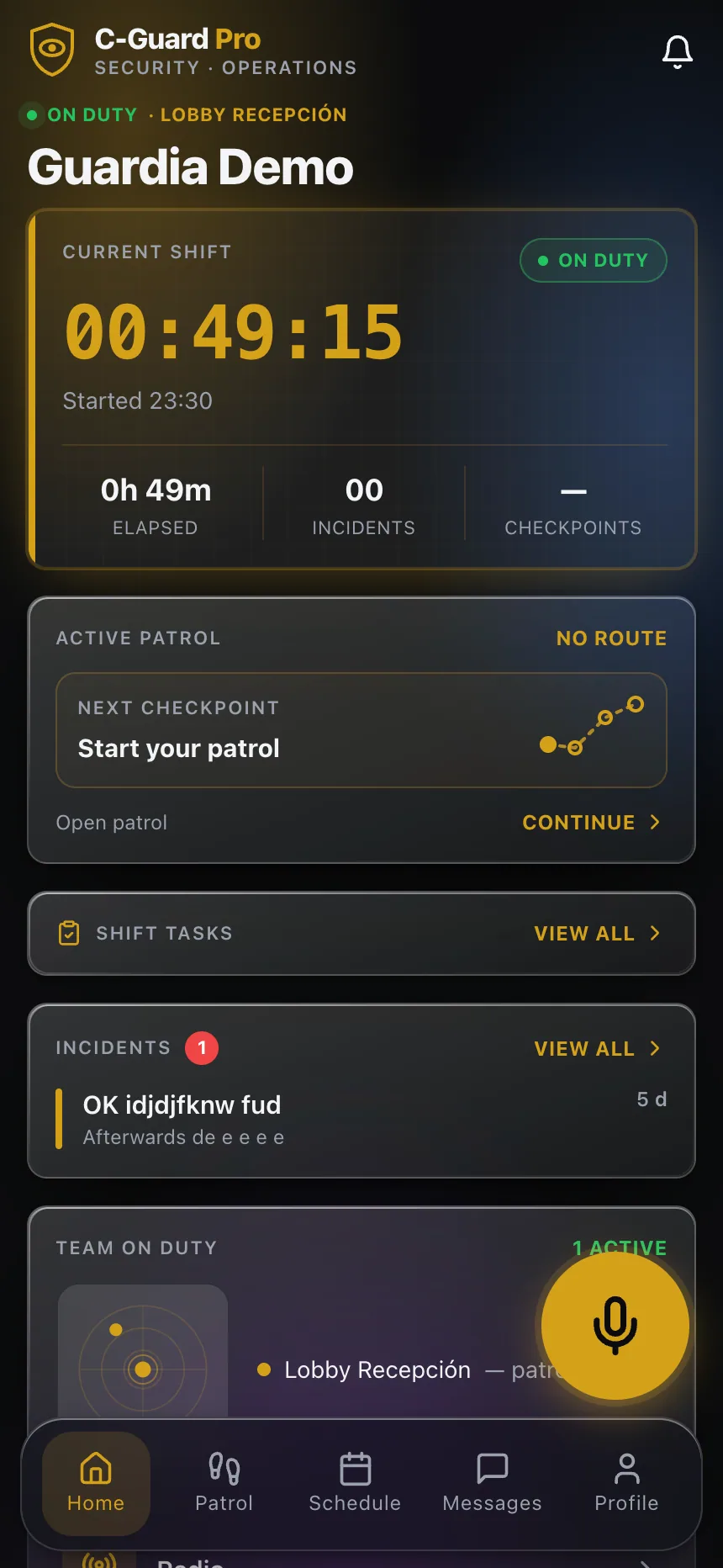
Real product screenshots
Short answer
An NFC guard tour system records patrols by having officers tap small NFC tags mounted at each checkpoint. In CGuardPro, the tag is read by the officer's own phone through the guard app; the server verifies every scan with its own time and the phone's position, and the officer can add a photo or a note. NFC and QR checkpoints can share one tour, with alerts for missed or late rounds.
At a glance
- Checkpoint types
- NFC tags and QR codes, mixed on one route
- Reader
- The officer's phone; it needs NFC hardware
- Verification
- Server time and phone position on every scan
- Per checkpoint
- Optional photo or note
- Alerts
- Skipped checkpoints, late and missed tours
Why companies move off wands and paper
A wand is one more device to lose
Proprietary readers get dropped, left in vehicles and forgotten in the charger. The tour data waits inside them until someone docks them at the office.
Printed codes give up outdoors
Sun, rain and grime wear a QR code down until it takes ten seconds to scan, then stops scanning altogether — usually on the exterior points that matter most.
A tap is not proof on its own
A tag can be pried off and carried. Without the time and position recorded by the system, a scan only proves that a phone met a tag somewhere.
How NFC checkpoints work in CGuardPro
Mount the tags
Fix an NFC tag at each point of the route. On steel doors, cabinets or frames, use tags built for metal mounting — a standard tag stuck straight onto metal often fails to read.
Register each tag as a checkpoint
Link every tag to its checkpoint and route in the dashboard, alongside any QR checkpoints the same tour uses.
The officer taps with the guard app open
The guard app reads the tag. The server records the scan with its own time and the phone's position, and the officer can attach a photo or note.
Gaps raise alerts during the shift
Skipped checkpoints, late rounds and missed tours alert dispatch while there is still time to act, and the client sees its own tour history in the portal.
When NFC beats QR, and when it does not
- NFC wins outdoors, in the dark, under grime and for officers wearing gloves
- NFC wins where you want the officer within a few centimeters of the point
- QR wins indoors, on sites that change often, and when a point must go live today
- QR wins on replacement: reprint it on site in minutes instead of ordering a tag
- Mix both on one route: NFC on the exposed points, QR everywhere else
Guides on this topic
QR vs NFC vs BLE Checkpoints: What Each Proves
QR, NFC and BLE checkpoints compared: how each one physically works, what it actually proves to a client, where it fails, and which one belongs at which post.
NFC vs. QR Checkpoints for Guard Tours: How to Choose
NFC vs QR checkpoints for guard tours: durability outdoors, cost per point, what happens when a tag is damaged, and why most companies end up mixing both.
Frequently asked questions
Do officers need special phones to read NFC tags? +
The phone needs NFC hardware. Most modern Android phones and iPhones have it, but many budget Android models do not, so if officers use their own phones, check the devices before you mount tags across a site. On iPhone, tags are read with the guard app open at the checkpoint.
Can one tour mix NFC tags with QR codes? +
Yes. A single route can combine NFC tags and QR codes. The officer follows one tour and the client reads one history, whatever kind of point each stop happens to be.
Is NFC harder to fake than QR? +
Harder, not impossible. A QR code can be photographed and an NFC tag can be removed and carried. That is why CGuardPro validates every scan on the server with its time and the phone's position, so a scan made away from the site does not pass as a visit.
Does CGuardPro support Bluetooth (BLE) beacons? +
No. CGuardPro checkpoints are NFC tags and QR codes, read with the officer's phone — no wands or readers. A beacon is detected from meters away and runs on a battery, so it can show that a phone was near an area but not that someone stood at a specific door.
What happens if a tag is damaged or missing? +
The checkpoint shows up as skipped on the tour, so a supervisor hears about it the same shift. The officer should still walk to the point and leave a note explaining what was found. A printed QR code can stand in at that point until a replacement tag is mounted.
What does it cost? +
USD 5 per user per month, where a user is anyone with a login, with every feature in one plan, including all checkpoint types. Implementation is a one-time USD 299.99 and there is a 7-day free trial.
Put NFC on the points that keep failing
Book a demo and see NFC and QR checkpoints on one tour, scanned from a phone and verified by the server.