Event security management software
for sites that exist for a weekend
Event work breaks the assumptions a guarding platform is usually built on. The site did not exist last month and will not exist next month. The headcount goes from nobody to eighty and back to nobody inside seventy-two hours. Half the roster has never worked for you before or works two events a year. And the promoter wants an invoice reconciled against actual hours while the crew is still loading out. CGuardPro treats an event as a real site with real posts rather than a spreadsheet exception, which is what makes the hours defensible when the settlement conversation starts.
Real product screenshots
Short answer
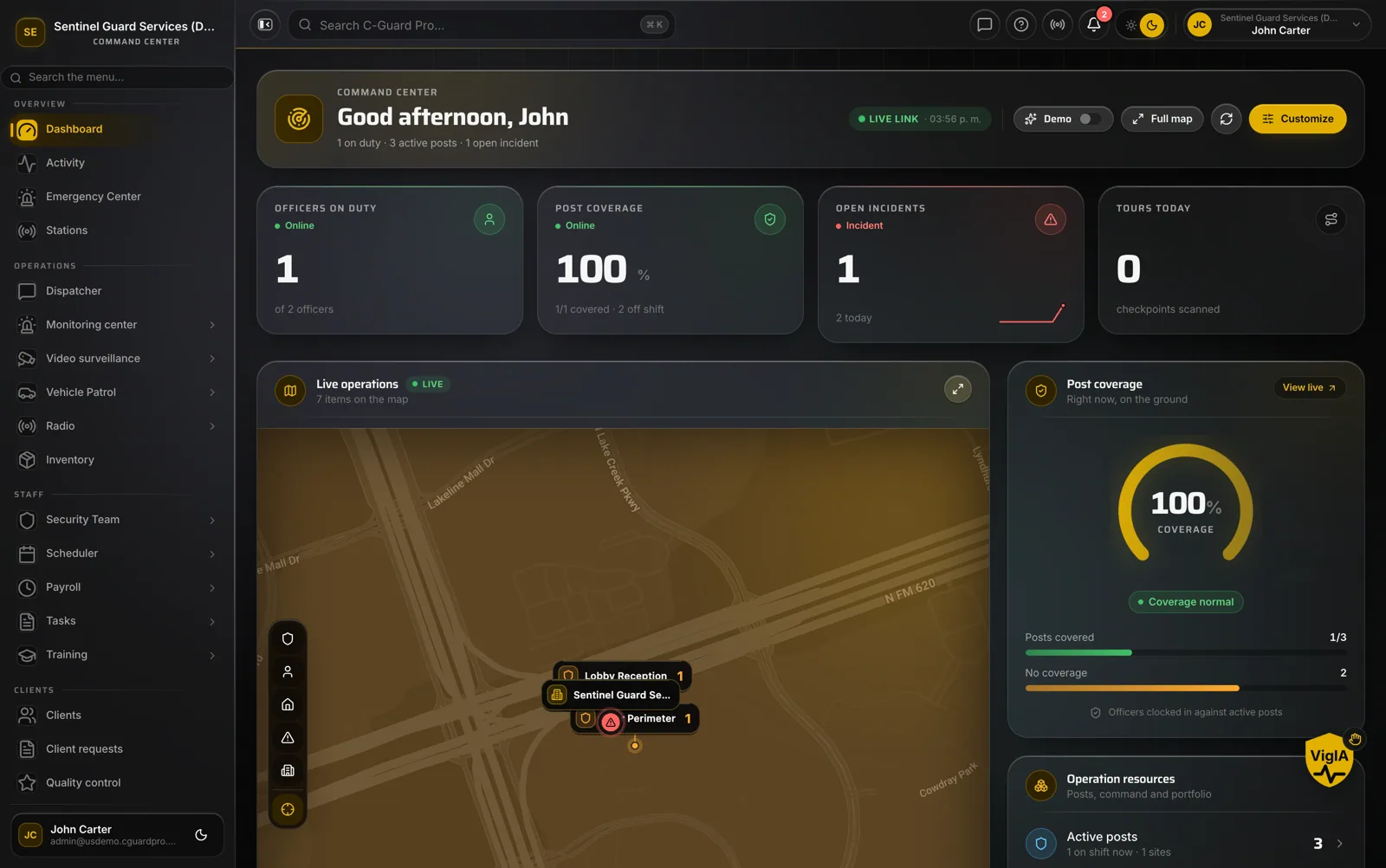
Event security management software has to stand up a site that lasts a weekend, fill a sudden staffing surge and record the hours actually worked. CGuardPro creates the venue as a real site with a radius or polygon clock-in boundary and separate positions, sends open shifts to officers on WhatsApp with an expiry, gives each zone its own orders, and logs doubles, early releases and no-shows with a reason as they happen.
At a glance
- Typical positions
- Front and back of house, loading dock, artist compound, perimeter
- Staffing
- Shift offers on WhatsApp; first acceptance takes it
- Key records
- Clock-ins per position, deviations with reasons, incidents
- Not included
- Ticketing, audience credentials, crowd-flow analytics
- After the event
- Per-event history stays searchable
Where event contracts lose money
The surge is filled by phone and remembered wrong
Eighty positions get filled through group chats, a phone tree and whoever a supervisor happens to reach. Two people believe they were given the same post, one person was never confirmed at all, and on the Monday nobody can reconstruct who agreed to what. The disputes that follow are paid out of margin.
One event is really six different jobsites
Front of house, back of house, the loading dock, the artist compound, the perimeter and the car parks each have their own instructions, their own escalation contacts and their own idea of who is allowed through. Issuing all of it as one briefing document means most officers carry rules that do not apply to where they are standing.
Settlement happens after everyone has gone home
Scheduled hours are not worked hours. Somebody covered a double when a colleague did not appear, somebody was released two hours early when the crowd cleared, and three positions were added on the Saturday at the promoter's request. Invoicing the plan instead of the reality either shorts you or triggers a dispute.
Running an event as an operation, not an exception
Stand the site up, then stand it down
The venue is created like any other site, with a clock-in boundary drawn as a radius or as a polygon traced around an irregular footprint, and with as many separate positions as the event actually has. When the load-out finishes the site is stood down and the whole record — hours, reports, incidents — stays searchable under it.
Fill the headcount from officers who answer
Extra positions are recorded as reinforcement against the event rather than smuggled in as edits to the standing roster, so the added heads are visible as added heads. Offers for open shifts go out to officers on WhatsApp with an expiry, and the first person to accept takes it — no double promises, and no supervisor working a call list.
Give every zone its own orders
Instructions are written against the position, not the contract, so the officer at the artist compound reads the artist compound's rules and its escalation chain, and the officer on the perimeter reads theirs. Recurring items are scheduled on the position — a barrier check before doors, a sweep at each set change — and completion is recorded with the time and the name.
Close the hours as they happen
Officers clock in against the position inside the boundary. Doubles, early releases and no-shows are recorded as deviations with their reason at the moment they occur, by the supervisor who dealt with them. What you take into the settlement meeting is the operational record of the weekend rather than a reconstruction of it.
What you can put in front of a promoter
- A site created for one weekend with its own posts, boundary, orders and checkpoints
- A clock-in boundary drawn as a polygon when a venue footprint is not a circle
- Added heads recorded as reinforcement against the event rather than hidden inside the standing roster
- Shift offers sent to phones with an expiry, taken by the first officer to accept
- Position-level instructions, so an officer reads only the zone they are standing in
- Doubles, early releases and no-shows logged with a reason at the moment they happen
- Incidents filed from a phone with photos, keeping the time they occurred even without signal
- A per-event history that stays searchable long after the fencing has been collected
Frequently asked questions
Does this scan tickets or credential the audience? +
No. There is no ticketing, no wristband or pass issuance for the public, no bag-search queue tooling and no crowd-flow analytics. This is a staff-side platform: it manages the officers you deploy, the positions they stand, what they are instructed to do there and what they report. Attendee accreditation belongs to the promoter's ticketing provider, and any vendor telling you one product does both well is selling you the weaker half of two.
How do you staff an eighty-officer weekend at short notice? +
Open positions are offered to officers on WhatsApp with an expiry attached, and the first acceptance takes the shift, which removes the double-promise problem that phone-tree staffing creates. Every additional head is recorded as a reinforcement against that event, so at settlement you can show which positions were the contracted plan and which were added during the show, and at whose request.
What about officers who work two events a year for us? +
They are ordinary users of the guard app with an assignment to the positions they are working. The practical constraint is not the software but the briefing: an officer who has not worked for you since last summer will not remember your escalation chain, which is exactly why the instructions live on the position and open on their phone at clock-in rather than being handed out as a printed briefing they will not read.
Can different zones of the same event have different rules? +
Yes, and they should. Each zone is set up as its own position with its own orders and its own contacts. The dock has vehicle and delivery rules, the compound has an access list and a very short escalation chain, the perimeter has an eviction procedure. Writing one briefing for the whole event is the most common reason an officer applies the wrong rule at the wrong door.
How do we prove the hours we invoice? +
Officers clock in and out against a specific position inside the site boundary, and every deviation from the plan is captured as it happens with its reason. The hours you bill are therefore the hours the system recorded rather than the hours the roster predicted. How those hours turn into rates and an invoice is covered on our payroll and billing page.
What happens in a stadium bowl or a basement dock with no signal? +
Incidents, visitor entries and the start and finish of a tour are queued on the phone and sent when signal comes back, and an incident keeps the time it happened rather than the time it uploaded. Two limits to plan around at a large venue: clocking in needs a live connection, so a check-in point should sit where there is coverage, and a checkpoint scan is timestamped by the server on arrival rather than at the moment of the scan.
Can a supervisor run the whole event from a phone? +
Largely, yes — supervisors work their site visits as a route of points, record deviations on the spot, and see the live position of their officers. What is genuinely better on a laptop is the initial build: creating the positions, drawing the boundary and writing the zone orders is a sit-down job you do in the week before, not something to attempt on a phone on the Friday.
How far ahead should an event be built in the system? +
Build the site and its positions as soon as the post plan is agreed, because the orders are the slow part and they are what the officers actually consume. Staffing can stay open much later, since offers go out to phones and fill in minutes rather than days. Companies that leave the whole build to the week of the show end up deploying officers with no instructions attached to their post, which defeats the point.
Build one event with us before the next one lands
Bring a post plan from a show you have already run. We will build the venue, its zones and its orders in the demo, then fill an open position by offer so you can see how the surge is actually covered.