Security patrol software
for the whole route, not one stop
A checkpoint scan proves a moment. A patrol is the thing you actually sell: a defined set of stops, at a defined frequency, between defined hours, delivered by an officer on foot or a car working fourteen accounts a night. CGuardPro plans that route, verifies each arrival by position and time, alerts dispatch when a stop is missed while the vehicle can still turn around, and reconstructs the night afterwards account by account.
Real product screenshots
Short answer
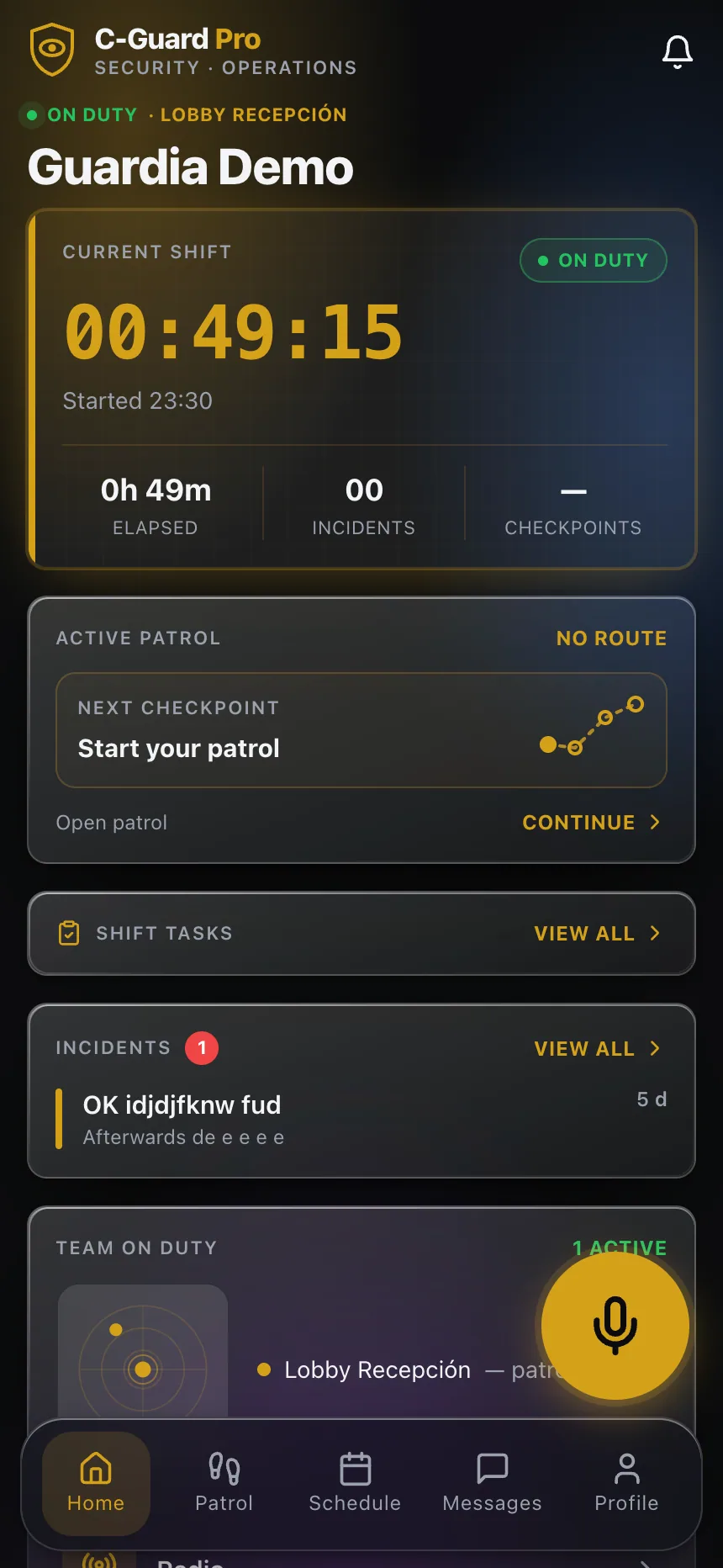
Security patrol software plans and verifies patrol routes, from foot posts to mobile patrols covering several accounts a night. In CGuardPro, routes are built from stops with frequency, hours and late tolerance. Officers work the route from their phone, arrivals are verified by position and server time, dispatch gets alerts for missed or late stops during the shift, and each account keeps its own visit history.
At a glance
- Route rules
- Frequency, hours and late tolerance
- Arrival
- Verified by position and server time
- Alerts
- Missed and late stops during the shift
- Vehicles
- No tracking hardware; the officer's phone reports position
- Offline
- Stops stored and uploaded when coverage returns
Why mobile patrol goes wrong
A night nobody can reconstruct
One car covers fourteen accounts between ten and six. In March the client asks how many hits their property received and at what times. What you have is a driver's memory and a log sheet written at the end of the shift, in one sitting.
Windshield time eats the contract
Routes grow by accounts and are almost never re-planned. The officer spends more of the shift driving than on the properties, and the sites at the bottom of the list get the thirty-second visit because that is all the clock allows.
The call-out that silently costs you stops
An alarm response at ten past two takes fifty minutes. The remaining accounts quietly lose their second hit, the paper log still reads as though the route ran, and nobody knows until the client with cameras asks a question.
How patrols run in CGuardPro
Build the route from its stops
Define which posts and sites the route covers, in what order, how often each one is due and between which hours, with the tolerance you are willing to accept before it counts as late.
The officer works it from the phone
The app carries the active patrol and the next stop due. Arrival is registered by scanning the point at the location, and anything worth reporting is filed from the same screen, at the property, rather than remembered until the end.
Dispatch sees it while it matters
Officers and patrol vehicles sit on the live map with their status. A stop that is running late or has been skipped raises an alert during the shift, when a car can still be redirected.
The night reconstructs itself
Each account ends up with its own list of visits: time, position and the officer who made them, exportable for the period and visible to that client in their portal.
Patrol you can plan and defend
- Routes defined per client with frequency, hours and late tolerance
- Arrival verified by position and server time, not by a signature at the end of the shift
- Alerts for missed and late stops while the shift is still running
- Live map of officers and patrol vehicles, with route history by date
- Works with no signal: stops are stored on the phone and upload when coverage returns
- Every account can read its own visit history in the client portal
Guides on this topic
24/7 Coverage vs Mobile Patrol: Which?
24/7 coverage vs mobile patrol: how to decide by risk and budget, when a scheduled patrol is enough, and the GPS proof to demand either way.
Random vs. Fixed Patrol Schedules: What the Evidence Says
Random patrol schedules vs fixed rounds: when predictability is a liability and when it is the product, plus how to randomize without losing accountability.
How Many Stops One Patrol Vehicle Can Cover Reliably
How many sites can one patrol vehicle cover before response time slips? Work backward from the slowest response you'll accept, not a map full of pins.
Warehouse and Distribution Center Patrol Best Practices
Warehouse patrol done right: dock doors, trailer yards, shrink hot spots and the shift-change window, with route design for a working facility.
Frequently asked questions
How is this different from a guard tour system? +
They are the same evidence at two different altitudes. A guard tour is the checkpoint layer — the QR or NFC point on the wall, scanned and verified, which is covered on the guard tour page. Patrol management is the layer above it: the route those points belong to, the accounts it covers, the frequency each client is owed, and what dispatch does when the route falls behind. A single-site building runs tours. A car covering fourteen accounts runs a patrol made of tours.
Can one officer cover several clients on one vehicle route? +
Yes, and that is the case worth designing for. Stops belong to the sites and posts they serve, so a route can cross clients while each account keeps its own visit history — which is what lets you answer one client without exposing another, and what lets you see whether the route has grown past what one shift can carry.
The contract says three hits a night between ten and six. Can we show we delivered them? +
That is exactly the shape the route rules take: how many visits are due, in which window and with what tolerance. Delivered visits carry a verified time and position; the ones that did not happen appear as missed rather than as silence. Both halves matter, because a report that can only ever say yes is not evidence of anything.
What happens when a call-out pulls the car off the route? +
Dispatch sees the vehicle divert and sees the stops falling behind, so the choice of what to sacrifice is made deliberately during the night rather than discovered afterwards. The record afterwards shows what was covered and what was not, which is the conversation you want to have with the client before they have it with you. When you evaluate any patrol system, ask to see this exact scenario played out live: pull a car off its route mid-shift and watch what the dashboard and the client report do with the stops that were missed.
Do we need to fit tracking hardware in the patrol vehicles? +
No. The officer's phone reports position while they are on duty and stops when the shift ends, so there is no vehicle unit to buy, install, move between cars or explain to a driver. Location is tied to the shift, which also keeps the privacy question narrow: on duty, at work, for operational purposes.
How do we work out whether a mobile route is actually profitable? +
The platform gives you the operational facts the arithmetic needs — hours worked by post and client, visits per account, arrival times and how the night was really spent between properties and between them. What it will not do is tell you your margin, because your bill rate, your pay rate and your vehicle costs live in your own model. Bring those numbers to the same table and the route usually explains itself.
Can we mix static posts and mobile routes in one operation? +
Yes. A guard standing a lobby post, a supervisor running vehicle patrols across sites and a driver working an overnight account list are all scheduled, clocked in and verified through the same system, which is what makes the hours and the evidence comparable across contract types instead of living in separate tools.
What does the client actually see? +
Their own sites and nothing else: the visits made to their property with verified times, the reports filed there and the incidents raised. It answers most of the questions that would otherwise arrive as a phone call to your operations manager at seven in the morning.
Put one night's route on the screen
Book a demo with a real account list and we plan the route, run a stop from the phone and show the night as the client would read it afterwards.