The dispatcher doesn’t need payroll.
The client doesn’t need your schedule
A security company has owners, operations managers, dispatchers, HR, supervisors, officers and clients — each needing a different slice of the system. CGuardPro lets you define those slices with editable roles and adjust them person by person.
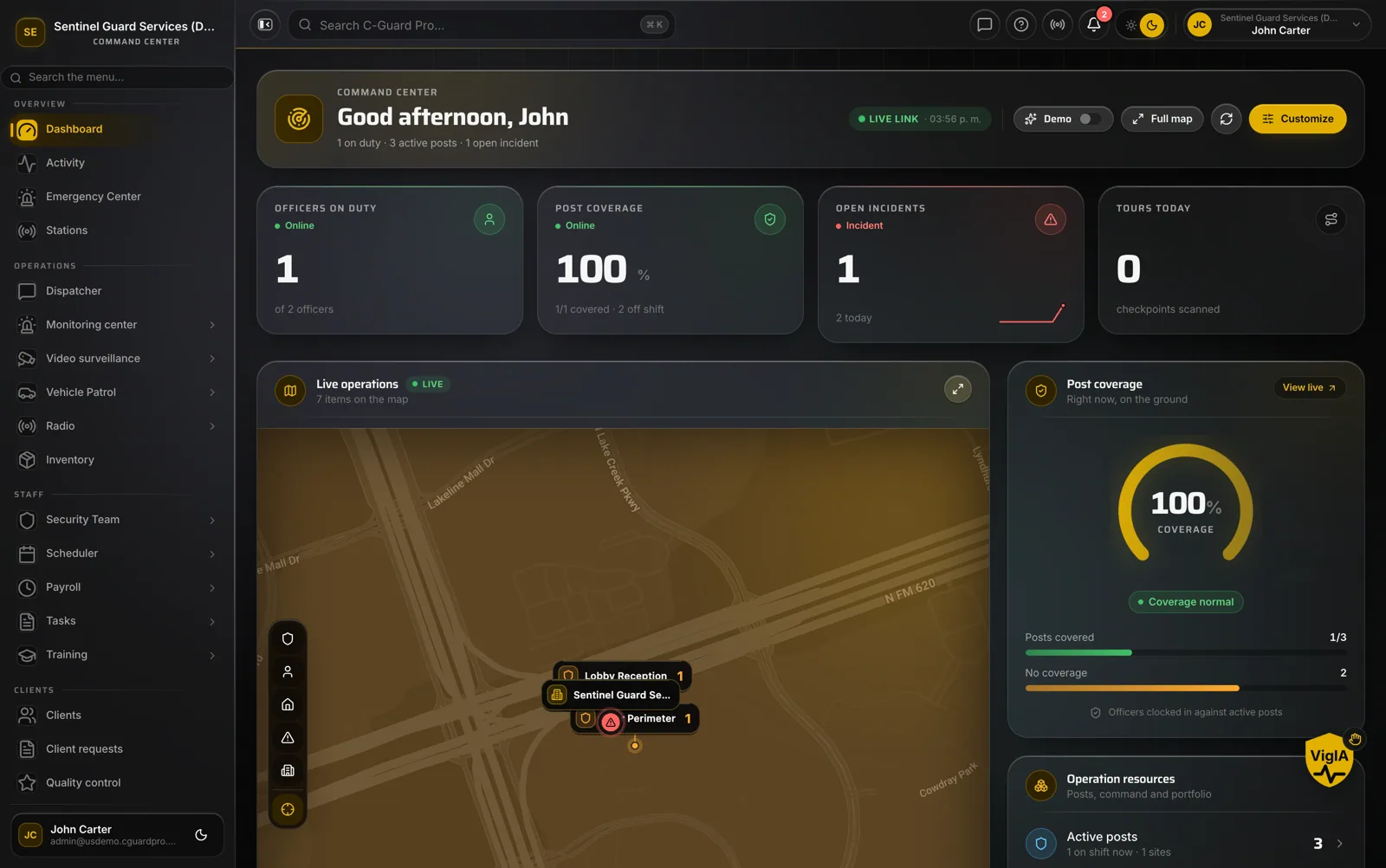
Real product screenshots
Short answer
Role-based access control (RBAC) decides which screens and actions each user can reach. CGuardPro ships with built-in roles for a security company — such as administrator, operations manager, supervisor, officer and client — that you can edit. On top of the role, you can grant or deny individual permissions to a specific person. Officers, office staff and clients also use separate apps, and each app only accepts the roles it is meant for.
At a glance
- Roles
- Built-in and editable
- Per person
- Grant or deny individual permissions
- Precedence
- A denial on the person overrides the role
- Apps
- Web app, guard app, supervisor app, client app — each limited by role
The shared-login problem
One admin password for everyone
When everybody uses the owner’s account, nobody knows who changed what.
All or nothing
Giving a dispatcher access to schedules should not also show them pay rates.
Exceptions break the model
One supervisor needs one extra permission, and the only fix is a new role.
How access is controlled
Start from built-in roles
Roles that match a security company’s jobs are ready on day one.
Edit them
Add or remove permissions from any role to match how your company works.
Adjust per person
Grant an extra permission or deny one for a specific user without creating a new role.
Right app, right person
Officers cannot log in to the office web app and clients only see their own sites.
What it protects
- Every action tied to a named user
- Pay and personal data limited to those who need it
- Exceptions handled per person
- Clients isolated to their own information
- No shared logins between staff
Frequently asked questions
Can I create my own roles? +
You can edit the built-in roles and adjust permissions per person. Most companies cover their needs this way without new roles.
What wins: the role or the person’s setting? +
A denial on the person wins over what the role grants, so exceptions are reliable.
Can officers use the web app? +
No. Officers use the guard app. Staff who work the console, such as central operators, can be given web access explicitly.
What do clients see? +
Only their own sites and records, through the client portal and app, with the sections your company enables.
Give everyone their own login
Book a demo and we map your team’s jobs to roles in a few minutes.