Security company management software
for the owner who is tired of running five systems
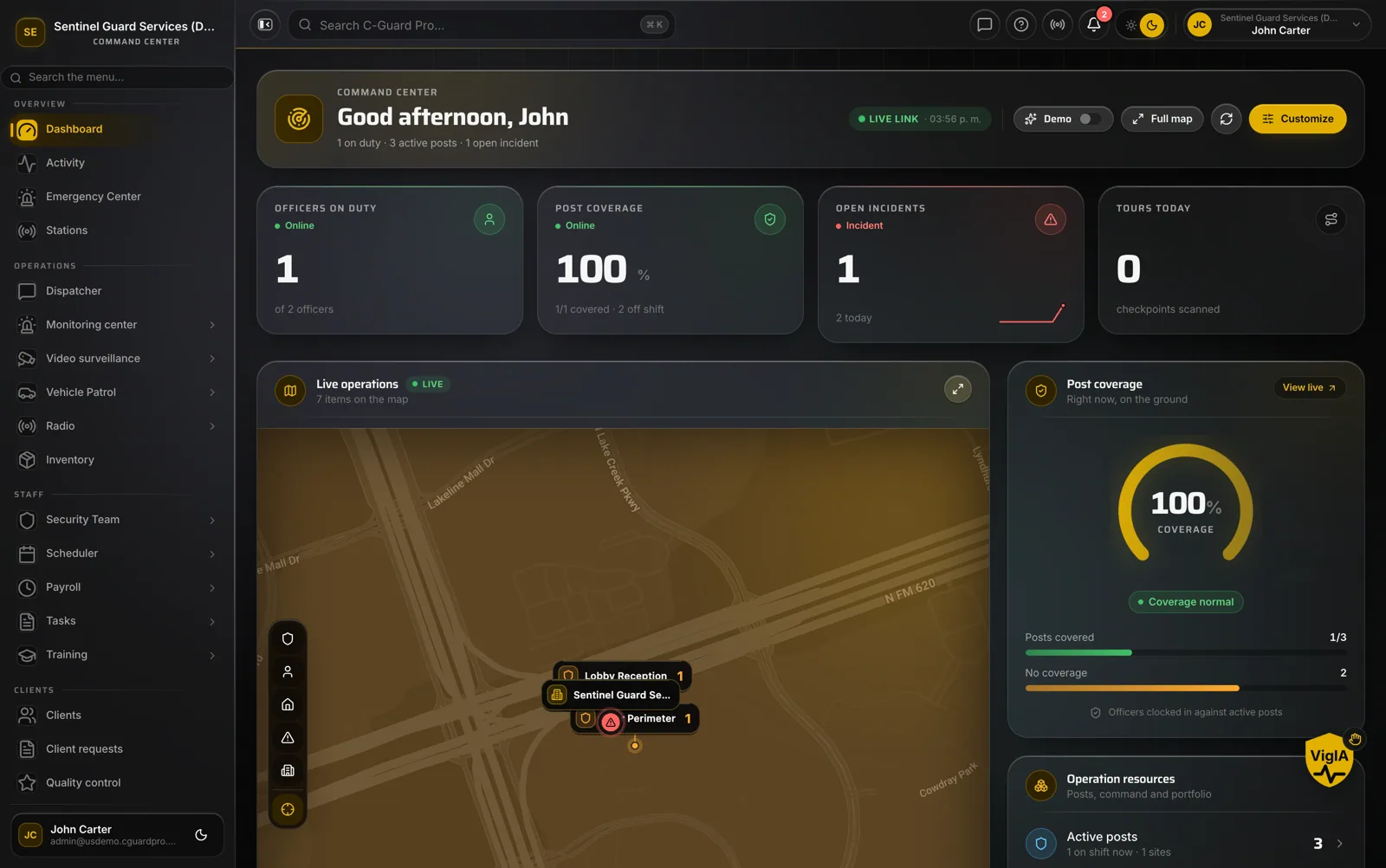
Most guard companies are managed across a scheduling spreadsheet, a punch-clock app, a paper DAR book at each post, a group chat for the supervisors and an inbox full of client complaints. CGuardPro is security company management software that puts those jobs on one record: the schedule for each post, the officer who clocked in against it with a selfie and a geofence, the tours and reports filed during the shift, the incidents and dispatch calls, and the portal your client reads the next morning. It is operations software. Payroll processing, taxes and benefits stay where you run them today, and we say so on every page where it matters. CGuardPro is trusted by 600+ security companies worldwide.
Real product screenshots
Short answer
Security company management software is a single platform for running a guard company's operations, from scheduling to client reporting. CGuardPro links each client, site and post to its schedule, selfie-and-geofence clock-ins, QR tours, activity and incident reports, dispatch and a client portal. It is operations software: payroll processing, taxes and benefits stay in the systems you already use. Published pricing is $5 per user per month.
At a glance
- Covers
- Scheduling, clock-in, tours, reports, dispatch, client portal
- Price
- $5 per user per month
- Trial
- 7 days
- Implementation
- Optional one-time $299.99 package
- Not included
- Payroll processing, taxes and benefits administration
What running a guard company on disconnected tools actually costs
Every question needs three logins
Who is at the Main Street post right now, did they walk the tour at two, and did anyone file the broken gate? Each answer lives in a different place, so the owner or the night supervisor spends the shift phoning people instead of managing them.
The evidence is in somebody's phone
Photos of the damage are in an officer's camera roll, the clock-in is a text message and the pass-down is a sheet at the desk. When a client disputes a week or a carrier asks for a report, the record has to be rebuilt by hand, and rebuilt records are the ones that lose arguments.
Growth multiplies the admin, not the margin
Every new contract adds posts, rotations, officers and a client who wants proof of service. On disconnected tools the office headcount grows with the guard headcount, which is exactly the cost structure that keeps small guard companies small.
How one platform covers the operation
Clients, sites and posts, set up once
Each client has their sites, each site has its posts, and each post carries its rotation, its post orders and its tour. Everything else in the platform hangs off that structure, which is why a report or a punch always knows whose contract it belongs to.
The shift is scheduled and then proven
Rotations generate the month without double-booking, and the officer clocks in from the guard app with a selfie, a geofence check and the server's time. Late arrivals, no-shows and coverage gaps surface the same day, while there is still time to fix them.
The work of the shift leaves a record
QR tours, daily activity reports with photos, incidents that open a case, visitor entries, dispatch calls and the pass-down to the relief — all filed from the phone, stamped by the system and searchable by site, officer and date.
The client and the office read the same thing
Your client sees tours, reports and incidents at their own sites in their portal, and gets notices when their officer clocks in and out. Your office sees the whole operation on the command center, with GPS, alerts, push-to-talk radio and a panic button wired into dispatch.
What is in the platform
- Scheduling with rotations, relief coverage and double-booking blocked at the source
- Clock-in with selfie, geofence and server time, reconciled against the scheduled shift
- QR guard tours, daily activity reports and incident cases with photos
- Dispatch, post orders, visitor management and a panic button for officers and clients
- Push-to-talk radio and live GPS supervision in the same guard app
- Officer license and document expiry alerts, and a training module with completion tracking
- A client portal with proof of service at their own sites
- Vigia AI, an AI assistant for the office, and published pricing: $5 per user per month
Guides on this topic
The Levers That Move Margin in a Guard Company
The four levers that move security company margin: overtime, unbilled hours, turnover cost and supervision efficiency — and how to see each one clearly.
Org Structure as a Security Company Grows
Security company org structure as you grow: which roles to add and in what order, and the point where the owner has to stop dispatching every callout.
Security Company KPIs: 12 Metrics You Should Track
Twelve KPIs for security guard companies — each with its formula, its review cadence, and how to set a threshold from your own baseline.
How to Start a Security Guard Company in Texas
What it takes to launch a guard company in Texas: state licensing, insurance and bonding, entity setup, hiring, pricing your first contracts and the tools to run them.
Frequently asked questions
What does security company management software actually replace? +
In most guard companies it replaces the scheduling spreadsheet, the separate time-clock app, the paper DAR book and tour sheets at each post, the group chat the supervisors use for incidents and pass-downs, and the monthly report someone assembles in Word for each client. It does not replace your accounting system, your payroll provider or your HR and benefits administration. The honest test during an evaluation is to list every tool and binder you use today and mark which ones would genuinely disappear.
Does CGuardPro run payroll or file taxes? +
No. We do not calculate wages, cut checks, withhold taxes or administer benefits. What the platform produces is the input payroll depends on: scheduled hours, worked hours from verified punches, and exceptions like late arrivals and early departures, consolidated by officer, post and client and exportable for the payroll run. CGuardPro does not invoice your clients either: the same verified hours, by client and post, back your billable hours in the accounting system you already use. Approved hours can also go straight to Gusto or QuickBooks Online for payroll. If you need payroll processed inside the same product as operations, that is a legitimate requirement and it points to a different kind of vendor.
We have 40 officers. Is this built for a company our size? +
Pricing is per user, so the cost follows your headcount rather than a tier designed for a national contractor: $5 per user per month on the pricing page, with an optional one-time $299.99 implementation package and a 7-day trial. A user is anyone with a login, including officers, supervisors, office staff and the client contacts you invite. Run the arithmetic for your own roster before the demo so the conversation is about fit, not price.
Do our officers need a separate app for tours, reports, radio and clock-in? +
No. It is one guard app: clock-in and clock-out, the schedule, QR tours, activity and incident reports with photos, tasks, messages, push-to-talk radio and the panic button. Supervisors have their own app for field visits and coverage. Fewer apps on an officer's phone is not a cosmetic point; it is most of what decides whether the app gets used on a twelve-hour night shift.
What happens at a post with no cell signal? +
It depends on the action, and you should get this demonstrated at your worst post rather than take anyone's word for it. Incidents and their photos are stored on the device and upload when the phone reconnects, carrying the time they were captured. The clock-in itself needs a connection at the moment of the punch, so for a post with no coverage at the door the practical answer is to establish where the signal reaches and clock in there.
How long does it take to get running? +
The software side — importing clients, sites, posts and officers, printing QR codes for tours and getting the app onto phones — is measured in days. The optional $299.99 implementation package covers us doing the import, the configuration and a training session. What takes longer is organizational and it is the same with any platform: agreeing incident categories, rewriting post orders that nobody has read in two years, and getting supervisors to stop keeping a parallel record in a group chat.
Can our clients see everything we do? +
They see what you decide they see, and only for their own sites. The client portal shows tours, reports, incidents and visitor activity at their properties and sends notices when their officer clocks in and out. Pay rates, other clients and your internal operation are never part of a customer-facing view.
Is it only for Texas or Spanish-speaking teams? +
No. The product is used in English and Spanish, and a company can run mixed-language crews on the same platform. We are based in the Austin metro, and the platform is built for guard companies generally, not for one state's rules; state licensing and training requirements remain your responsibility, and the platform keeps the records that show you met them.
Bring your messiest week
Book a demo and bring one client, one post and one week you would rather forget. We set it up live — schedule, punches, tours, reports and the client's view — and you decide whether it would have gone differently.