A lot of the friction between buyers and their security providers comes down to a mismatch in expectations. You picture a guard who chases down a shoplifter, makes an arrest, and hands over a signed confession. The reality is more limited — and understanding those limits is what lets you buy the right coverage and avoid a lawsuit. So let’s be clear-eyed about what security guards can legally do, and what they can’t.
A hard caveat up front: the specifics vary enormously by state and are frequently updated. Nothing here is legal advice. Confirm anything that matters with the relevant authority and your own attorney. What follows is the general shape of it, so you can set realistic expectations with your provider.
The core job: observe, deter, report
At its heart, a private security guard’s authority is closer to that of an ordinary citizen than a police officer. Their power comes from presence and observation, not from a badge. The three things a guard reliably does are:
- Deter — a visible, professional presence changes behavior before anything happens.
- Observe — they watch, notice, and document what’s going on.
- Report — they escalate to you, to management, and to law enforcement when appropriate.
That may sound modest, but it’s exactly what prevents most incidents. Most theft, vandalism, and trespass never happen because someone is clearly watching.
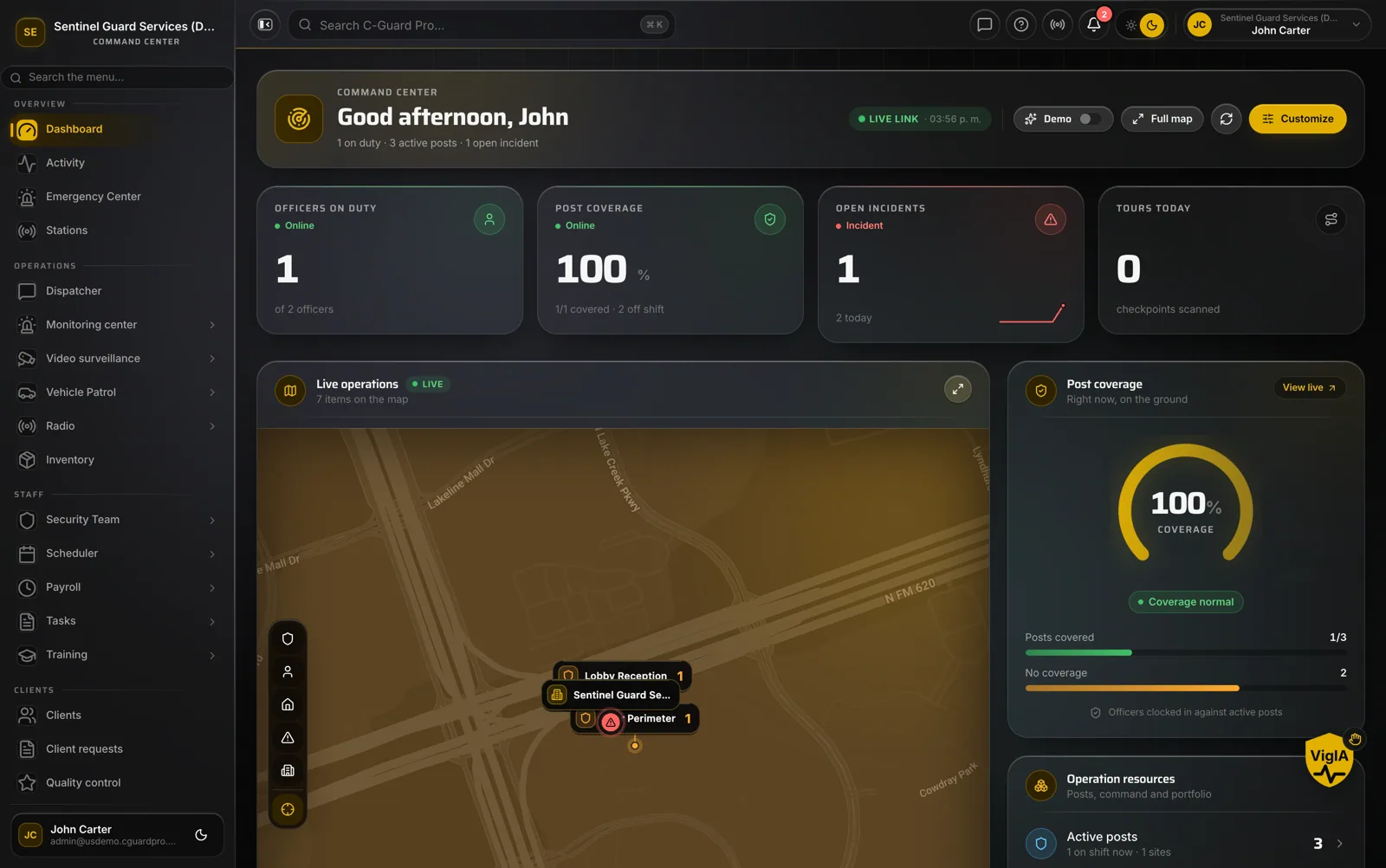 Most of a guard’s value is presence and observation — and a live view of that activity is what you should expect as the client.
What security guards can legally do — generally
Within the limits of the law and your instructions, guards can typically ask people to leave private property, enforce your rules on your premises, control access at entrances, and check bags or credentials where your posted policy and the law allow. They can call and cooperate with law enforcement, and they can gather and document evidence for a report.
In some places and situations, a guard may be permitted to make a citizen’s-arrest-style detention for an offense committed in their presence — but this is narrow, risky, and heavily dependent on local law. A responsible provider trains guards to use it rarely, if at all, and to prioritize safety over apprehension.
What a guard generally can’t (or shouldn’t) do
This is where buyers get providers into trouble by expecting too much:
- They are not police. They can’t make arrests the way an officer can, and they don’t carry police authority.
- Detainment is limited and dangerous. Holding someone against their will can expose you and the guard to serious liability — false imprisonment, assault claims — if it isn’t clearly within the law. “Just grab them” is not a policy; it’s a lawsuit.
- Use of force is a last resort. Reasonable force to protect people is one thing; going hands-on to recover a stolen item is another. A good provider’s policy is de-escalation first.
- They can’t search people without a lawful basis. What’s permitted varies, and overreach creates liability.
If a provider promises that their guards will “handle” anyone who steps out of line, be wary. That’s the mindset that turns a shoplifting incident into a courtroom.
Why documentation protects everyone
Here’s the part that actually matters for you as a buyer: because a guard’s real power is observe and report, the quality of that report is the whole ballgame. A well-documented incident — time, location, what happened, who was involved, photos — protects you when a claim is made, protects the guard from accusations, and gives law enforcement something to act on.
 A clean incident record — time, place, photos — is what turns “observe and report” into real protection for you and the guard.
When a guard follows the rules and documents everything, ambiguous situations become defensible records. When they improvise and there’s no record, you’re exposed. Require that your provider logs incidents digitally, with photos and timestamps, in a daily activity report you can actually access. That single requirement does more to protect you than any promise of a guard who’ll “take care of it.”
Set expectations in your post orders
The way to avoid the whole problem is to spell out, in writing, exactly what you want a guard to do and not do in each scenario — trespassers, shoplifters, disputes, medical situations. Those instructions should live in the provider’s system so every guard on your site follows the same rules. That protects you legally and operationally.
What to require from your provider
- A de-escalation-first, observe-and-report philosophy.
- A clear, written use-of-force and detainment policy that respects the law.
- Guards briefed on your specific instructions per scenario.
- Digital incident documentation with photos and timestamps you can review.
- Honest answers about what their guards will and won’t do — not bravado.
Realistic expectations are protective. A provider who tells you the honest limits of a guard’s authority — and backs it with disciplined documentation — is keeping you out of trouble, not underselling.
To see what documented, client-visible security looks like in practice, take a look at the client portal built for security companies.