An empty building looks quiet from the street. To trespassers, scrappers, and squatters, it looks like an opportunity. Whether you manage an office suite between tenants, a retail space being repositioned, or a property at risk of foreclosure, the question isn’t whether you need security—it’s which vacant building security options actually protect your asset and give you proof the work was done.
The most effective approach for a vacant building combines physical hardening, layered deterrence, and verified patrols. Your provider should deliver randomized patrol routes with GPS timestamps, QR checkpoints, photo-backed incident reports, and a client portal where you can see everything in near real time. Don’t accept a drive-by you can’t verify.
What are the most effective vacant building security options?
The best security for vacant commercial property almost always combines multiple layers. A single lock or a passive camera is not enough. The right mix depends on the building’s size, location, condition, and risk level, but most buyers should compare four core options.
| Option | What it does | Best for | What to require from a provider |
|---|---|---|---|
| Physical hardening | Reinforces doors, windows, fencing, locks, and lighting | Every vacant property, as a baseline | Documented inspection of all access points after hardening |
| Mobile patrol service | Sends a guard or patrol officer to check the site on a schedule or at random | Properties that need visible deterrence but not 24/7 staffing | GPS timestamps, photo reports, QR checkpoint proof |
| On-site security guard | Places a guard at the property for a full shift | High-risk sites, large properties, active repossession or construction | Live reporting, incident logs, panic button, supervisor oversight |
| Remote video monitoring | Uses cameras and sensors to detect activity and trigger response | Budget-conscious properties that already have power and internet | Verified alarm response, not just passive recording |
A strong vacant building security plan usually starts with hardening and adds patrols or remote monitoring based on risk. For many Texas property managers, a mobile patrol with randomized stops offers the best balance of cost and deterrence, especially when the provider gives you digital proof of every visit.
Security for vacant commercial property: what a buyer should demand
You are not buying a warm body in a car. You are buying verified risk reduction. When you evaluate security for vacant commercial property, treat proof as non-negotiable.
Your provider should give you:
- Randomized patrol schedules that a trespasser cannot learn or predict.
- GPS-tracked patrol officers so you know the guard actually arrived at the site.
- QR checkpoints at doors, gates, and utility areas that the officer must scan during each tour.
- Photo-backed incident reports showing what was found, not just a checkbox saying “all clear.”
- A client portal where you can review patrol logs, incident photos, and GPS timestamps without waiting for a monthly email.
Without these, you are relying on the security company’s word. A modern provider should be able to show you the same type of dashboard it uses internally. That is the difference between a professional service and a patrol that never leaves the parking lot.
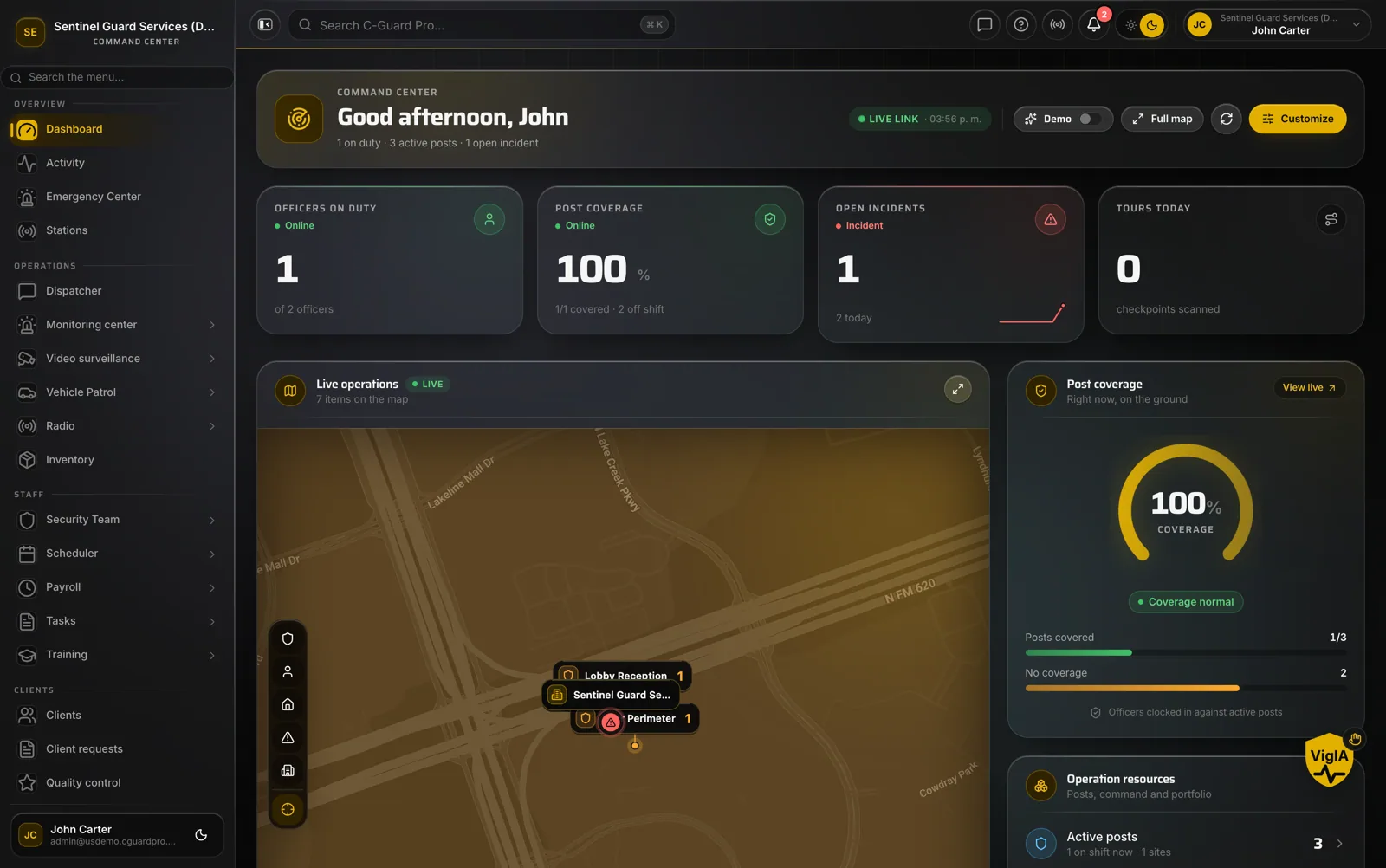
A client portal should show you patrol activity, incident reports, and GPS proof in one place.
Protecting an empty building from trespass: a layered approach buyers should require
Protecting an empty building from trespass starts with making the property an unattractive target and ends with verified response when someone tries anyway. A layered approach works best because each layer covers the gaps of the others.
Here is the order you should require from any security provider or property management plan:
- Perimeter hardening — Board or secure all ground-floor openings, reinforce door locks, and repair fencing.
- Lighting and visibility — Keep exterior lights working, or install motion-activated lighting. Dark corners invite entry.
- Posted signage — Clear “No Trespassing” signs and security warnings create legal clarity and deter casual intruders.
- Fire and life safety checks — Vacant buildings still need working smoke detectors, clear exits, and no accumulated combustibles.
- Alarm or remote video detection — Use sensors where power and internet are available to detect movement before a patrol arrives.
- Verified patrol response — A patrol service that scans QR checkpoints and submits photo reports closes the loop when alarms or neighbors report activity.
Each layer matters, but the patrol layer is where most buyers get frustrated. A vacant property patrol service should not be a slow drive past the front door. It should include a physical walk-around, checks of known weak points, and documentation that you can review from your desk.
Vacant property patrol service: proof beats promises
A vacant property patrol service is a scheduled or randomized mobile patrol that physically checks your empty building, verifies doors and windows, and documents conditions with photos and timestamps. The service itself is not new. What has changed is the technology that separates a credible patrol from a meaningless log sheet.
Ask your provider these questions before you sign:
- Can I see GPS breadcrumbs for every patrol visit?
- Do officers scan QR codes at specific checkpoints inside or around the property?
- Will I receive photo-backed incident reports if a door is open, a window is broken, or someone is on site?
- Can I view all of this in a portal without calling my account manager?
If the provider hesitates, treat that as a red flag. A modern guard management system can capture guard tour QR scans, GPS location, timestamps, and incident photos automatically. There is no technical reason a security company serving commercial clients cannot offer this.
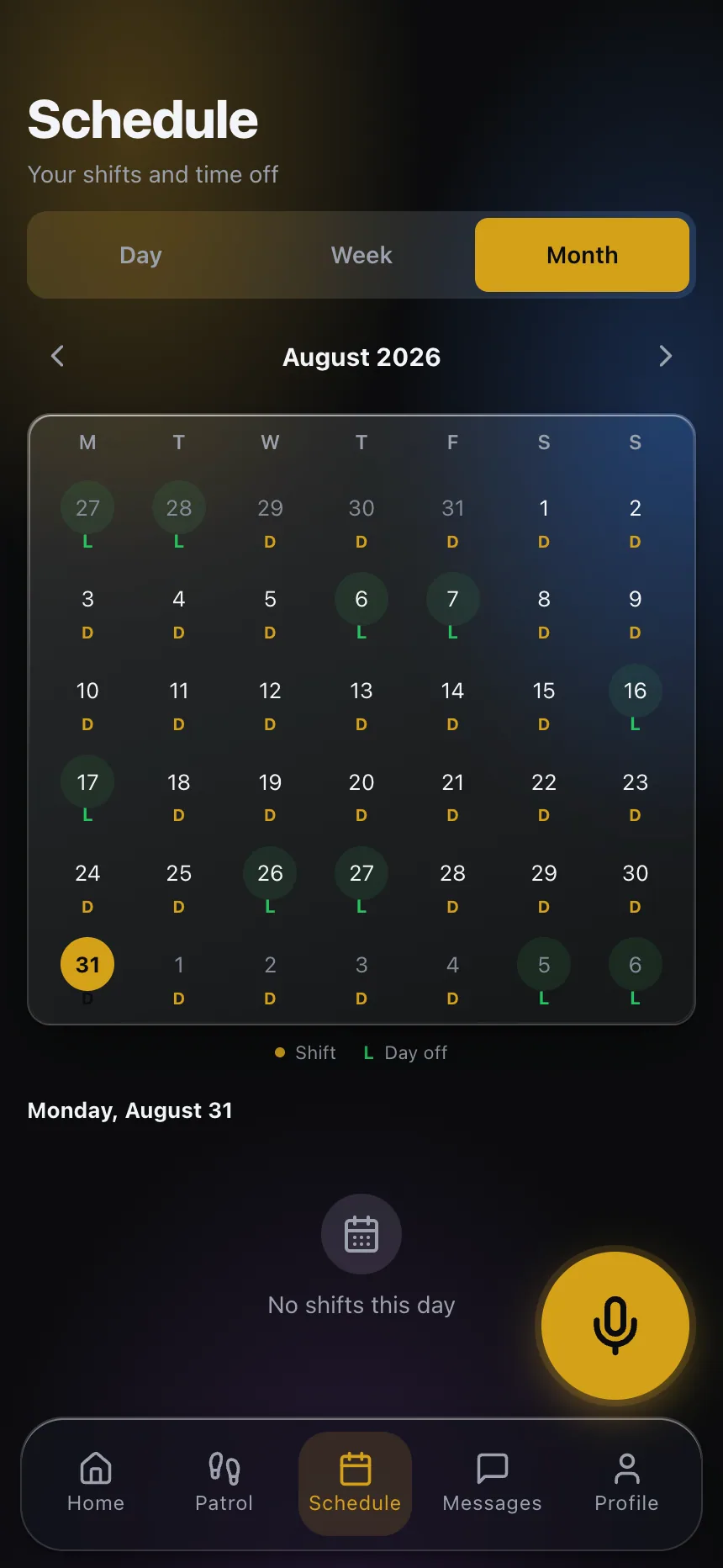
Ask your provider to show scheduled patrol tasks and time-stamped check-ins from the field.
Empty building security checklist for property managers
Use this empty building security checklist when you inherit a vacant space, prepare for a tenant turnover, or manage a foreclosure-risk property. It works for office, retail, warehouse, and medical buildings.
- Secure all doors, windows, loading docks, and roof access points.
- Remove dumpsters, pallets, and combustible debris from the exterior.
- Verify fire alarms, sprinklers, and emergency lighting are operational.
- Post no-trespassing signage with local code references where applicable.
- Photograph every access point before assigning security responsibility.
- Confirm the patrol provider uses GPS tracking and QR checkpoints.
- Require photo-backed incident reports for every abnormal finding.
- Schedule randomized patrol times rather than predictable hourly visits.
- Get client portal access before the first patrol begins.
- Review the first week of patrol logs personally to confirm proof quality.
This checklist also applies when you hire a security guard company or a mobile patrol provider. If your vendor cannot show you GPS proof or incident photos, the property is not being managed to the standard you are paying for.
What proof should you get that the site was inspected?
The minimum standard has changed. A paper log or a phone call is no longer enough. For any vacant building security contract, require digital proof for every inspection.
That proof should include:
- Time-stamped GPS coordinates showing the officer arrived on site.
- QR checkpoint scans at doors, gates, or interior points if the officer can enter.
- Photos or video of the property condition, especially after an incident.
- A timestamped incident report if anything is out of place.
- Client portal access so you can review all of this on your own schedule.
If you manage office buildings specifically, look for a provider that uses software designed for office building security guard operations. The same tools that help a provider manage guards should also give you, the buyer, transparent visibility into patrol activity. That is what CGuardPro’s client portal is built for.
Frequently asked questions
What is the best security option for a vacant building?
For most vacant buildings, the best option is a layered combination: physical hardening first, then a vacant property patrol service with randomized schedules, GPS proof, QR checkpoints, and photo-backed incident reports. High-risk or high-value sites may also need an on-site guard or remote video monitoring. The key is requiring verified proof for every layer you pay for.
Do I need guards or mobile patrols for an empty property?
Mobile patrols are usually more cost-effective than a full-time on-site guard for an empty property. On-site guards make sense for high-risk sites, active construction, or properties with valuable equipment still inside. If you choose patrols, require randomized visits and digital proof so you are not paying for a predictable drive-by.
How often should a vacant property be checked?
Most vacant commercial properties should be checked at least once every 24 hours, but higher-risk buildings may need multiple daily patrols or an on-site guard. The schedule should be randomized so trespassers cannot learn it. Even daily patrols should include exterior checks of all access points and, where possible, interior checks of critical areas.
What proof should I get that the site was inspected?
You should receive GPS timestamps, QR checkpoint scans, photo-backed incident reports, and a time-stamped log of every patrol visit. All of this should be visible in a client portal without you having to request it. If a provider cannot show digital proof, assume the inspection did not happen the way it was described.
Every vacant property is a liability until you make it a verified, managed risk. The right vacant building security options don’t just deter trespassers—they give you the documentation to prove your property is being protected. If your current provider still relies on paper logs or phone calls, it’s time to ask for better. See what a modern client portal should look like.