Most property managers evaluate security guard bids the way they compare janitorial contracts: lowest hourly rate, nearest start date, done. That approach misses the controls that determine whether guards actually show up, patrol, and report incidents. A security RFP scorecard for property managers changes the decision from a sales conversation into a documented, defensible security vendor evaluation.
A security RFP scorecard for property managers is a weighted matrix that scores staffing depth, supervision, reporting, and site fit. Require client portal access, digital incident reporting, and QR/GPS patrol proof as non-negotiable evidence. Rank vendors on verifiable controls, not sales promises, and tie each score to written RFP responses.
Why property managers need a security RFP scorecard
A security RFP scorecard for property managers turns a subjective security company bid scorecard into a repeatable, board-ready process. Without one, buyers tend to overweight hourly rate and the personality of the salesperson. That creates two risks: you may hire a vendor who understaffs the site, or you may skip a slightly higher-priced vendor who would actually document every patrol and incident.
The true cost of a poor security provider rarely shows up in the bid. It shows up later as missed patrols, handwritten logs that cannot be verified, delayed incident notifications, and liability exposure when something goes wrong. A weighted scorecard forces the provider to prove operational competence before the contract starts.
How to score security proposals: a weighted matrix
To score security proposals consistently, build a security vendor evaluation matrix with four or five weighted categories and require written evidence for each one. The table below is a practical starting point for property managers, HOAs, and facility teams in the US. Adjust the weights if your property has unique risks, but keep staffing, supervision, and reporting as the dominant categories.
| Category | Weight | What you are scoring | Evidence to require |
|---|---|---|---|
| Staffing depth and retention | High | Enough trained guards, low turnover, defined backup coverage | Staffing plan, retention data, training records, call-off policy |
| Supervision and GPS tracking | High | Field supervisors, check-ins, live guard tour proof | Supervisor-to-guard ratio, GPS/QR tour logs, escalation rules |
| Reporting and client portal | High | Digital incident reports, daily activity reports, live portal access | Sample reports, portal demo, incident report format |
| Site fit and account management | Medium | Sector experience, dedicated account manager, transition plan | References, account org chart, transition plan with defined timeline |
| Price and contract terms | Low | Total cost, billing transparency, cancelation or termination terms | All-in hourly rate, fee schedule, sample contract |
This structure prevents price from dominating the decision. A vendor can quote the lowest rate and still rank last if they cannot show supervision, retention, or reporting controls.
How to verify staffing depth and supervision before you sign
Staffing depth and supervision are the two categories most likely to expose a low-price security company bid scorecard. Ask each vendor to attach a real staffing plan—not a generic sentence—that names the post schedule, licensed or trained personnel per shift, and a named backup pool for call-offs.
For supervision, require a defined supervisor-to-guard ratio appropriate to your property type. The key is that supervisors must use GPS or patrol verification tools, not just phone calls. Ask for a sample week of supervision logs. If the vendor cannot produce them, award no points for that category.
Retention matters more than many buyers realize. A site that churns guards every month creates new training gaps and inconsistency. Ask for average guard tenure on similar accounts and a written retention guarantee. You are not hiring a security company; you are hiring the specific workforce they can actually place and keep on your site.
How to require verifiable reporting and patrol proof
The fastest way to separate operational vendors from sales-only vendors is to require client portal access, digital incident reporting, and QR/GPS patrol proof in the RFP itself.
A client portal is a secure web or mobile dashboard where the property manager can log in at any time to see live guard activity, completed patrols, and incident reports without calling the security company. If a vendor cannot offer portal access, you will be relying on phone calls and paper logs.
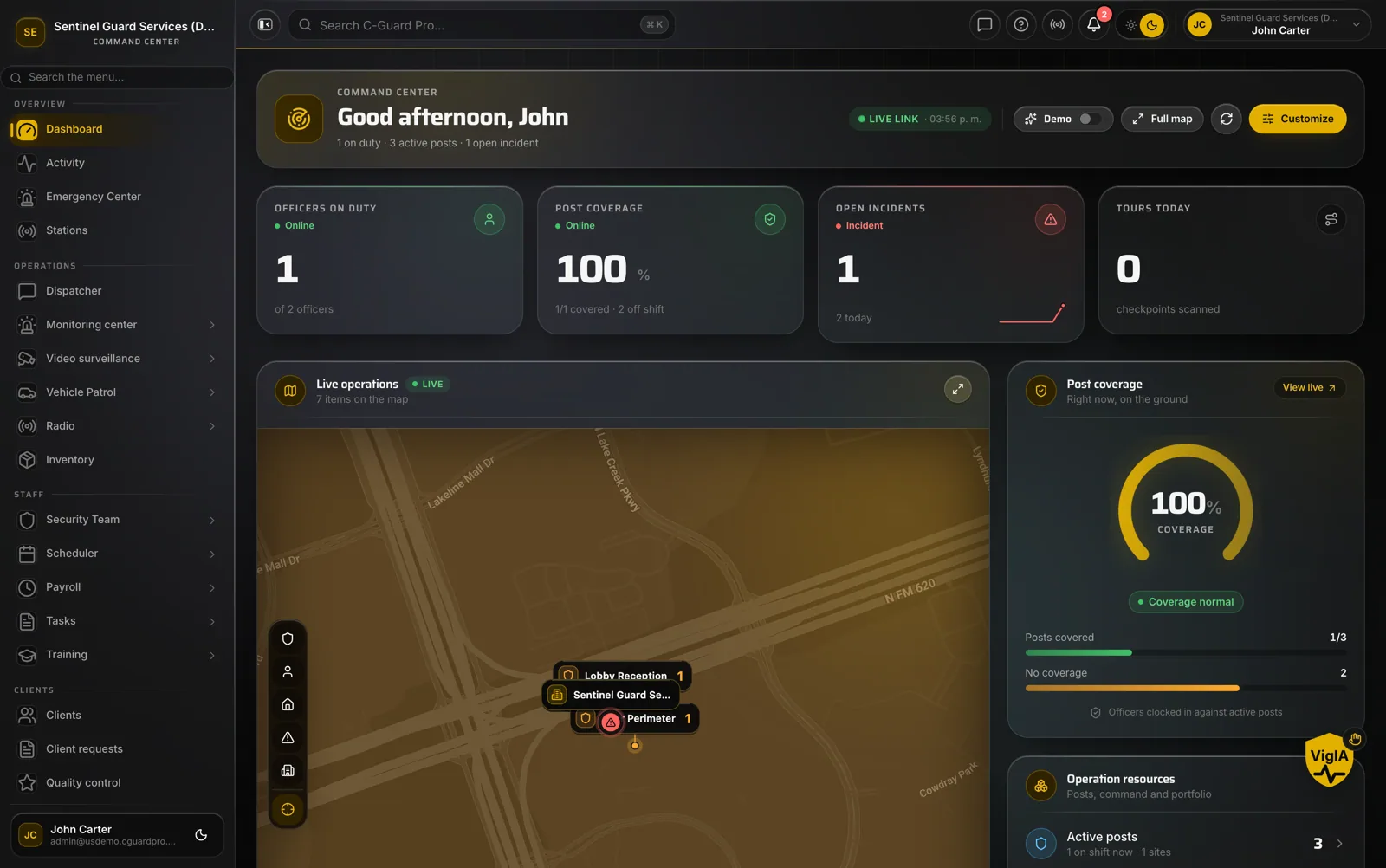 Client portal access lets property managers verify patrols and incidents without waiting for a phone call.
A digital incident report is a time-stamped, photo-backed record submitted from a guard’s mobile app instead of a paper log. It should include the location, time, description, photos, and follow-up action. QR/GPS patrol proof means guards scan tags at checkpoints or their GPS location is logged along an assigned route, so you can see actual movement rather than a checkbox.
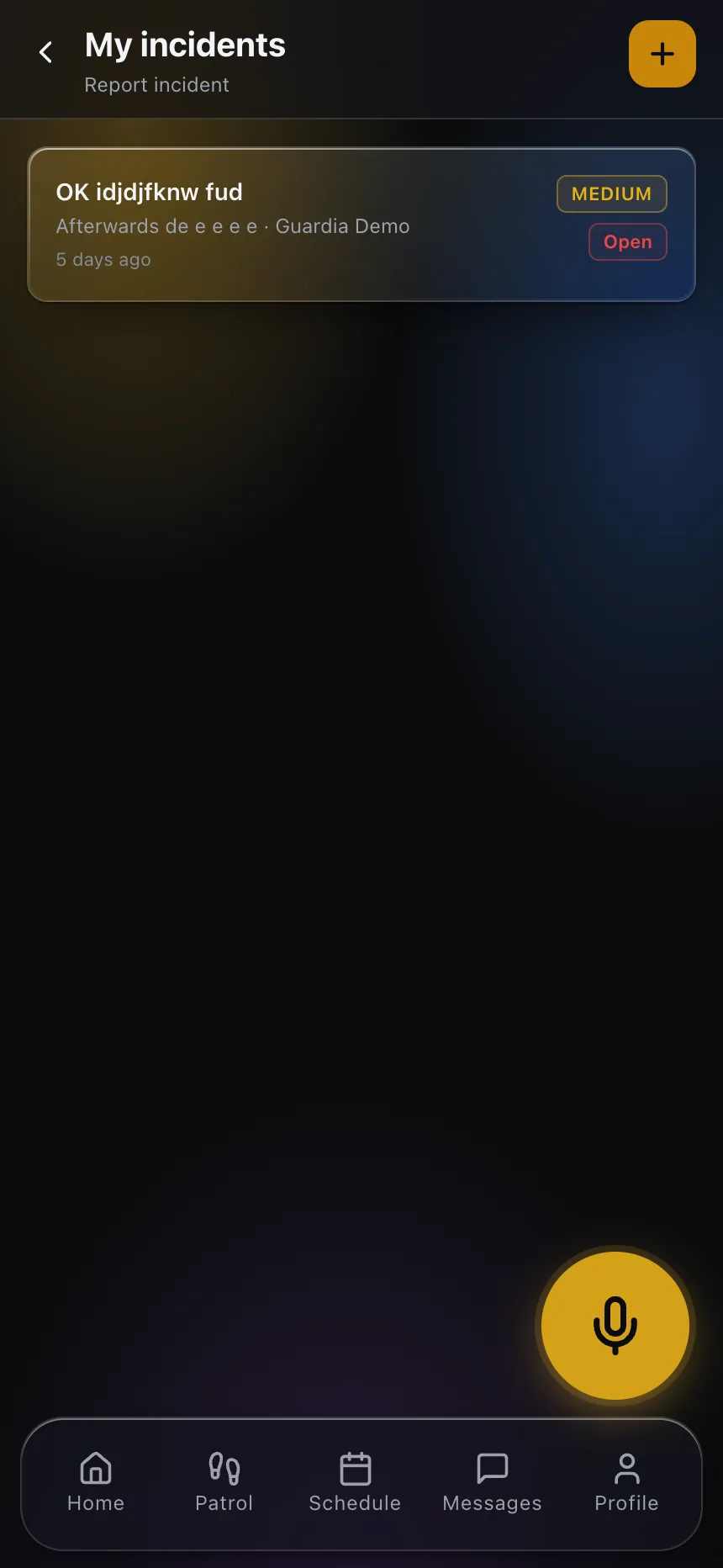 Digital incident reports replace paper logs with time-stamped, photo-backed records.
In your RFP, make these items mandatory. A vendor who will not demo their client portal or show a sample digital report is telling you how they will manage your property: by phone and by paper.
How to rank security guard vendors without sales bias
To rank security guard vendors objectively, score every RFP response against the same matrix and only award points when the vendor attaches evidence. Do not accept promises like “we have GPS tracking” or “we provide daily reports.” Require the vendor to show you the actual screen, the actual report, and the actual supervisor log.
A simple scoring approach is to rate each category on a scale from poor to excellent, then multiply by the category weight. For example, a vendor with strong staffing evidence might earn the full rating in staffing, worth the maximum points for that category. A vendor with no portal demo receives no points in reporting, losing the full category weight immediately. This is how you can compare a higher-rate vendor with strong controls against a lower-rate vendor with vague answers.
Use the same scoring sheet for every bid. Document the evidence you reviewed. That score sheet becomes your internal decision record and can be shared with ownership or the board later.
How to present the scorecard to ownership or the board
A security company bid scorecard makes your recommendation defensible because it shows the board exactly why a higher-rate vendor can be the lower-risk choice. Create a concise summary with each vendor’s weighted score, the evidence reviewed, and any risk flags such as high turnover, no portal access, or missing supervision logs.
When you present the scores, focus on operational proof rather than price per hour. A vendor with a strong overall score and a slightly higher rate is usually a safer recommendation than a vendor with a weak score and the lowest bid. The scorecard turns a subjective conversation into a clear ranking that ownership can approve with confidence.
Frequently asked questions
What should be on a security RFP scorecard?
A security RFP scorecard for property managers should include staffing depth, supervision, reporting and technology, site fit, and price. More important than the categories is the evidence: require written staffing plans, supervisor logs, sample digital incident reports, and a client portal demo. Score each category only when the vendor provides proof.
How do I compare security companies beyond price?
Compare security companies by requiring client portal access, digital incident reporting, QR/GPS patrol proof, supervisor-to-guard ratios, and guard retention data. Use a weighted matrix so staffing, supervision, and reporting carry more weight than hourly rate. A vendor with strong operational controls will score higher even if their price is not the lowest.
What weights should I assign to staffing, supervision, and reporting?
For most commercial properties, assign the highest weights to staffing depth, supervision and GPS tracking, and reporting and client portal access. Site fit can receive a medium weight, and price the lowest weight. Adjust the weights if your property has specific risks, but keep the operational categories dominant so price does not drive the decision.
How do I justify my security vendor choice to ownership or the board?
Present a concise weighted scorecard that shows each vendor’s score, the evidence reviewed, and any risk flags. Emphasize verifiable controls such as client portal access, digital incident reports, and GPS patrol logs. This turns the recommendation into an objective ranking and shows that a higher-rate vendor can be the lower-risk choice.
A modern security provider should be able to show you live activity, digital reports, and patrol proof before you sign the contract. If you want to see what that looks like in practice, explore our client portal or contact CGuardPro to build verifiable controls into your next security RFP.