Hotels do not hire a guard company just to fill a post. They hire to protect guests, support staff, reduce overnight surprises, and keep the property running smoothly. A good hotel security RFP template helps you define those expectations before proposals come in, so you can compare providers on service quality, reporting, and accountability—not just price.
A hotel security RFP template should define the areas to cover, patrol frequency, incident response rules, reporting standards, and the technology your provider must use. For most hotels, that means requiring mobile incident reports, real-time updates through a client portal, panic-button escalation, and QR/GPS proof that patrols actually happened across guest areas, back-of-house, parking, and overnight rounds.
What should a hotel security RFP include?
A hotel security RFP should include site scope, staffing expectations, patrol routes, reporting requirements, escalation procedures, and proof-of-service standards.
If these items are not specific, each bidder will interpret the assignment differently. That makes proposals harder to compare and creates room for missed expectations after startup.
| Section | What to require |
|---|---|
| Property scope | Lobby, guest floors, elevators, pool, event spaces, loading dock, back-of-house, parking, perimeter |
| Coverage model | Post hours, mobile patrols, overnight rounds, peak check-in/check-out support |
| Guard duties | Visibility, access control, guest assistance, de-escalation, incident response, lock/unlock tasks |
| Hotel patrol requirements | Route frequency, checkpoint locations, high-risk areas, QR/GPS verification |
| Reporting | Digital daily activity reports, incident reports with timestamps, photos, and actions taken |
| Live visibility | Client portal access for hotel management to review activity and report status |
| Escalation | Supervisor response, panic-button workflow, emergency contacts, police/EMS coordination |
| Staffing quality | Licensing as required by state, hospitality experience, training, uniforms |
| Performance review | KPIs, report timing, issue follow-up, review cadence |
A client portal is a secure online dashboard where hotel management can view guard activity, incident reports, and site status without waiting for emailed updates. A daily activity report is a structured shift summary that shows what officers did, what they observed, and what follow-up is needed. QR/GPS patrol proof means patrols are verified through checkpoint scans and location data rather than verbal confirmation alone.
How do you define hotel patrol requirements clearly?
You define hotel patrol requirements clearly by naming the patrol area, frequency, proof method, and response expectation for each zone.
Hotels have different risk levels across the property. Guest areas need visibility and calm handling, while loading docks or employee entrances may need tighter access control. Your security RFP for hotels should separate those expectations.
Guest areas
Guest-area patrols should focus on visibility, deterrence, and calm response.
Ask the vendor to describe patrol expectations for:
- Lobby and reception
- Guest corridors and elevator banks
- Pool, fitness, and amenity areas
- Meeting and event spaces
- Exterior guest entrances
State whether officers should assist with disturbances, support front desk teams, monitor unauthorized access, and note maintenance or safety issues affecting guests.
Back-of-house areas
Back-of-house patrols should focus on access control, asset protection, and staff safety.
Include areas such as:
- Loading dock
- Kitchen and service corridors
- Employee entrances
- Mechanical or storage rooms
- Receiving and delivery areas
Require the provider to explain what must be reported immediately, such as propped doors, unauthorized persons, or unsecured restricted areas.
Parking and perimeter
Parking patrols should focus on deterrence, suspicious activity, lighting failures, and escort support.
For parking lots and garages, require:
- Defined patrol frequency by time block
- GPS or QR proof at patrol checkpoints
- Reporting on lighting, gates, and cameras
- Handling of loitering or suspicious vehicles
- Escort support for guests or staff when requested
Overnight patrols
Overnight hotel patrols should be more structured and more thoroughly documented than daytime rounds.
Management should not arrive in the morning to a vague verbal handoff. Your RFP should require timestamped patrol records, exception reporting, photos when relevant, and immediate escalation for serious issues.
What to ask a hotel security vendor about incident handling
You should ask a hotel security vendor how they detect, escalate, document, and close incidents, especially during overnight shifts.
A hotel environment can involve guest disputes, trespassing, theft concerns, intoxication issues, medical calls, parking lot incidents, and after-hours access problems. Ask each vendor to explain their process in plain terms.
Use questions like these:
- How does the officer alert supervision during an urgent event?
- When is hotel management notified immediately?
- How are guest-sensitive incidents documented professionally?
- Are reports completed on mobile devices before shift end?
- Can managers review incident status in real time?
A mobile incident report is a report completed by the officer on a phone or handheld device in the field, usually including time, location, narrative, photos, and actions taken. This matters because delayed or handwritten reports often lose detail.
If you want more transparency from your provider, require a live client portal and structured daily activity reports instead of scattered calls and delayed summaries.
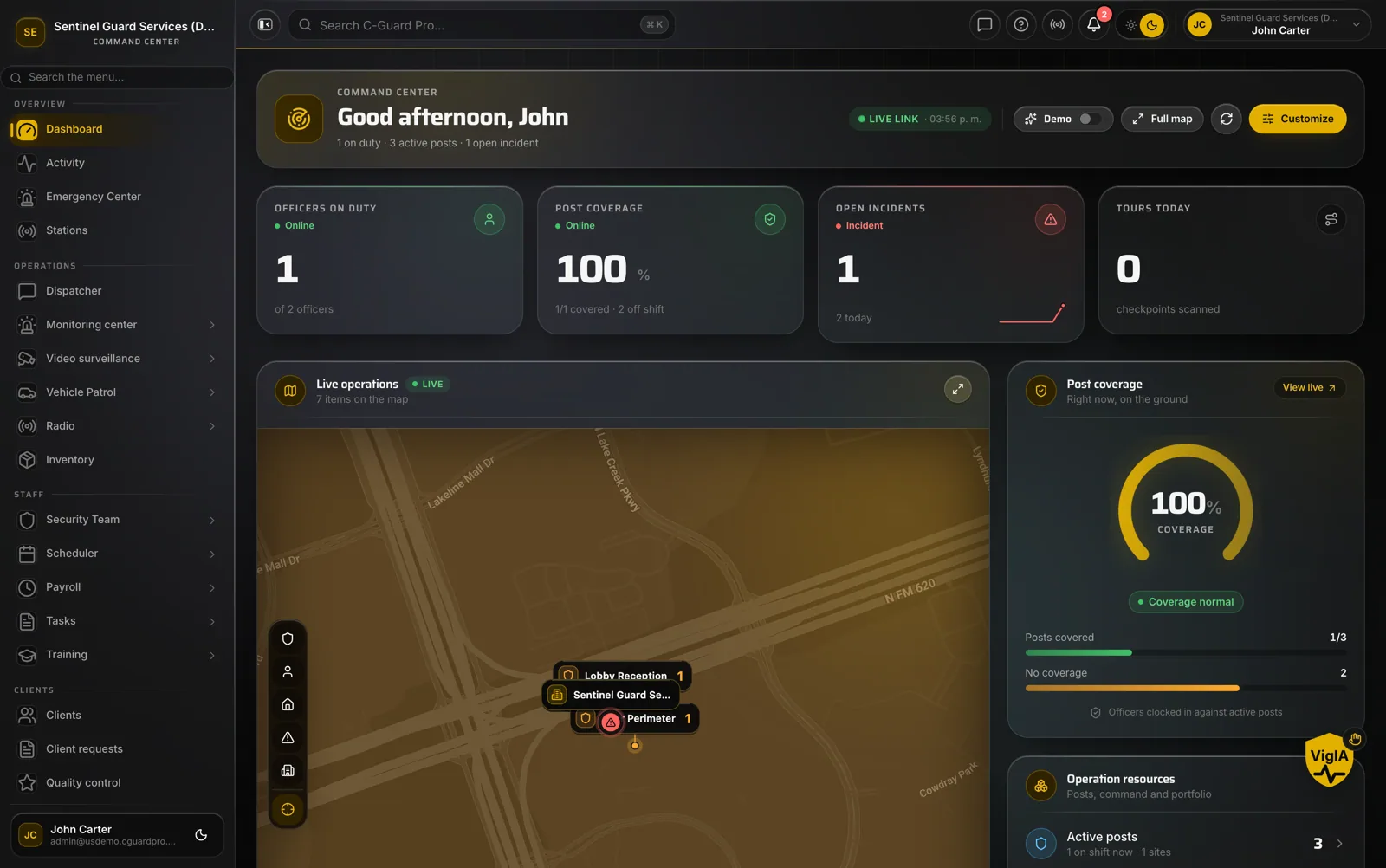
Example of a client portal where hotel management can review live status, reporting, and site activity.
How do I compare hotel security providers?
You compare hotel security providers by scoring them against the same checklist, not by looking at rate alone.
A lower hourly rate can hide weak supervision, poor reporting, or no reliable patrol verification. In a hotel, those gaps usually show up as guest complaints, unresolved incidents, and weak overnight handoffs.
Use this hotel guard company checklist during review:
- Do they address guest areas, back-of-house, parking, and overnight operations separately?
- Do they commit to digital reporting instead of paper logs?
- Do they provide real-time visibility for management?
- Do they verify patrols with QR/GPS?
- Do they offer panic-button escalation for urgent incidents?
- Do they define supervisor response times?
- Do they show hospitality-related experience?
The best provider is usually the one that turns your operating needs into measurable service standards.
Why should your RFP require technology, not just manpower?
Your RFP should require technology because hotel management needs proof, speed, and accountability, not just a posted officer.
A modern provider should be able to show where patrols happened, when they happened, what officers found, and who was notified. This is especially important for overnight shifts and larger properties where managers are not always on site.
That is why your hotel security RFP template should require:
- Mobile reporting
- Real-time client portal access
- Panic-button escalation
- GPS/QR patrol proof
A panic-button escalation is a one-touch emergency alert sent by the officer through a mobile device to supervisors or dispatch when immediate help is needed. In a hotel, this is especially useful in stairwells, parking structures, service corridors, and single-officer overnight posts. You can review that standard here: panic button for security guards.
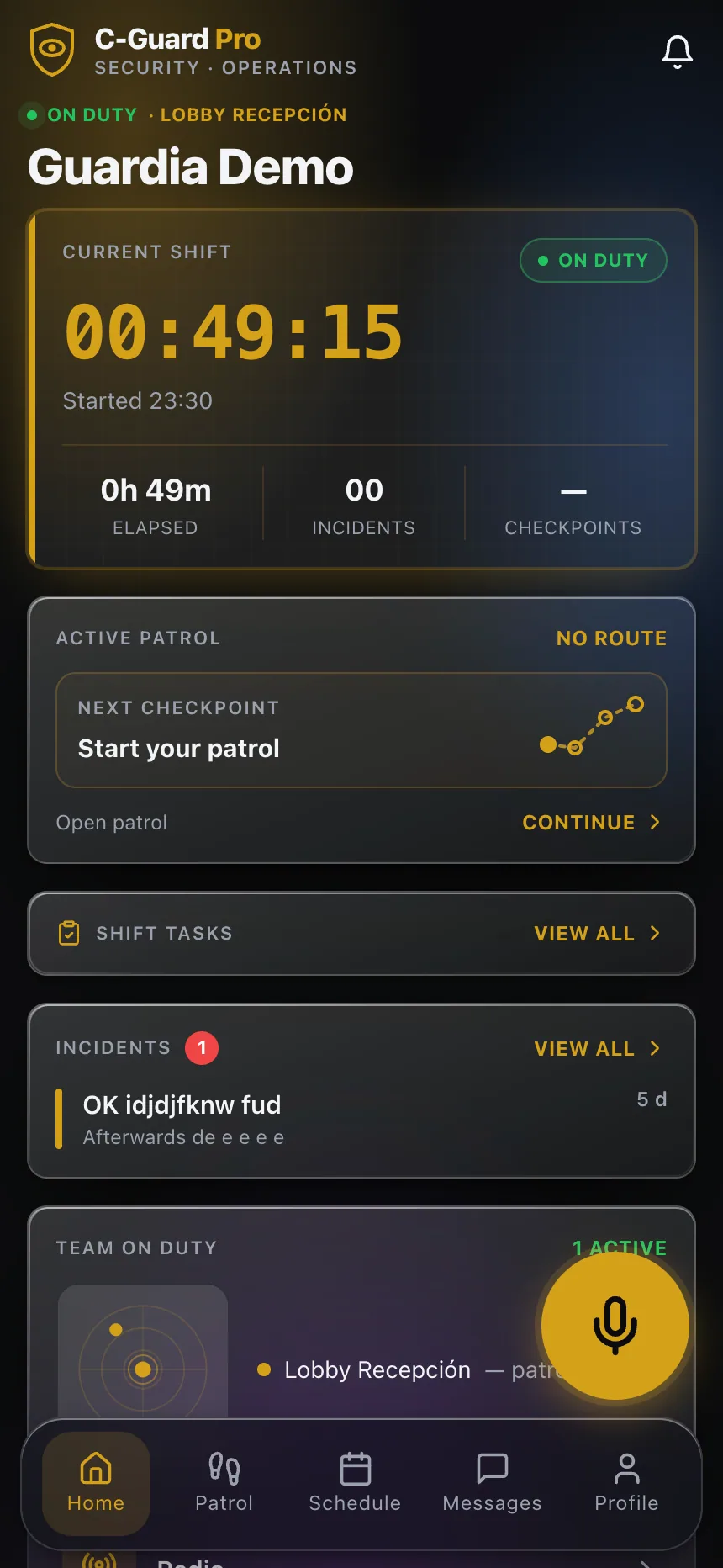
Example of a mobile guard dashboard used to document patrols, tasks, and incidents in the field.
Sample hotel security RFP checklist
A practical hotel security RFP checklist should help you validate scope, reporting, patrol accountability, and escalation before award.
Scope and staffing
- Property zones listed clearly
- Guest areas covered
- Back-of-house covered
- Parking and perimeter covered
- Overnight patrol schedule defined
Reporting and visibility
- Mobile incident reporting required
- Daily activity report required
- Client portal access required
- Photos supported in reports
- Report timing defined
Patrol accountability
- Patrol routes defined
- QR checkpoints used where practical
- GPS verification available
- Missed patrol exceptions documented
Escalation and safety
- Panic-button escalation available
- Supervisor response standard defined
- Emergency contact tree documented
- Police/EMS coordination process described
A clear RFP helps hotel management buy service with fewer blind spots and better control after launch. If you want to see the type of visibility a modern provider should offer, start with CGuardPro.
Frequently asked questions
What should a hotel security RFP ask for?
A hotel security RFP should ask for clear property coverage, patrol frequencies, incident response procedures, reporting standards, and proof that patrols occurred. It should also require mobile reporting, real-time client visibility, panic-button escalation, and QR/GPS verification across guest, staff, and parking areas.
How do I compare hotel security providers?
Compare hotel security providers using the same criteria for scope, patrol proof, reporting, escalation, supervision, and hospitality fit. A provider with better visibility and accountability is often a stronger choice than one that only appears cheaper on hourly pricing.
What reports should hotel management receive from guards?
Hotel management should receive daily activity reports, incident reports, and immediate alerts for urgent issues. The best reports are digital, timestamped, easy to review, and available through a client portal so managers do not have to wait for manual updates.
How should overnight hotel patrols be documented?
Overnight hotel patrols should be documented with timestamped mobile logs, QR/GPS checkpoint proof, incident narratives, and photos when appropriate. Serious events should be escalated immediately, while routine findings should appear in a structured morning report that management can review quickly.