Most guard contracts describe what you’ll pay and how many hours you’ll get. Very few describe what happens when the service falls short — and that silence always works in the provider’s favor. A security guard service level agreement fixes that. It turns “professional, reliable coverage” into specific, measurable commitments with consequences attached, so you’re not left arguing about whether the service was good enough after the fact.
Why a vague contract costs you
Without a written service level agreement, “reliable” is whatever the provider says it is. A post goes uncovered for two hours? “Staffing challenge.” Reports show up a week late? “We were busy.” You have no defined standard to point to. A security guard service level agreement replaces feelings with thresholds: this is the standard, this is how we measure it, and this is what happens if we miss it.
The catch is that a service level only means something if it’s measurable. That’s where software earns its place — you can’t enforce what you can’t see.
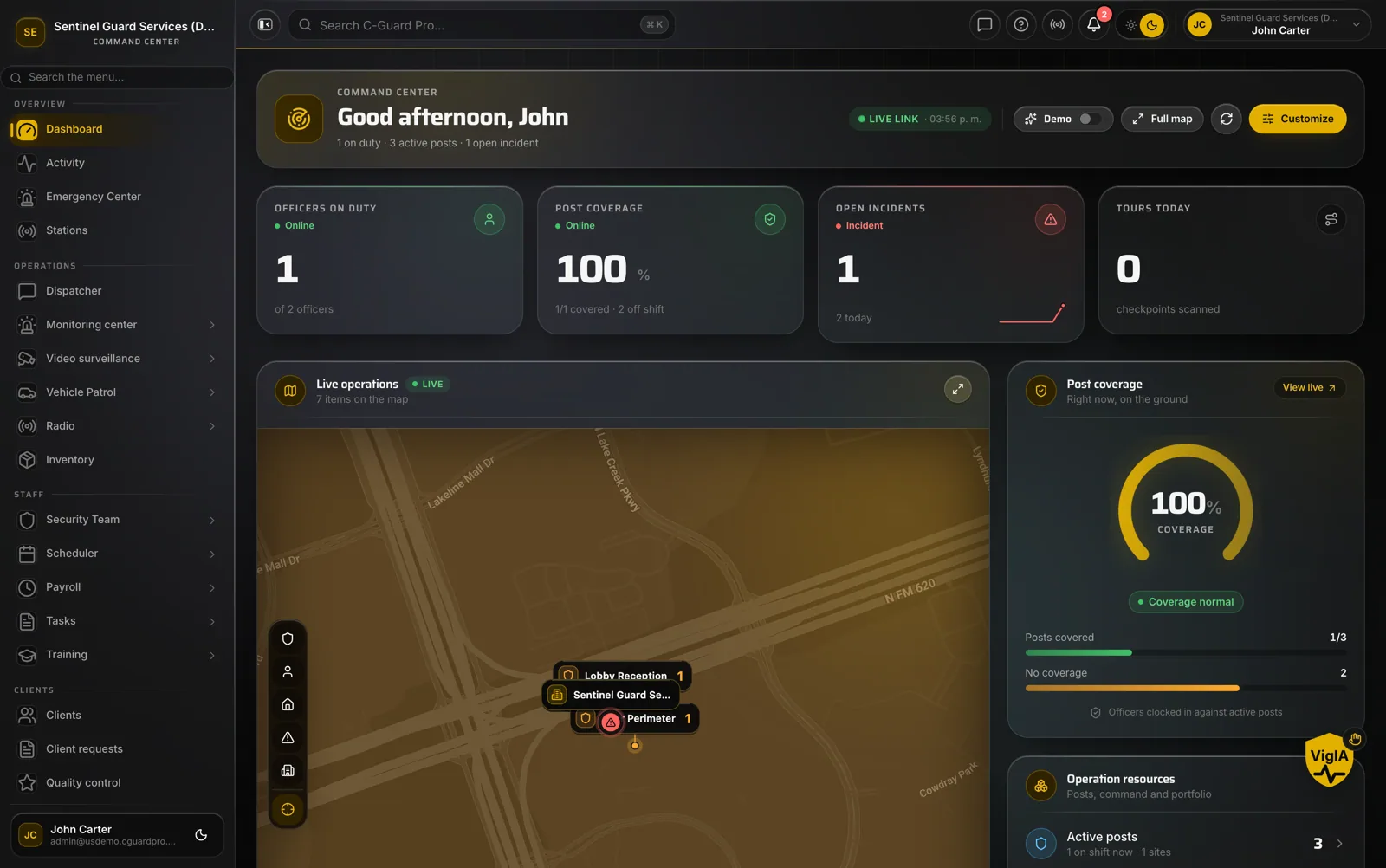 Service levels only hold up when both sides can see the same numbers — coverage, patrols, and response times in one view.
The four service levels every buyer should demand
1. Coverage and staffing
Define post coverage precisely: which posts, which hours, and the maximum time a post may go uncovered before it counts as a breach. Require the provider to prove coverage rather than assert it — clock-ins tied to the post via guard time and attendance give you a defensible record instead of a schedule that may or may not have been followed.
Also spec how call-offs are handled. A serious provider commits to a backfill window; a weak one leaves the post empty and hopes you don’t notice.
2. Response times
Set a target for how fast an officer responds to an alarm, an incident, or a duress call, and how fast a supervisor is reachable. Tie duress specifically to a panic button flow so an officer in trouble reaches help in seconds, with a timestamp you can review afterward. Response time is meaningless if no one records when the clock started and stopped — so require that it’s logged.
3. Reporting cadence
Specify what you receive and when. Same-day daily activity reports, incident reports within a defined window, and patrol logs available on demand. Put the format in writing too: digital and searchable, not a scanned clipboard. Reporting that arrives late or incomplete is itself a service-level miss, and your SLA should say so.
4. Supervision and patrol verification
Require proof that patrols happen as promised — checkpoint scans via a QR/GPS guard tour system, with a threshold for completed patrols per shift. Missed patrols below the threshold trigger a review. This converts “we patrol regularly” into a number you can hold them to.
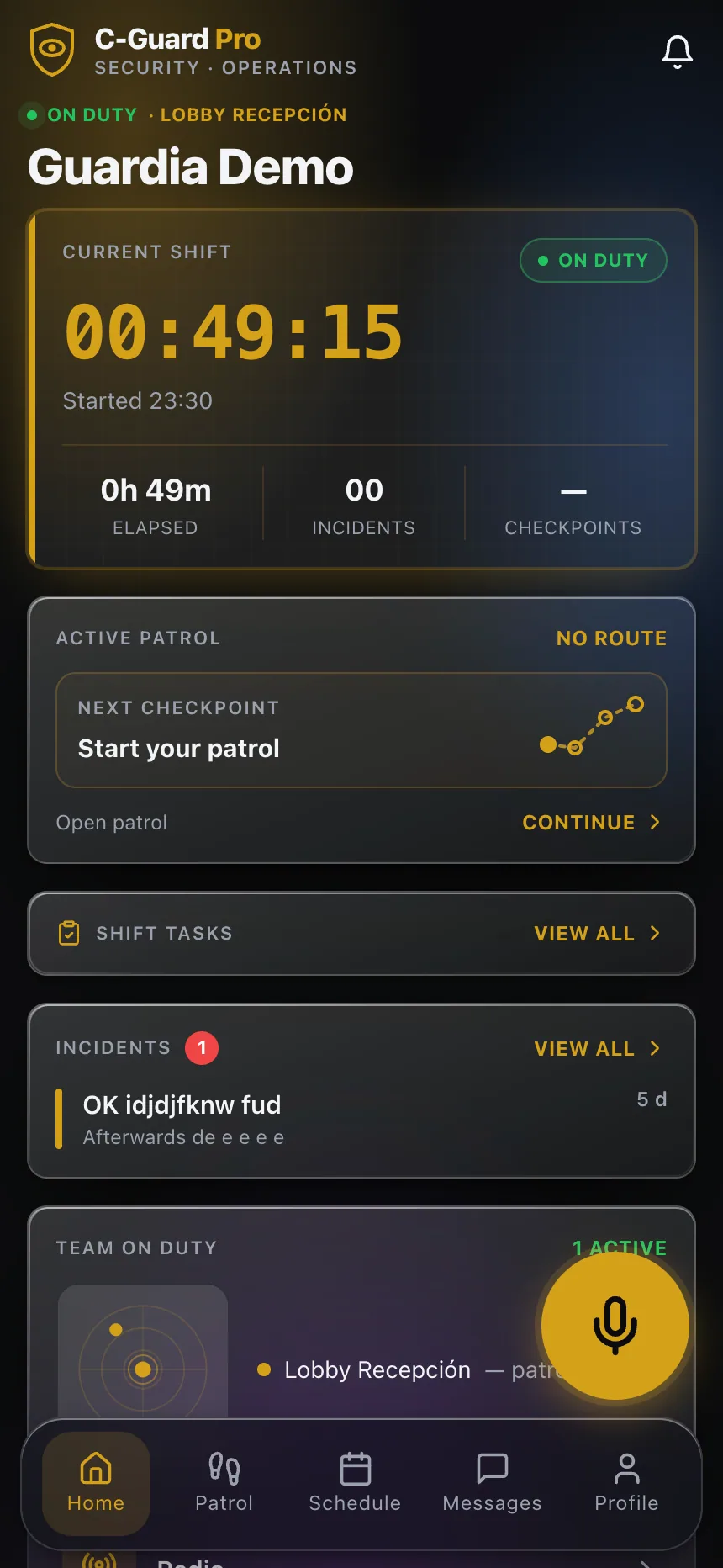 Every completed check and logged task becomes evidence you can measure the SLA against.
Make the metrics enforceable
An SLA needs teeth. For each service level, define:
- The metric — what’s measured (e.g., percentage of scheduled patrols completed).
- The threshold — the minimum acceptable level.
- The measurement source — where the number comes from, ideally the same portal both sides can see.
- The remedy — what happens on a miss: a credit, a corrective-action plan, or, for repeated breaches, the right to exit.
Credits and penalties don’t have to be punitive to work. Their real value is that they make the provider watch the same numbers you do — when a miss costs them something, prevention becomes their problem, not just yours.
A one-page SLA checklist to bring to the table
You don’t need a lawyer to draft the first version. Bring a plain checklist to your next provider meeting and watch how they react to each line — the reaction tells you as much as the answer. For every item, you want a number, a source, and a consequence.
- Post coverage — which posts, which hours, and the maximum minutes a post may sit uncovered before it’s a miss. Ask: how do you prove a post was staffed, not just scheduled?
- Call-off backfill — the window to fill a no-show, and who pays for the gap.
- Duress and alarm response — a target time and a logged start-and-stop. Ask: where is that recorded, and can I see it?
- Reporting — same-day activity reports, incident reports within a set window, digital and searchable. Ask: can you send an anonymized sample from a live site?
- Patrol completion — a minimum percentage of scheduled patrols per shift, verified by checkpoint scans.
- Remedies — the credit or corrective-action plan on a miss, and the breach count that lets you exit.
A provider who has run real accounts answers these in specifics and offers the data source without flinching. One who deflects with “we’ve never had a problem” is telling you they don’t measure — which means you won’t be able to either.
Picture the first post going live. In week three an officer calls off sick an hour before a night shift. Without an SLA, you find out from an empty lobby and a defensive phone call. With one, the backfill clock is defined, the miss is logged, and the credit is automatic — so the review is about the fix, not about whether it happened.
Review the numbers on a schedule
Set a recurring review — monthly or quarterly — where you walk the SLA metrics together. A provider running on guard scheduling software and a client portal can pull these numbers in minutes. If your SLA report is a scramble every month, that’s a signal the underlying data is thin.
A note on the legal side: how penalties, credits, and termination clauses are enforced varies by jurisdiction and contract law. Treat this as an operational checklist, not legal advice, and have a qualified attorney review your final agreement.
Turn service into something you can prove
The point of a security guard service level agreement isn’t to punish your provider — it’s to make the quality of service visible and mutual. When coverage, response, reporting, and patrols are all defined, measured, and reviewed, good providers thrive and weak ones can’t hide. You stop relying on trust and start relying on evidence.
See how measurable service looks from the buyer’s side in the client portal, and make these metrics part of your next agreement.