Every guard company inherits its 10-code card from somewhere: a founder who came out of law enforcement, a client’s own security department, a laminated sheet handed down from whoever held the contract before you. Nobody sat down and asked which codes a contract guard actually needs on a private post, so the card ends up carrying entries officers never use — running a plate, calling in a pursuit — while missing the calls they make constantly, like a vendor showing up unannounced or a vehicle parked somewhere it shouldn’t be for the third night in a row. A security guard 10-codes full list that actually gets used on a post is not the list a police department issues. It’s a shorter one, matched to the job, with a clear rule for when a code should be dropped in favor of plain speech.
Where the laminated card actually comes from
Ten-codes date back to an era of radio channels with limited bandwidth and no reliable way to spell things out clearly over static. They were never standardized nationally. Different police departments, sheriff’s offices and dispatch centers adopted different versions of the same numbers, which is why “10-4” means “acknowledged” almost everywhere but a code like “10-50” can mean a traffic accident in one jurisdiction and something else entirely in another. When a guard company photocopies a departmental card, it inherits one agency’s private dialect, most of which has nothing to do with a contract officer’s actual job.
That mismatch is why half the card sits unused. Codes for vehicle pursuits, warrant checks, and evidence handling don’t belong on a private security post no matter how official they look on paper. Copying a police list and calling it your radio protocol looks thorough. It isn’t; it’s just borrowed.
The security guard 10-codes full list that actually gets used
Strip the list down to what a contract officer needs to say on a shift, and it gets short fast. These are the codes we consistently see survive the cut across guard operations, regardless of which regional dialect a company started from:
- 10-4 — acknowledged, message received.
- 10-20 — location: “what’s your 10-20” is the single most common radio exchange on any multi-post account.
- 10-8 — in service, on post and available.
- 10-7 — out of service, off post or unavailable (break, restroom, moving between checkpoints).
- 10-23 — arrived at the location.
- 10-9 — repeat, say again; more useful than it sounds on a site with dead radio spots.
- 10-52 — request medical assistance.
- 10-33 — emergency traffic, everyone else stay off the channel.
That’s close to the whole list a functioning contract post needs. Everything past those eight codes is usually decoration copied from somewhere else — and decoration is exactly what gets an officer fumbling for the right number during the one radio call where fumbling actually matters.
The codes worth cutting entirely
It’s worth naming what to actually strike from the card, because “keep only what you use” is easy advice to agree with and hard to act on when the laminated sheet has forty entries and nobody wants to be the one crossing them out. Cut anything tied to law-enforcement authority the officer doesn’t have: codes for warrants, pursuits, arrests, evidence custody, or requesting backup from another patrol unit. Cut vehicle-stop codes entirely — a contract officer conducting a traffic stop is a liability conversation, not a radio-protocol one. Cut anything that assumes a dispatch center staffed by sworn personnel monitoring multiple jurisdictions, because a guard company’s dispatch function looks nothing like that even on a large multi-site account.
What’s left after those cuts is almost always the same short list regardless of which police department’s card the company started from, which is a useful sanity check on its own: if two accounts in different states, inheriting completely different original code sheets, converge on the same eight or so working codes once the unusable entries are stripped out, that convergence is telling you something real about what a contract post actually needs versus what got copied along for the ride.
When plain language beats a code
Codes exist to save airtime, and that’s a real benefit on a busy channel. But airtime savings only pay off if everyone on the channel understands the code the same way, instantly, without translating it in their head first. That assumption breaks down constantly in contract security, where crews turn over, event staffing brings in people who never touched your card, and a client’s own front desk sometimes shares the same channel and never learned your codes at all.
For anything that qualifies as an actual emergency — a medical event, an aggressive person, a fire, anything that would trigger a panic button or man-down alert — the calculation flips. The two or three seconds a code saves are worthless next to the risk that a new hire mishears “10-52” as something else and dispatch loses ten seconds figuring out what was actually said. Plain language costs a little more airtime and buys certainty. In an emergency, certainty wins every time. The practical rule that holds up on real accounts: codes for routine traffic, plain language for anything urgent enough that a misunderstanding would matter.
Making the list survive contact with a real roster
A code list only works if the whole crew learned the same one, which means it has to live somewhere more durable than a laminated card taped to a podium that gets left behind when the account changes supervisors. Put it in the post orders for the site, cover it at pass-down when a new officer starts the account, and reinforce it during the first few shifts rather than assuming a written page did the teaching.
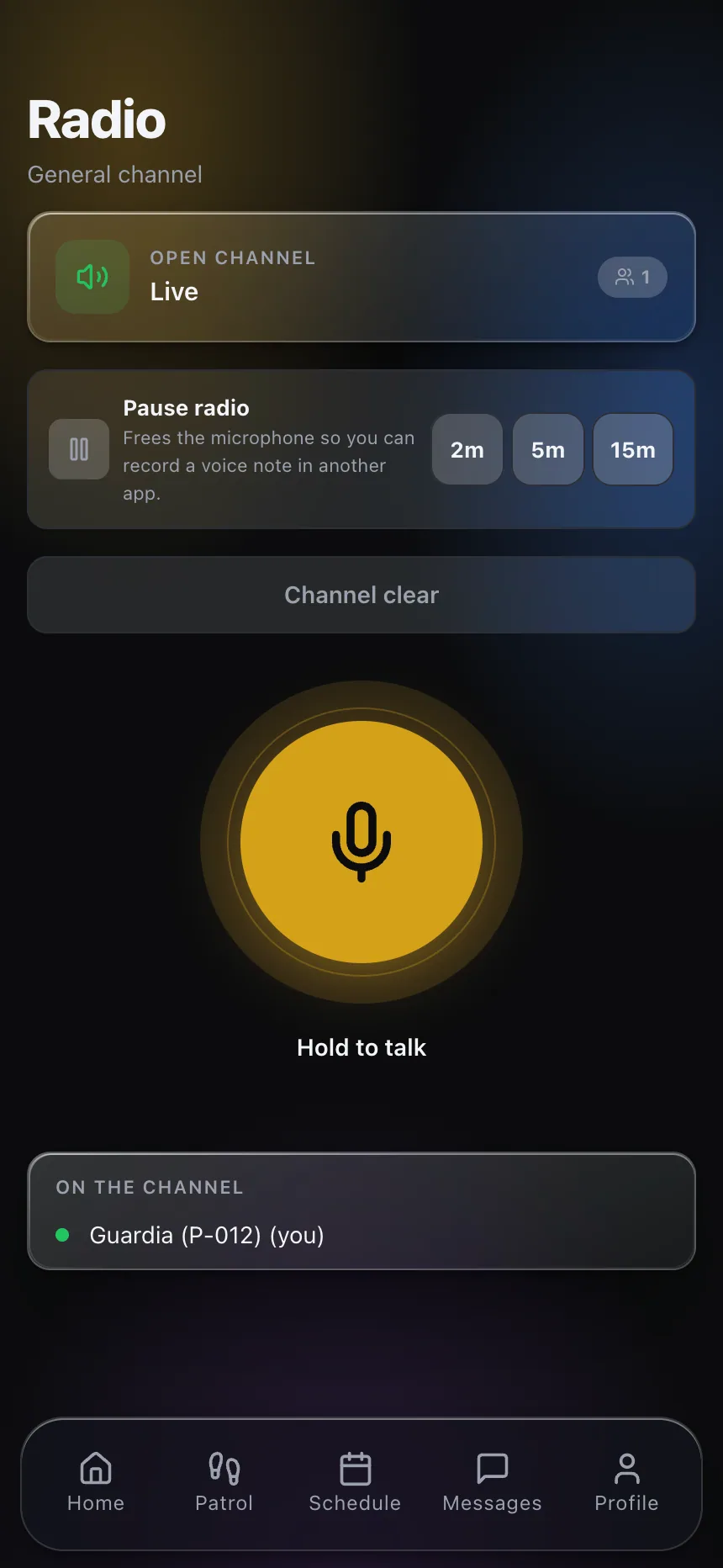
It also has to travel with the officer, not just the post. A push-to-talk radio channel run through the same app the officer already uses for the shift keeps the code reference, the talk group and the officer’s own record in one place, instead of asking someone to remember a card from a different account they worked six months ago. That matters more than it sounds on companies running mixed armed and unarmed contracts, seasonal event staff, or officers who rotate across several client sites in a month — the code card that made sense on one account is not automatically the one that applies on the next.
The short version
Don’t hand a new officer a police department’s 10-code sheet and call it training. Give them the eight or so codes that actually carry traffic on a contract post, tell them explicitly which situations call for plain language instead, and put both in a place they’ll actually see before their first shift — not a laminated card that walks off with the last supervisor who used it.
If you want to see how radio traffic, post orders and officer records fit into one system instead of three, explore CGuardPro or get in touch.