Every use-of-force review starts the same way: a supervisor watching camera footage, or reading three conflicting accounts, trying to reconstruct the moment an officer went from talking to touching. The paperwork that follows an incident asks what happened and why. A use-of-force continuum for unarmed security guards is the training that’s supposed to prevent the review from being necessary in the first place, and it’s worth being clear about that distinction — a continuum isn’t a form you fill out afterward, it’s a sequence an officer is supposed to have internalized before they’re ever standing in front of someone who won’t leave.
For unarmed officers, the continuum runs through four broad levels: presence, verbal command, soft physical control, and hard physical control. The framework itself is simple enough to write on an index card. What separates officers who use it well from officers who don’t isn’t whether they can recite the four levels — it’s whether, under stress, they actually move through them in order.
The Use-of-Force Continuum for Unarmed Security Guards: Four Levels, and Why Order Is the Whole Point
Presence is the officer simply being there, visible, positioned, attentive. It sounds too passive to count as a use-of-force level, but it does the most work of any of the four — a uniformed officer standing at the right distance, watching, often ends a situation before it becomes one. Skipping past presence — not giving a developing situation the time and visible attention it needs before moving to words — is itself an escalation error, even though nobody thinks of “not standing there long enough” as a force problem.
Verbal command is direct, specific instruction: what the officer needs the person to do, stated plainly, without negotiation buried in the wording. This is the level most officers are weakest at, not because they don’t know to talk, but because they talk vaguely — “you need to calm down” is not a command, it’s a suggestion, and it gives an agitated person nothing concrete to comply with. A real verbal command sounds like “step back from the door” or “put the item down on the counter,” something specific enough that compliance or non-compliance is unambiguous to everyone watching, including the officer.
Soft physical control covers hands-on techniques used to guide, redirect, or restrain without causing injury — an escort hold, a controlled block of a doorway. This is the level where training matters most directly, because “soft” only stays soft when the technique is practiced enough that it doesn’t turn into something harder under adrenaline.
Hard physical control is the level that produces incident reports and, often, the level people mean when they say “use of force” without qualifying it further. It exists for a reason, but for an unarmed officer working a typical commercial post, reaching this level should be rare enough that when it happens, it’s genuinely notable — not a routine outcome of an ordinary confrontation.
The escalation error nobody talks about
When a use-of-force incident goes wrong for an unarmed officer, the post-incident conversation almost always focuses on the final level — was hard control necessary, was it proportionate, did it match what happened. That’s the wrong place to look for the actual mistake most of the time. The error that produces a bad outcome is usually several steps earlier: the officer skipped straight from verbal command to hard control because soft control wasn’t attempted, wasn’t trained well enough to be usable in the moment, or wasn’t considered at all under stress. An officer who’s only comfortable at two levels — talking, and the last resort — doesn’t have a continuum. They have a light switch.
This is why training the continuum as a sequence matters more than training each level as an isolated skill. An officer needs enough repetition with soft control specifically that it’s an available option under stress, not something they only remember exists during the debrief. The gap between verbal command and hard control is where nearly all of the actual bad outcomes live, precisely because it’s the gap officers are least drilled on.
What this looks like at 3 a.m. on a real post
A lone officer at a residential or commercial site, well past midnight, dealing with someone who won’t leave a lobby, doesn’t have a supervisor standing next to them coaching the next move. They have whatever’s been trained into muscle memory, and if the training never went past “be polite, then call for backup,” the officer has nothing between those two states when the person doesn’t respond to politeness and backup is minutes away. That’s the moment an officer either reaches for soft control they’ve actually practiced, or skips straight to something harder because it’s the only thing that feels available.
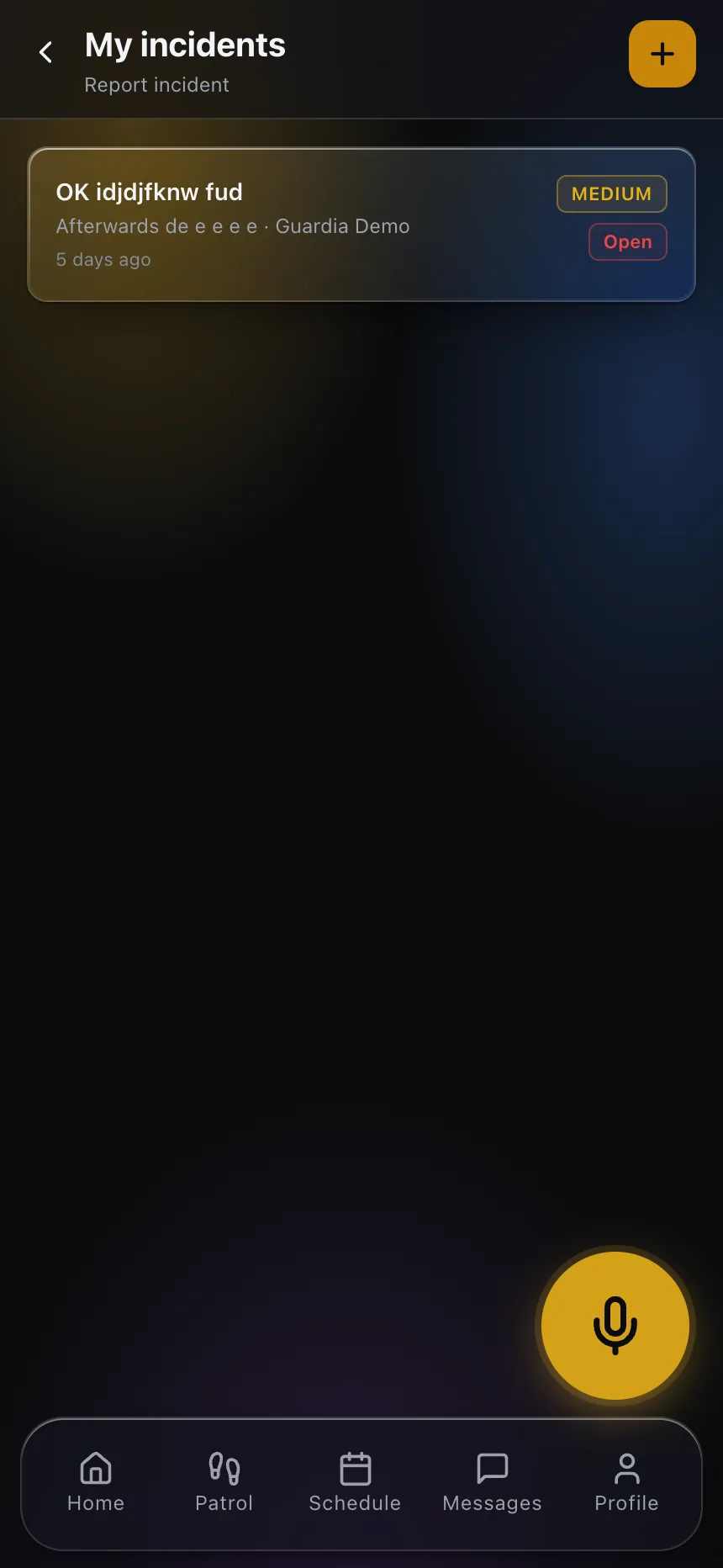
This is also, not coincidentally, the moment when getting a supervisor or dispatch looped in early — before things escalate rather than after — changes the outcome. An officer who can flag a developing situation through an incident reporting workflow the moment it starts, rather than only writing it up afterward, gives dispatch and a field supervisor the chance to send help or offer guidance while there’s still time to de-escalate rather than react. And for the moments that go past what dispatch can help with over the radio, a panic button that gets a location and an alert out immediately is the backstop training can’t replace.
Building this into post orders, not just onboarding
A use-of-force continuum taught once during initial training and never revisited fades exactly the way any skill does without practice — and it fades fastest in the middle levels, verbal command specificity and soft control technique, because those are the ones that get the least attention in refresher training compared to the dramatic final level. Post orders for sites where confrontations are foreseeable should reference the escalation sequence explicitly, not assume it’s covered by generic training everyone received once. Our post orders template is a reasonable starting point for building that expectation into a site’s actual documentation instead of leaving it to memory.
The continuum’s value was never the four labels. It’s that an officer trained to move through them in order has more available responses than an officer who only has two — and more available responses is what actually keeps a 3 a.m. confrontation from becoming a report nobody wanted to write. If you want to see how CGuardPro supports incident logging and real-time alerts for moments like this, explore the platform.