Every panic button policy assumes the same thing: that the officer has a free hand, a moment unobserved, and a device within reach. Most of the time that’s true. It isn’t always. An officer walked to their vehicle by someone who won’t leave, an officer at a front desk with a person standing directly across the counter, an officer whose radio is clipped somewhere they can’t discreetly reach without drawing attention — these are the situations a duress code word policy for security guards is built for, because a spoken signal folded into a routine-sounding radio call doesn’t require a free hand or a private moment. It requires the officer to say something that sounds completely ordinary to anyone listening in.
Why a duress code word policy for security guards exists alongside the panic button, not instead of it
A panic button is the right tool when an officer can reach it without being noticed, and it should stay the primary escalation path for exactly that reason — it’s fast, and it doesn’t rely on anyone remembering a script under stress. But it assumes physical access and a beat of privacy, and coercion situations don’t always offer either. If someone is standing close enough to see what an officer’s hands are doing, or close enough to hear every word on a radio call, the officer needs a way to signal that something is wrong without doing anything that looks like signaling at all. That’s what a verbal duress code is for: it lives inside a conversation that’s already happening, so it doesn’t require a separate, noticeable action.
The design goal is narrow and specific. The phrase has to sound completely unremarkable to someone who isn’t listening for it, while being unambiguous to dispatch, who is. A phrase that sounds even slightly odd defeats the purpose — if it would make a bystander think “that’s a strange thing to say,” it’s not a good code, because the entire value of the system depends on it passing as normal conversation.
Building the code into something that already happens
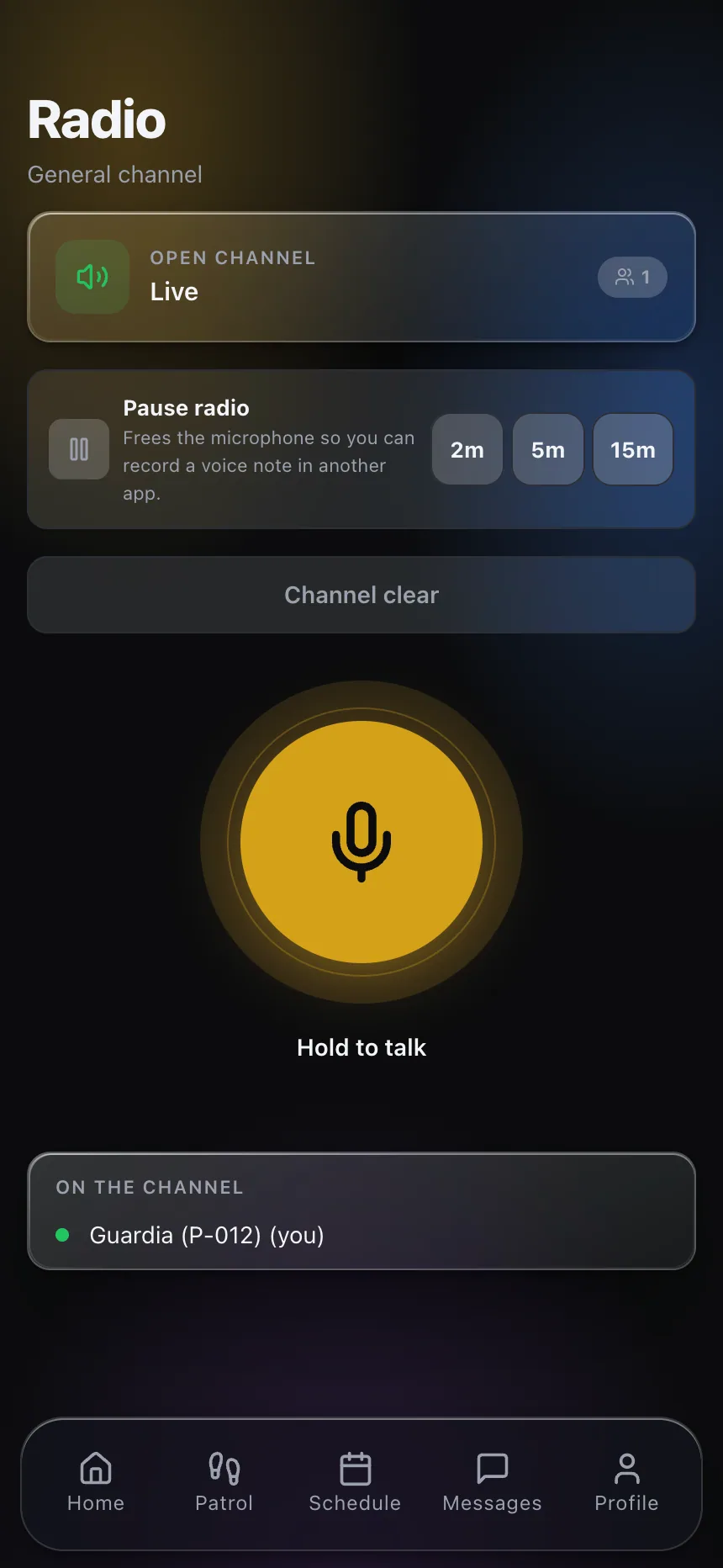
The strongest versions of this policy don’t invent a new radio habit — they attach the duress signal to a check-in the officer is already doing routinely, so its presence or absence doesn’t stand out. If your officers do scheduled radio checks, the code word gets folded into how that check is phrased: a specific word substitution, a specific way of stating the time, a specific answer to a question dispatch always asks. The point is that an officer under duress isn’t performing something unusual — they’re doing the check-in they always do, just with one detail altered in a way only dispatch is trained to catch.
This only works if the code is simple enough to produce under real stress. A complicated phrase, a long sentence, anything that requires the officer to remember multiple steps while someone is standing over them, will get botched or skipped entirely in the moment it matters. The best codes are single-word substitutions or a small, fixed set of phrases the officer has practiced enough that producing them doesn’t take conscious effort — because under coercion, conscious effort is exactly what’s in shortest supply.
What dispatch does when they hear it
A code word is only as good as the response behind it, and that response has to be planned in advance, not improvised the first time dispatch actually hears the phrase. Dispatch needs a clear, rehearsed protocol: how to keep the conversation going normally so the officer isn’t put at further risk by dispatch’s own reaction, how to escalate — including whether and when law enforcement gets contacted — and how to attempt to get the officer’s location and situation without asking direct questions that would tip off whoever’s standing next to them. This is a scenario worth actually rehearsing with dispatch staff, not just documenting in a manual nobody has practiced against.
It’s also worth deciding in advance what “false alarm” recovery looks like. An officer will occasionally use a similar-sounding phrase by accident, or dispatch will mishear a routine call as the code. Whatever the escalation protocol is, it needs a fast, low-friction way to confirm a false alarm without making an officer feel like using the system was a mistake — because an officer who worries the code will trigger an overreaction is an officer who hesitates to use it when it’s real.
Choosing a code that actually fits the site
A code word that works at one post can be a bad fit at another, because the whole design depends on the phrase sounding natural in that specific context. A word or phrase that would be an odd thing to say at a quiet office lobby overnight might be completely unremarkable at a busy retail entrance during business hours, and the reverse is just as true. Building the code around vocabulary the officer would plausibly use anyway at that specific post — referencing a piece of equipment, a location on-site, or a routine task genuinely tied to that post — makes it far less likely to sound forced if someone happens to be listening closely.
It’s also worth rotating codes periodically and keeping them limited to people who genuinely need to know them — officers, dispatch, and direct supervisors — rather than posting them somewhere broadly accessible. A code that’s been used for years without change, or that’s been casually mentioned to people outside the small group who need it, is a code that can’t be trusted to still be secret when it matters. Treat it the way you’d treat any other security control: reviewed periodically, limited to those who need it, and updated if there’s any reason to think it’s no longer confidential.
Documentation and training make the policy real
A duress code that exists only on paper isn’t a policy an officer can execute under stress — it has to be trained until it’s close to automatic, the same way any emergency procedure is. New officers should learn it during onboarding alongside panic button procedures and lone worker protocols, not as an afterthought mentioned once. And every time a duress code is actually used, real or false alarm, it should get documented — what was said, what dispatch did, how it resolved — the same way any other incident on a post gets a written record, so the policy can be reviewed and improved rather than just assumed to be working.
None of this replaces a panic button, a duress alarm, or direct contact with law enforcement when a situation calls for it — a verbal code is one more layer for the specific gap those tools can’t cover, not a replacement for them. Build it as a supplement, train it until it’s second nature, and make sure dispatch has a rehearsed response ready before an officer ever needs to use it for real.
If you want to see how panic alerts, radio communication, and incident documentation work together to cover situations like this, explore CGuardPro or get in touch.