A distribution center or logistics yard is a different animal than a lobby. You are protecting a large footprint, a fence line measured in acres, high-value cargo that moves in and out around the clock, and a stream of drivers and contractors who all have a reason to be there. When you hire warehouse security guards, the hard part is not putting someone at the gate. It is knowing that the perimeter was actually walked, that every truck was logged, and that a guard on the far side of the yard is where they are supposed to be. This guide is about buying coverage you can verify across all that space.
The problem with big sites: you can’t see the whole thing
On a small property, you can practically watch the guard. On a 40-acre logistics campus, you cannot. That is the core challenge, and it is why so many warehouse security programs quietly underdeliver: the guard could skip the back fence for weeks and no one would know until something is cut open.
So the first requirement for warehouse security guards is verification, not trust. You need proof that patrols cover the whole footprint, not just the well-lit front. When you evaluate providers, ask directly: how do you prove the perimeter was patrolled, and how do I see it?
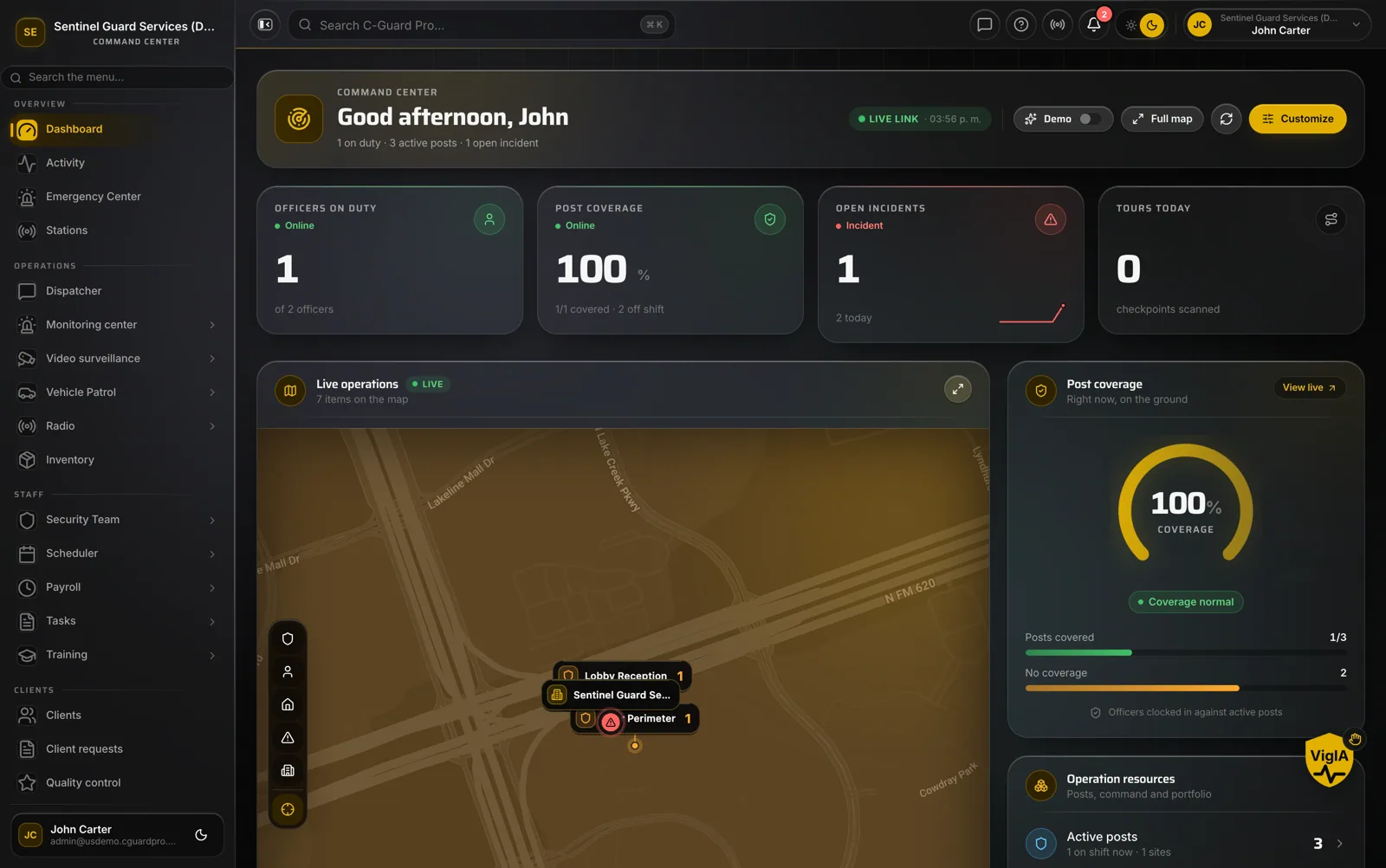 Across a large footprint, a client should be able to see that patrols actually reached the far corners, not just the front gate.
Perimeter patrols with GPS proof
For a large site, the answer is patrols verified two ways: checkpoints and location. Checkpoints, scanned at fixed points along the fence line, the loading docks, and the trailer yard, prove the guard reached each spot. A QR guard tour system makes each of those stops a timestamped record.
For the space in between, GPS guard tracking shows the route the guard actually walked or drove, so you can see that the whole perimeter was covered and not just the checkpoints connected by a straight line on a map. Together they answer the question that keeps a logistics manager up at night: was the back fence checked at 3 a.m., or did the guard stay warm at the gate?
Require both in the contract, define the checkpoints and the frequency, and require that you can review the routes and scans yourself.
Gate and access control that actually logs
The gate is where most of your risk and most of your traffic meet. Trucks, drivers, contractors, and yard staff all pass through, and each one is a record you may need later. When a pallet goes missing or a trailer leaves with the wrong seal, the gate log is your first evidence.
Require a digital access process: which vehicle and driver arrived, the carrier, the appointment or reference, time in and time out. A searchable record turns “a truck came through around midnight” into a precise entry with a name attached. Paper gate logs, by contrast, are almost impossible to search when it counts, and they are easy to lose.
Also clarify how the guard handles the exceptions that cause incidents: the driver with no appointment, the seal that does not match the paperwork, the after-hours pickup. Your provider should have written protocols, because these gray zones are exactly where cargo walks off.
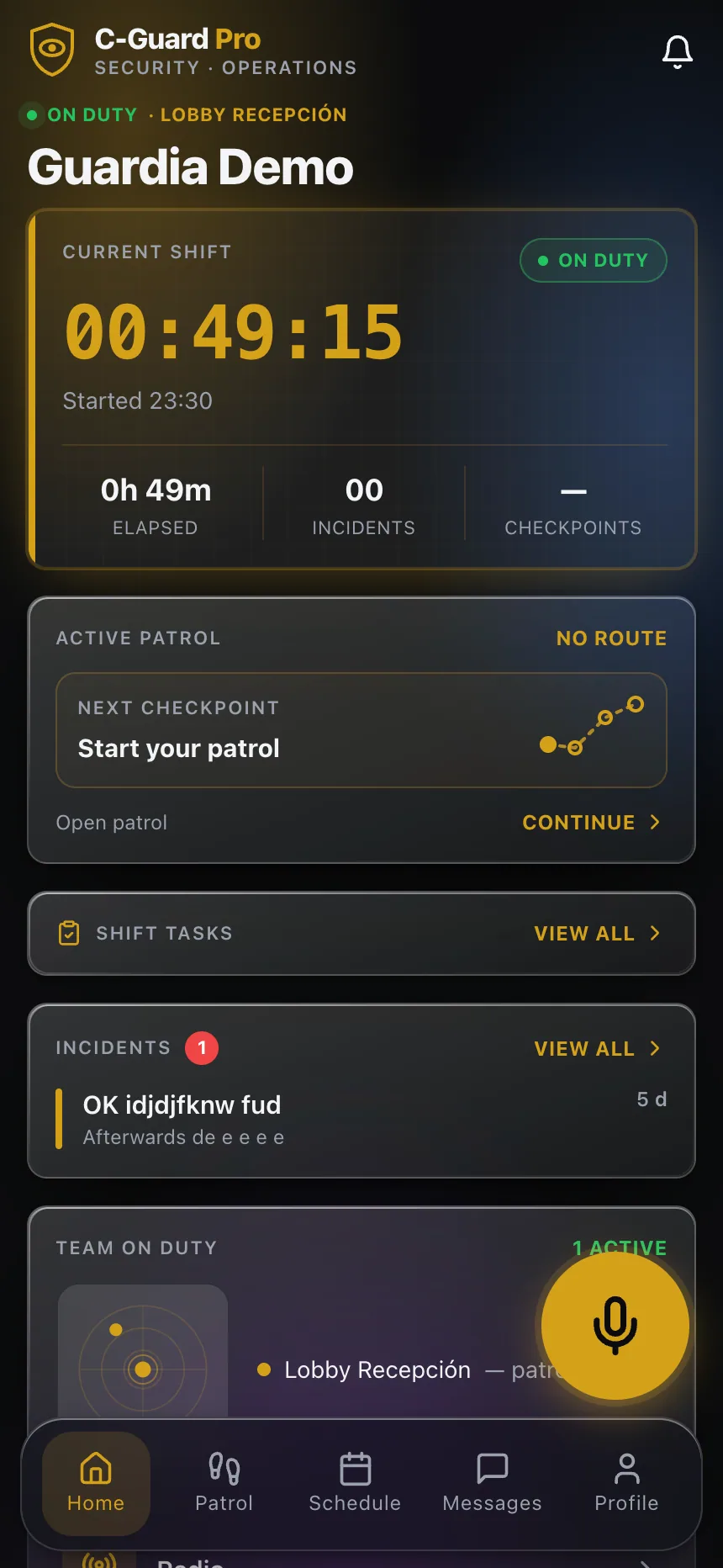 Gate checks, patrol scans, and shift activity flow into one record, so the day’s coverage is documented, not remembered.
Cargo protection is about the record as much as the guard
You cannot put a guard on every trailer. What you can do is make the site one where theft is hard to hide, because everything is logged. When access, patrols, and incidents are all documented and time-stamped, a would-be thief has far fewer blind spots to exploit, and any loss leaves a trail you can follow.
This is why documentation is not a nice-to-have for logistics. It is the deterrent and the investigation kit rolled into one. Require digital incident reports with time, location, and photos, and make sure they roll up so you can spot patterns: if losses cluster at one dock or one shift, you can adjust coverage with evidence.
Give yourself real visibility
A logistics operation runs on data everywhere else, and security should be no exception. A client portal for security lets you see live status, patrol routes, gate activity, and incidents without calling your provider. For a facility that runs around the clock, that means the overnight shift is as visible to you as the day shift.
If you want the fuller picture of how a program fits a distribution environment, the warehouse and logistics security guard software page lays out the pieces for a large-footprint site.
What to require from your provider
Turn all of this into contract language:
- Verified perimeter patrols with defined checkpoints and frequency.
- GPS-tracked routes so you can see the whole footprint was covered.
- A digital, searchable gate and access log for vehicles and drivers.
- Written protocols for access exceptions and seal discrepancies.
- Digital incident reports with time, location, and photos.
- A portal where you can see status, patrols, and gate activity across all shifts.
A note on limits and rules
GPS and checkpoints are powerful, but not magic. Signal can drop in a steel-heavy warehouse, and a scan proves the guard was at a point, not that they were attentive everywhere in between. Treat the technology as an amplifier of a well-staffed, well-trained team, and ask your provider how they train and supervise guards, not just how they track them.
Requirements around guard licensing, cameras, and worker and data privacy vary by state and locality, and this article is not legal advice. Confirm specifics with the relevant authority and your own counsel.
The takeaway
On a large site, the enemy is the blind spot. Buy patrols you can verify by both checkpoint and GPS, a gate log you can search, and incident records that roll up into patterns. Then give yourself a place to see it all. To see what that visibility looks like for a logistics buyer, explore the CGuardPro client portal.