An event is a security operation with a hard deadline and no do-overs. The crowd arrives whether or not you are ready, the risks peak in a few concentrated hours, and every decision has to be made live. When you hire event security guards, you are buying the ability to manage a crowd in real time, coordinate a team across a venue, and come out the other side with a record of what happened. This guide is about buying that capability deliberately, because an event is the wrong place to discover your provider improvises.
Start by sizing the event honestly
Before you talk staffing, describe your event to yourself in plain terms. Expected attendance, the venue layout, the number of entrances, whether alcohol is served, whether there is a stage or a VIP area, and the profile of the crowd. A seated corporate gala and a general-admission concert are different jobs, and a provider who does not ask these questions is not thinking about your event.
The honest sizing drives everything downstream: how many guards, where they stand, and how they move as the night changes. When you evaluate event security guards, expect the provider to walk the venue, ask about crowd flow, and identify the pinch points, entrances, bars, exits, and the stage front, before quoting a number.
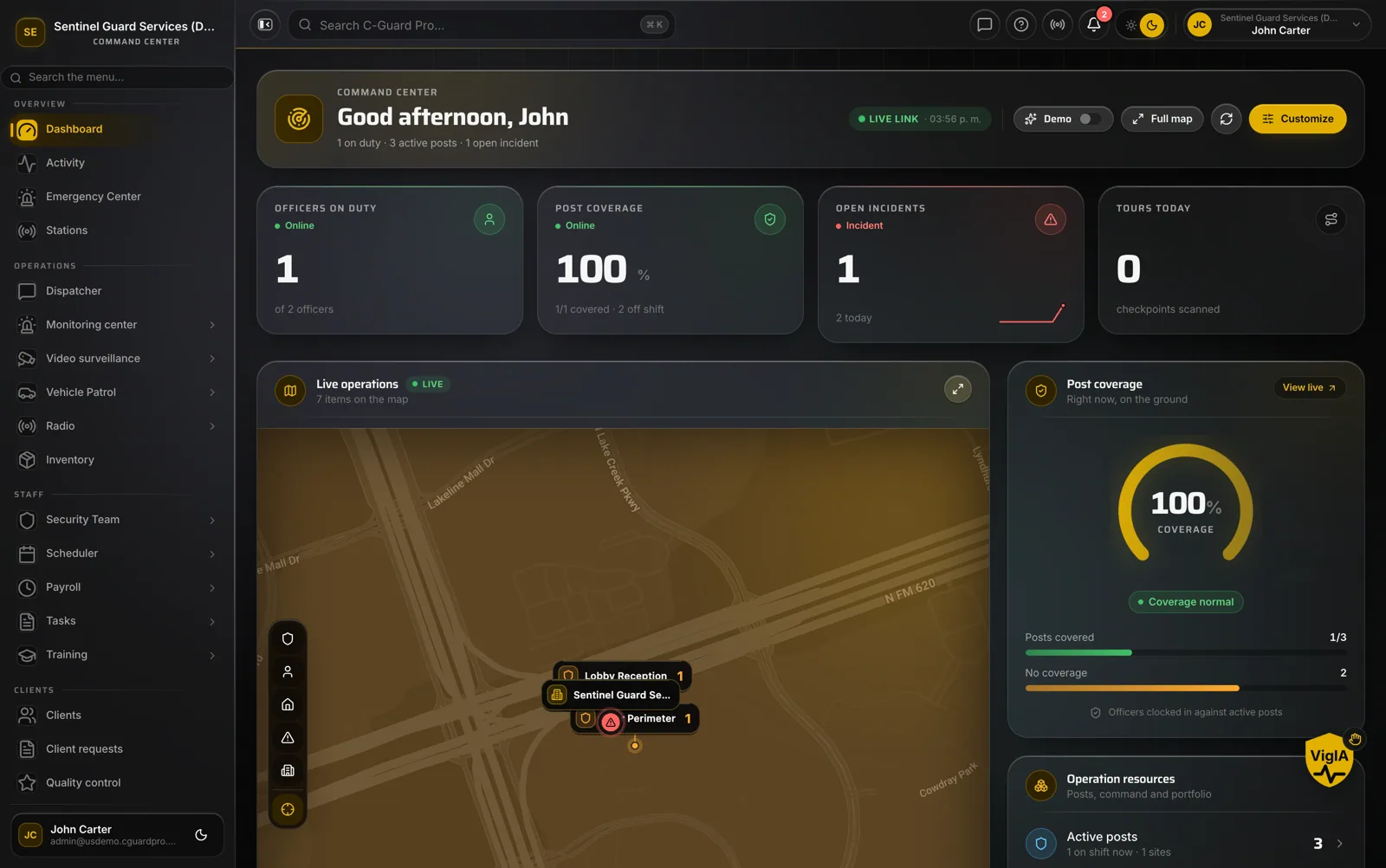 During a live event, an organizer should be able to see where guards are and what is happening, without radio guesswork.
Staffing ratios and positioning
You will hear about “ratios,” the number of guards per attendee. Be careful with any provider who quotes a single magic number, because the right staffing depends on your specific event, not a formula. Alcohol, crowd density, the presence of a stage, and the venue’s own layout all move the number.
What you should require instead is a staffing plan tied to positions and phases: how many guards at each entrance during arrival, how they redeploy once the crowd is in, who covers exits during the rush at the end, and who is dedicated to the highest-risk zones. Ask the provider to justify their number against your event, not against a rule of thumb. Regulations and venue or permit conditions can also affect required staffing, and those vary by locality; confirm with the relevant authority, since this is not legal advice.
Real-time coordination is the whole game
At a static site, a guard can work a shift with little contact. At an event, guards who cannot coordinate instantly are nearly useless. The crowd surges, a fight starts near the stage, someone needs medical help at the far gate, and all of it happens in minutes.
That is why communication is a core requirement, not an afterthought. Instant push-to-talk radio for security guards lets the team talk across the venue without fumbling for phones, so a problem at one gate becomes a coordinated response in seconds. When you evaluate a provider, ask how their guards communicate during an event and how a call for help reaches the whole team, not just the nearest person.
Location awareness matters here too. Knowing roughly where each guard is, and where an incident is unfolding, lets whoever is coordinating send the closest people to the right spot instead of shouting into a radio and hoping.
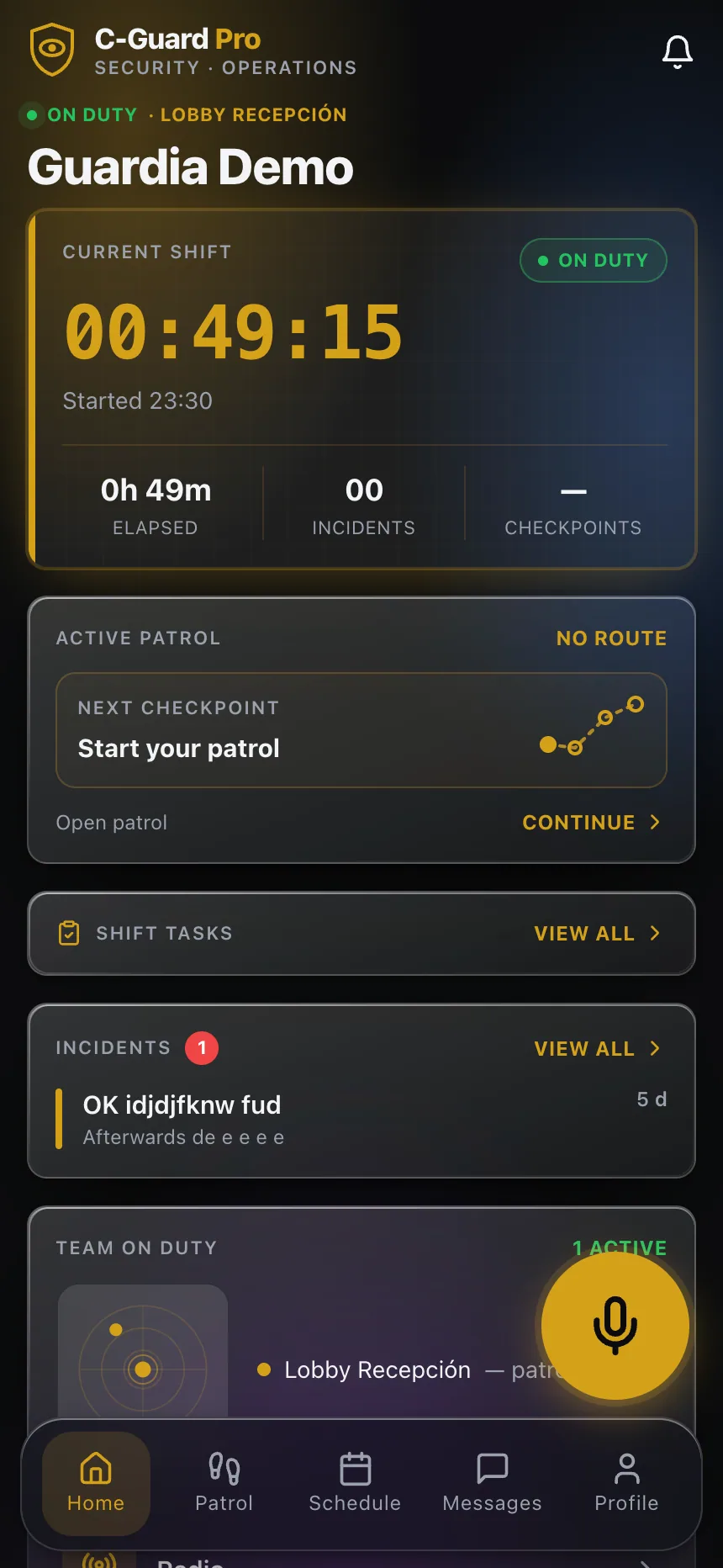 Each guard’s activity and position feed into a shared picture, so coordination during the event is based on facts, not guesses.
Log incidents as they happen
Events generate incidents in bursts: ejections, medical calls, lost children, altercations, property damage. In the moment, the temptation is to handle it and move on. But an undocumented incident is a liability waiting to surface weeks later when someone files a claim.
Require that guards log incidents digitally, with time, location, and photos where appropriate, during the event. A record captured live is worth far more than one reconstructed from memory the next day, and it protects you, the venue, and the guard alike. It also gives you an honest debrief afterward, so your next event is planned on evidence rather than impressions.
Give yourself and the venue visibility
You are running the event, not the security detail, so you need to see the operation without standing at the command post all night. A client portal for security lets you and the venue see live status and incidents as they are logged, and gives you a clean record afterward for your own review and for anyone who asks.
What to require from your provider
Turn it into requirements before the doors open:
- A staffing plan tied to positions and phases, justified against your event.
- Instant team communication across the whole venue.
- Location awareness so the closest guards respond to an incident.
- Digital incident logging during the event, with time, location, and photos.
- A portal where you and the venue can see status and incidents live.
- A clear command structure and escalation path for serious events.
A word on limits
Technology coordinates people; it does not control a crowd. Radios and apps make a well-trained team faster and better informed, but they do not substitute for enough experienced guards, a solid plan, and a walkthrough of the venue. Ask your provider about the humans and the plan first, and treat the tools as what makes the plan executable in real time.
The takeaway
An event gives you one chance to get security right. Size the event honestly, demand a staffing plan you can defend, insist on real-time coordination, and require that every incident is logged as it happens. Then give yourself a live view of the operation. To see what that visibility looks like for an event organizer, explore the CGuardPro client portal.