There’s a specific kind of helplessness that comes with hiring security: you hand over responsibility for your property, and then you wait. You wait for the monthly report. You wait for someone to tell you if the guards showed up, if the patrols happened, if anything went wrong overnight. By the time you find out, whatever it was is already history. The cure for that helplessness is a real-time security guard client portal — a live window into your own service, open whenever you want to look.
Visibility isn’t a luxury feature. It’s the thing that turns security from an act of faith into a service you can actually manage. When you can see what’s happening as it happens, a good provider gets confirmed daily and a slipping one gets caught early — while the problem is still small enough to fix.
The problem with waiting for the monthly recap
The traditional model runs on delay. Guards work, paper accumulates, and once a month someone compiles a summary and sends it your way. Every part of that is stacked against you.
- You learn about problems too late to prevent them. A missed patrol reported four weeks later is useless; the risk it created has already passed.
- The provider controls the narrative. When they compile the report, they decide what to emphasise and what to round off. You’re trusting their account of their own performance.
- Small issues compound in the dark. A pattern of late arrivals or skipped rounds that you’d have caught in week one instead runs for a month before it surfaces.
The monthly recap isn’t management. It’s a post-mortem. And a service you can only examine after the fact is a service you’re not really in control of.
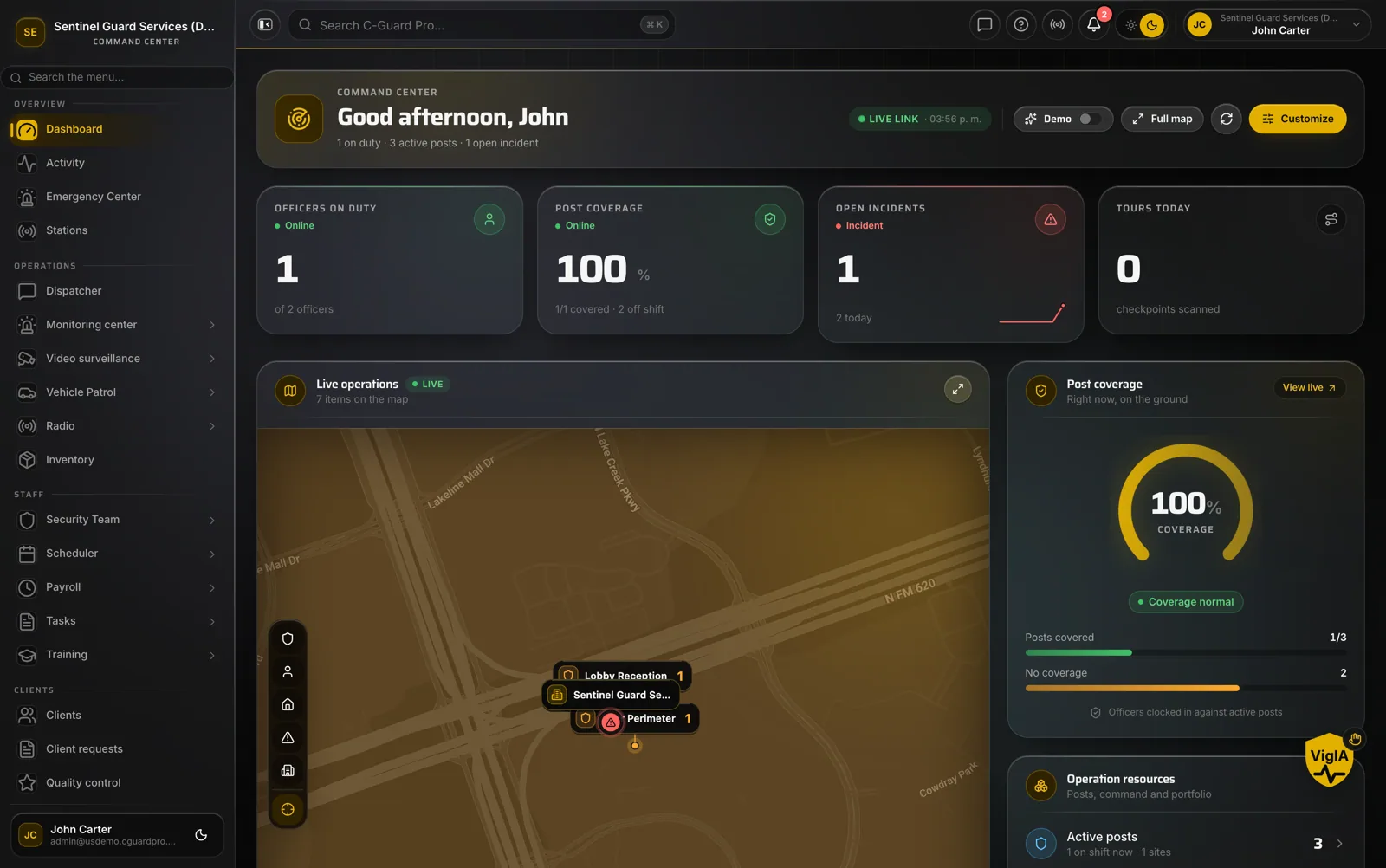 One screen, updating as the work happens — coverage, patrols and incidents visible in real time instead of a month later.
What a real-time security guard client portal shows you
A live client portal collapses the delay to zero. Instead of waiting for a summary, you open a screen and see the current state of your service:
- Who’s on site right now. Guards clocked in, at which posts, since when — so coverage gaps are obvious the moment they appear. This ties directly to the provider’s time and attendance tracking.
- Patrols as they complete. Each checkpoint reached, time-stamped, so you can watch tonight’s rounds progress rather than take them on faith.
- Incidents as they’re logged. The moment a guard reports something, it’s there — with time, location and detail — not written up days later.
- The trail of activity. A running record you can scroll back through whenever a question comes up.
The point isn’t to have you glued to a screen all night. It’s that the truth is always one click away. You check when you want reassurance, when something seems off, or when you’re building your regular audit. The information waits for you instead of the other way around.
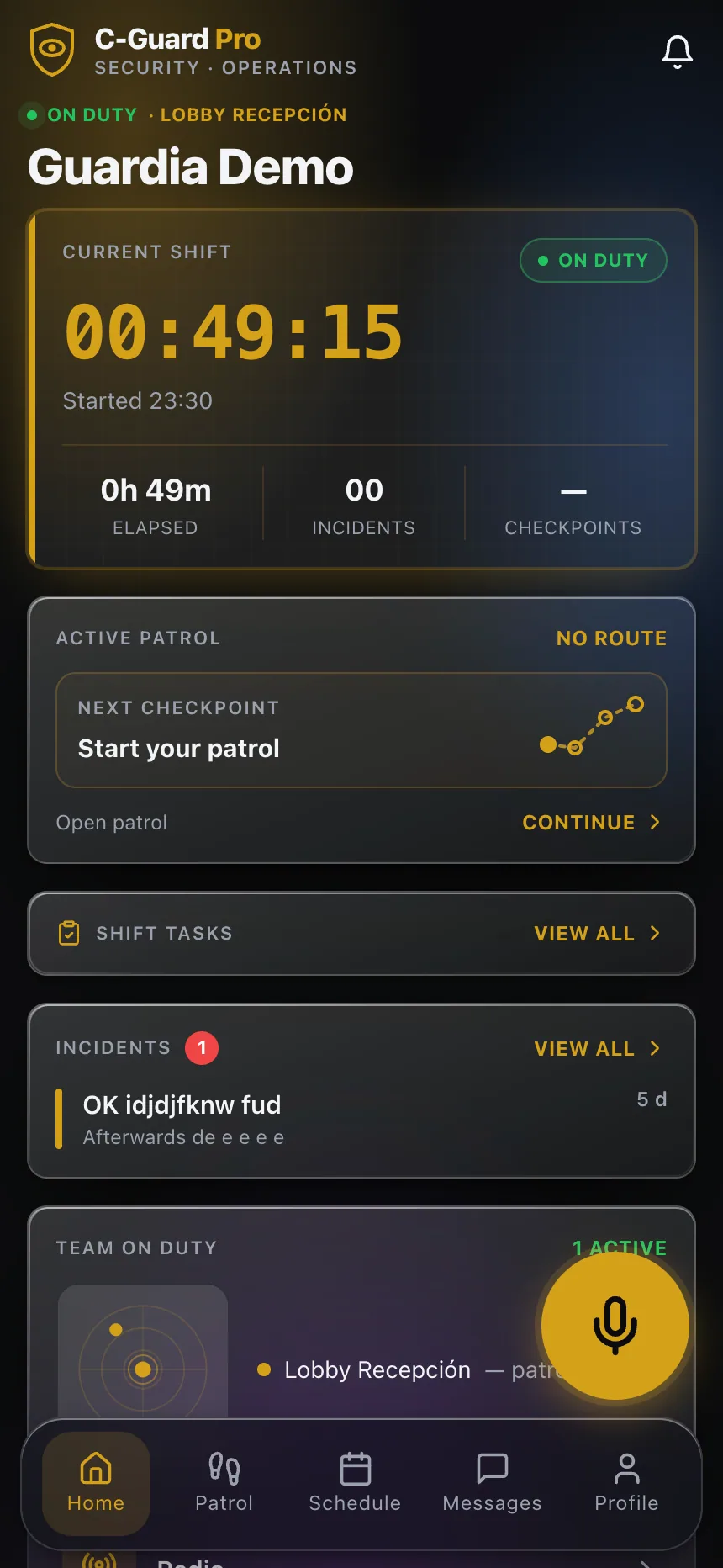 Every action a guard takes on the ground — a clock-in, a completed round, a logged incident — appears in your portal in real time.
Why real-time visibility changes the relationship
Live visibility does more than inform you. It quietly reshapes how the whole service behaves.
It aligns incentives. When a provider knows you can see the service as it runs, corner-cutting stops being a safe bet. The work gets done properly because it’s visible, not because someone might audit it later.
It shortens the loop. You raise a missed patrol the morning after, the provider fixes it that day, and the pattern never takes hold. Problems get solved while they’re small.
It builds trust on evidence, not promises. You stop relying on “everything’s fine” and start relying on what you can see. For a good provider that’s a gift — the portal is their best proof they’re worth the money.
It protects you when it counts. If an incident is ever questioned, or an event becomes an insurance matter, you have a live, time-stamped record instead of a reconstructed story.
Making visibility a requirement, not a hope
When you evaluate a provider — or push your current one to modernise — treat live visibility as a must-have, not a nice-to-have. Ask directly: “Can I open a screen and see my service in real time, any time, without requesting a report?” A modern provider says yes and shows you. A dated one offers to email you a summary instead, which is your answer.
Get it in the arrangement, too. Agreeing up front that you’ll have live access sets the expectation that the service is meant to be seen, and it saves you from discovering months later that “visibility” meant a PDF.
See your security, don’t wait for it
A real-time security guard client portal ends the helpless waiting. Instead of a monthly recap of problems you can no longer touch, you get a live view of patrols, incidents and attendance as they happen — the difference between managing your security and merely paying for it.
If you want to see what that looks like from the buyer’s chair, take a look at the client portal a modern provider should be able to give you today.