A property manager or facilities director weighing in house security guards vs contract security company options is making a build-vs-buy decision, and like most build-vs-buy decisions, the honest answer is “it depends on what you’re optimizing for” rather than a universal winner. This isn’t a question of whether officers who work directly for a company are more classified employees than contract officers — that’s a separate legal question about worker status inside a security firm, and a different topic entirely. This is about which model a property should choose to protect itself, and what each one actually costs the buyer in ways that don’t show up on the invoice.
What in-house buys you
Site familiarity that compounds. An officer employed directly by a property, a hospital, or a corporate campus works the same site for years, often the same shift, and builds a depth of institutional knowledge that’s genuinely hard to replicate — who belongs in the building at 2 a.m., which tenant always sets off the motion sensor on the third floor, which delivery driver is legitimate and which one is new and needs a closer look. That familiarity is real and it’s valuable.
Direct loyalty and culture fit. An in-house officer reports through the same management structure as everyone else on-site, wears the culture of the organization more than the culture of a vendor, and in many buyers’ experience feels more like “our team” to staff and tenants who interact with them daily.
Full control over hiring and standards. The buyer sets the bar for who gets hired, how they’re trained, and how they’re evaluated, without a vendor’s own standards sitting in between.
What that control actually costs
Every one of those advantages comes with an operational burden the buyer now owns directly. Recruiting, background checks, scheduling around callouts and vacations, payroll, workers’ compensation exposure, and — the part that surprises new in-house programs most — covering a post when the regular officer is out sick and there’s no bench of relief officers to pull from the way a contract vendor maintains. A property running its own security program is running a small HR and operations function it didn’t previously have, on top of whatever its core business is.
What contract buys you
Flexibility without the staffing burden. A contract vendor absorbs the recruiting, the relief coverage, the payroll administration, and the liability that comes with employing officers directly. If a client’s needs change — more coverage during a renovation, less during a slow season — a contract relationship can flex in a way an in-house program structurally can’t without a hiring or layoff cycle.
Liability transfer. This is the part that gets undersold in casual comparisons. A contract security company typically carries its own insurance and assumes a layer of liability for the actions of its officers that would otherwise sit entirely with the property. That’s not a minor detail — it’s often the deciding factor for a property’s own risk management or legal team.
A vendor whose entire business is getting this right. A dedicated guard company lives or dies on training, supervision, and documentation quality across many accounts, which — when the vendor is a good one — produces more consistent standards than a property managing one small in-house team as a side function of its main business.
What contract has to earn back
The tradeoff is the one every buyer worries about out loud: does a contract officer, rotating in from a staffing pool, actually know this property the way an in-house officer would? That’s a fair concern, and it’s the one a contract vendor has to actively counter with continuity — the same officers on the same post whenever possible, documented post orders that capture site-specific knowledge instead of relying on memory, and visibility the client can check without having to call and ask.
The accountability gap, and who can close it
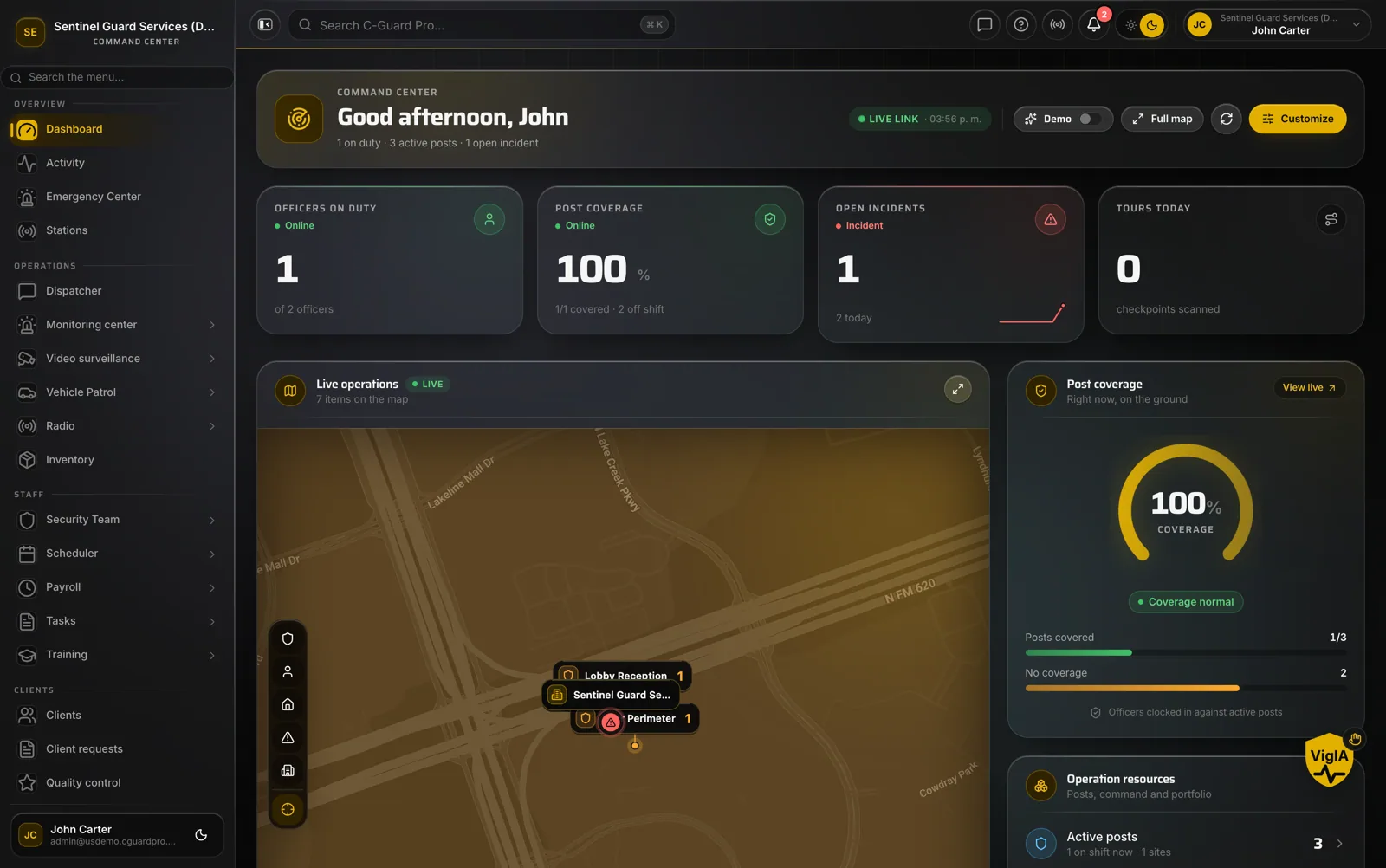
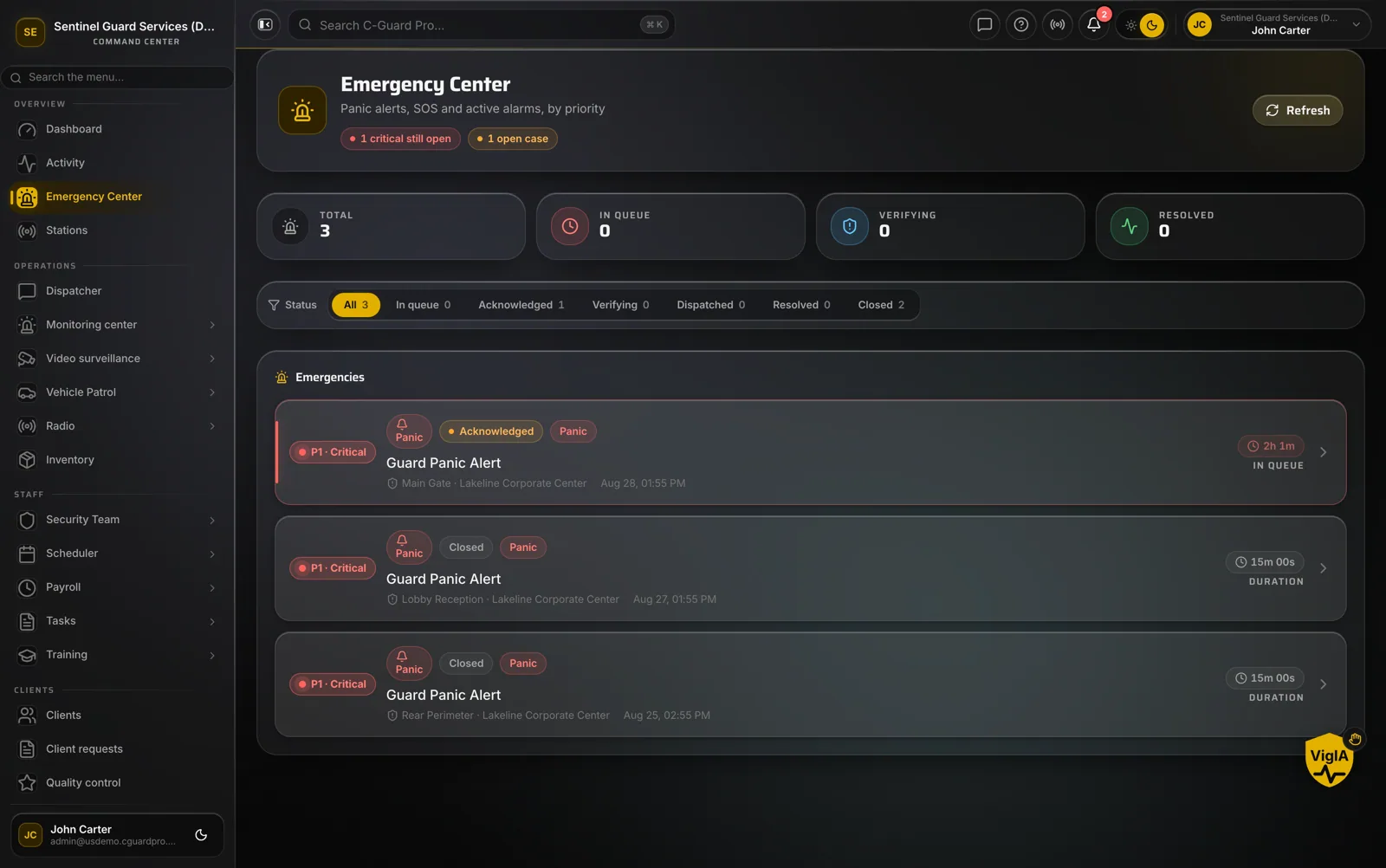
Here’s the part that doesn’t get said plainly enough in most comparisons: an in-house security program, run as a side function inside a property management or facilities team, rarely has the operational tooling that a dedicated security vendor builds as its core product — real-time visibility into where officers are, documented rounds, incident reports filed and routed the same day, a portal a stakeholder can check without picking up the phone. Building that internally, on top of an in-house program, is possible but rarely happens, because it isn’t the core business of the team running it.
A contract vendor whose software backs up its service — a client portal showing coverage and incidents in real time, verified rounds, transparent billing tied to actual hours worked — closes exactly the accountability gap that in-house programs tend to leave open. That’s not a claim that contract is universally better. It’s a specific, mechanical advantage: the client gets proof of what happened without depending on trust in one team’s internal reporting, because the vendor’s own business depends on that proof being available.
The hybrid option worth naming
The choice isn’t always binary. Some properties run a small in-house core — often a security director or a handful of long-tenured officers who carry institutional knowledge and manage the relationship — while contracting the bulk of shift coverage out to a vendor for flexibility and liability transfer on the rest. This hybrid model tries to keep the site-familiarity advantage of in-house on the roles where it matters most while pushing the staffing burden onto a contract partner for everything else. It adds coordination overhead of its own — two reporting lines instead of one, and a need to be explicit about which decisions sit with the in-house lead versus the contract supervisor — but for a large or complex property, that overhead is sometimes worth it compared to running either model in its pure form.
In house security guards vs contract security company: making the actual decision
The right call depends on scale, site complexity, how much operational overhead the buyer wants to own, and how much the liability transfer matters to their risk profile. A single-tenant office building with a stable, long-tenured officer might do fine in-house. A multi-site portfolio, a hospital system, or a property with regulatory exposure often finds the liability transfer and the flex staffing worth more than the marginal site-familiarity advantage of a permanent in-house team. Neither answer is wrong on its own — it’s a question of what the specific property actually needs. If you’re evaluating vendors as part of that decision, how to evaluate guard management software is a reasonable place to check what separates a vendor with real operational backbone from one selling coverage alone, and you can always get in touch to talk through your specific situation.