A guard company owner wins a shot at a government contract far bigger than anything they’ve run before, gets excited about the revenue, and only later runs into a surety underwriter who won’t back a bond anywhere near the size the contract requires. The company had the officers, the schedule, and the willingness to do the work. What it didn’t have was bonding capacity for large government security contracts, and no amount of enthusiasm from the contracting officer’s side changes what a surety is willing to underwrite.
What bonding capacity for large government security contracts actually measures
A performance bond guarantees that if your company fails to deliver on the contract, the government agency gets compensated by the surety, which then goes after your company to recover that cost. A payment bond does something similar for your subcontractors and suppliers, guaranteeing they get paid even if your company doesn’t pay them directly. Bonding capacity is the surety’s own internal ceiling on how much total bonded work it’s willing to stand behind for a given company at one time, based on that company’s financial strength, work history, and management track record — not on how good the proposal looks or how confident the owner is that the work will go smoothly.
This is a fundamentally different gate than winning the bid itself. A company can write the strongest technical proposal in the pool, meet every staffing and post-order requirement the solicitation describes, and still be unable to accept the award because no surety will issue a bond of the size the contract requires. Bonding capacity doesn’t grow just because a company wants bigger contracts — it grows because a surety has evidence, usually multiple contract cycles of evidence, that the company reliably completes what it bonds for.
Why the first government contract is usually small on purpose
This is the part that trips up owners who assume bigger is always better: a company chasing its first government contract is often better served bidding on something noticeably smaller than the largest opportunity it could technically staff, specifically because a smaller contract requires a smaller bond, and a smaller bond is easier to get approved without a long financial and operational history behind it. Bidding for the largest available contract straight out of the gate, before a surety has any track record to underwrite against, is how companies get their bond application declined or approved only with conditions — additional collateral, a co-signer, a much higher premium — that make the contract far less profitable than it looked on paper.
The companies that build real bonding capacity over time do it deliberately: win a contract sized to what current capacity supports, perform it cleanly from start to close-out, and use that completed contract as evidence the next time a surety evaluates a larger request. Bonding capacity compounds this way. It rarely jumps. A company with one small, clean government contract behind it is in a genuinely different underwriting conversation than one with none, and a company with several is different again.
Why your bonding agent and your insurance broker aren’t the same relationship
A common mistake among owners chasing a first government contract is treating the bonding conversation as a subset of the general liability and workers’ comp insurance they already carry, handled by the same broker as an afterthought. Surety bonding is a fundamentally different product from insurance, even though both often get arranged through people with overlapping titles. Insurance pools risk across many policyholders and pays out for covered losses. A surety bond is closer to a line of credit backed by the surety’s confidence that your company specifically will perform — and if it doesn’t, the surety expects to recover what it paid out from your company afterward, not just absorb the loss the way an insurer does. That’s why sureties scrutinize financial statements, management experience, and work history so closely: they’re underwriting your company’s actual ability to deliver, not spreading a statistical risk across a large pool of unrelated businesses.
Finding a bonding agent or surety broker who specifically understands security services contracting, rather than a generalist who occasionally places a bond, tends to matter more than owners expect going in. An agent who’s placed bonds for other guard companies knows what a surety in this specific field is going to ask about — staffing stability, payroll timeliness, contract performance history — and can help a company present its financials and track record in the terms a surety underwriter actually evaluates, rather than in a generic business format that leaves out exactly the details that would move the underwriting decision.
What a surety is actually looking at
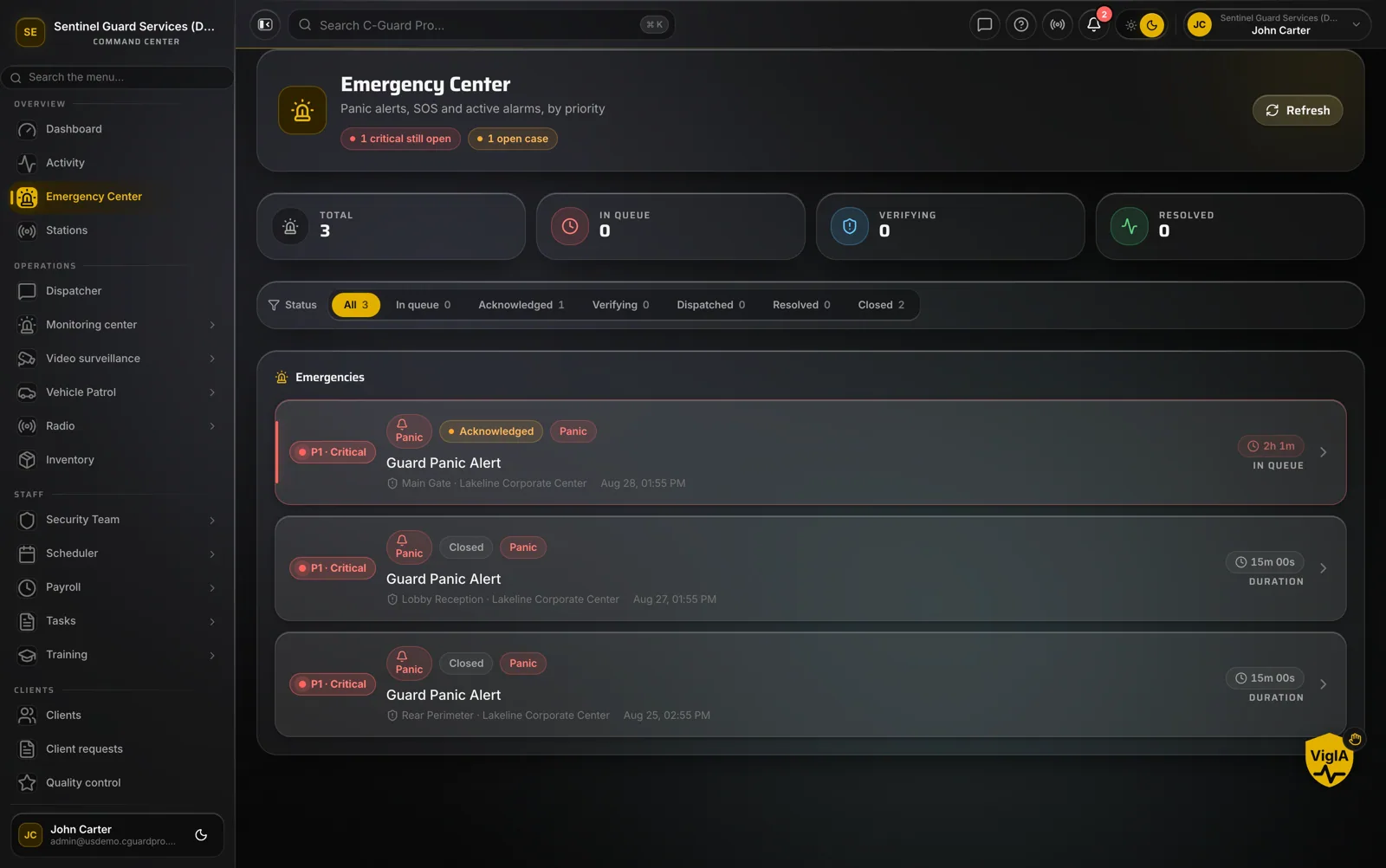
Underwriters weigh financial statements and working capital heavily, but they also weigh operational track record — completed contracts, on-time performance, and how well a company’s management systems demonstrate it can actually run the scope it’s bidding on. This is where day-to-day operational discipline becomes evidence rather than just internal housekeeping. A company that can show consistent daily activity reports, documented incident handling, and a clean scheduling and coverage record across its existing contracts has something concrete to hand a surety or point to in a past-performance reference, rather than asking the underwriter to take the company’s word for it.
This matters just as much on the government side of the relationship. Past-performance evaluations on federal and state contracts are a real factor in future award decisions, and a company that can produce clean, dated records of how a prior contract was actually run — coverage maintained, incidents documented and closed, post orders followed — has a materially easier time both with the contracting agency’s evaluators and with its own surety when it’s time to ask for a larger bond.
Building toward larger bonding capacity without overreaching
The practical sequence looks less like “win the biggest contract you can staff” and more like “win the largest contract your current bonding capacity comfortably supports, run it well enough that it becomes a reference, and let capacity grow from there.” That means talking to a bonding agent or surety before bidding, not after winning, so you know what capacity you’re actually working with rather than finding out mid-proposal that the number doesn’t fit. It also means treating every current contract, government or private, as part of the track record you’re building toward the next bonding conversation, because sureties and contracting officers are both, in their own way, asking the same underlying question: has this company actually done this before, and can it show it.
None of this is a substitute for advice from your surety agent or an attorney familiar with government contracting in your jurisdiction — bonding requirements and underwriting practices vary by surety and by contract type, and the specifics of your situation should be confirmed directly with the professionals handling your bond application. What’s consistent across the industry is the underlying pattern: bonding capacity is earned through demonstrated performance, not requested on the strength of a proposal, and sizing your first government award to your actual capacity is a strategy, not a limitation.
If you want to see how CGuardPro helps a growing guard company build the kind of clean operational record that supports both client references and bonding conversations, explore CGuardPro or get in touch.