Banks do not need vague “coverage.” They need a clear, verifiable atm and bank entrance security plan that covers the vestibule, front doors, ATM area, parking lot, and opening/closing windows without blind spots. If you hire a security company for a branch, the real question is not whether guards were scheduled. It is whether your provider can prove the right checks happened at the right places at the right times.
A strong atm and bank entrance security plan should define the exact areas to cover, the patrol frequency, the escalation rules, and the proof your provider must deliver. For most branches, that means verified checks of the vestibule, entrance, ATM approach, and parking areas, plus immediate incident alerts and a client portal where branch leaders can confirm coverage fast.
What should an ATM and bank entrance security plan include?
An effective plan should specify where guards check, when they check, and how those checks are verified. For a bank branch, that usually includes the public entrance, ATM vestibule, drive-up ATM if present, parking lot, sidewalks, and opening/closing periods.
At minimum, your plan should include:
- Bank branch entry security during business hours
- ATM area guard coverage at defined intervals
- Security for bank parking lots and ATMs
- Opening and closing procedures
- After-hours exterior and vestibule checks
- Immediate escalation rules for safety and security events
- Time-stamped patrol verification by GPS or QR
- Client access to live status, reports, and incidents
A guard tour system is a patrol verification method that records that an officer reached required checkpoints, usually through QR scans or GPS-based location confirmation. A client portal is an online dashboard where you, as the customer, can review patrol completion, incidents, and site status without asking dispatch for updates.
How do you secure an ATM vestibule and bank entrance?
You secure an ATM vestibule and bank entrance by combining physical presence, standard patrol routines, and documented proof of completion. Guards should follow a clear route and checklist, not an informal “walk-through when possible” approach.
During operating hours, the guard’s job near the entrance is to observe behavior, keep access points clear, and identify conditions that could affect customers or staff. That includes loitering, suspicious surveillance, damaged doors, blocked exits, and signs of tampering around the vestibule.
Opening and closing periods need extra structure because they are predictable risk windows. Your provider should define tasks such as perimeter observation, parking lot scan, vestibule inspection, employee arrival/departure awareness, and confirmation that all assigned entry points are secure.
After hours, the plan should shift toward deterrence and condition checks. Guards should confirm door condition, lighting, signs of forced entry, suspicious persons, vandalism, and any issue affecting vestibule safety or ATM access.
Should guards patrol the parking lot and drive-up ATM area?
Yes. If your branch has customer parking, side approaches, or a drive-up ATM, those areas should be included in the patrol scope. Many risks start outside the front door, especially in low-visibility periods such as early morning, evening, or after closing.
Security for bank parking lots and ATMs should cover:
- Vehicle and pedestrian observation near entrances
- Lighting checks
- Suspicious parked vehicles
- Loitering or trespassing near walkways
- Drive-up ATM visibility
- Exterior conditions affecting staff or customer safety
If your provider says the officer is “on site” but cannot show verified checks for these zones, you do not really know whether coverage happened. For banking locations, visibility without proof is not enough.
What does a bank vestibule security checklist look like?
A useful bank vestibule security checklist should make critical checks repeatable and easy to verify. It should be short enough that guards use it every time, but specific enough that branch managers can trust what was checked.
| Area | What the guard checks | What you should receive |
|---|---|---|
| Front entrance | Door condition, obstruction, loitering, suspicious behavior | Time-stamped patrol record |
| ATM vestibule | Lock or door function, tampering signs, damage, unsafe occupancy | Patrol log and incident if needed |
| Drive-up ATM | Lighting, suspicious vehicles, area safety | Verified exterior check |
| Parking lot | Lighting outages, suspicious cars, trespassing, hazards | Recorded patrol checkpoint |
| Opening/closing | Perimeter status, access points, unusual activity | Completed digital checklist |
| After-hours | Glass damage, forced-entry signs, unsecured entry points | Alert and activity report |
This is where a modern guard tour system with QR verification matters. It helps ensure your bank vestibule security checklist is not just a contract promise but an executed routine.
How can a branch manager confirm ATM area guard coverage quickly?
The fastest way is through a client-facing dashboard that shows patrol completion, incidents, and recent site activity. A branch manager should not have to call a dispatcher to ask whether the vestibule or parking lot was checked.
A good provider should offer a client portal for security companies that lets you verify:
- Whether the officer arrived on time
- Whether the required checkpoints were completed
- Whether opening or closing checks were done
- Whether incidents were reported and escalated
- Whether the ATM area guard coverage happened when agreed
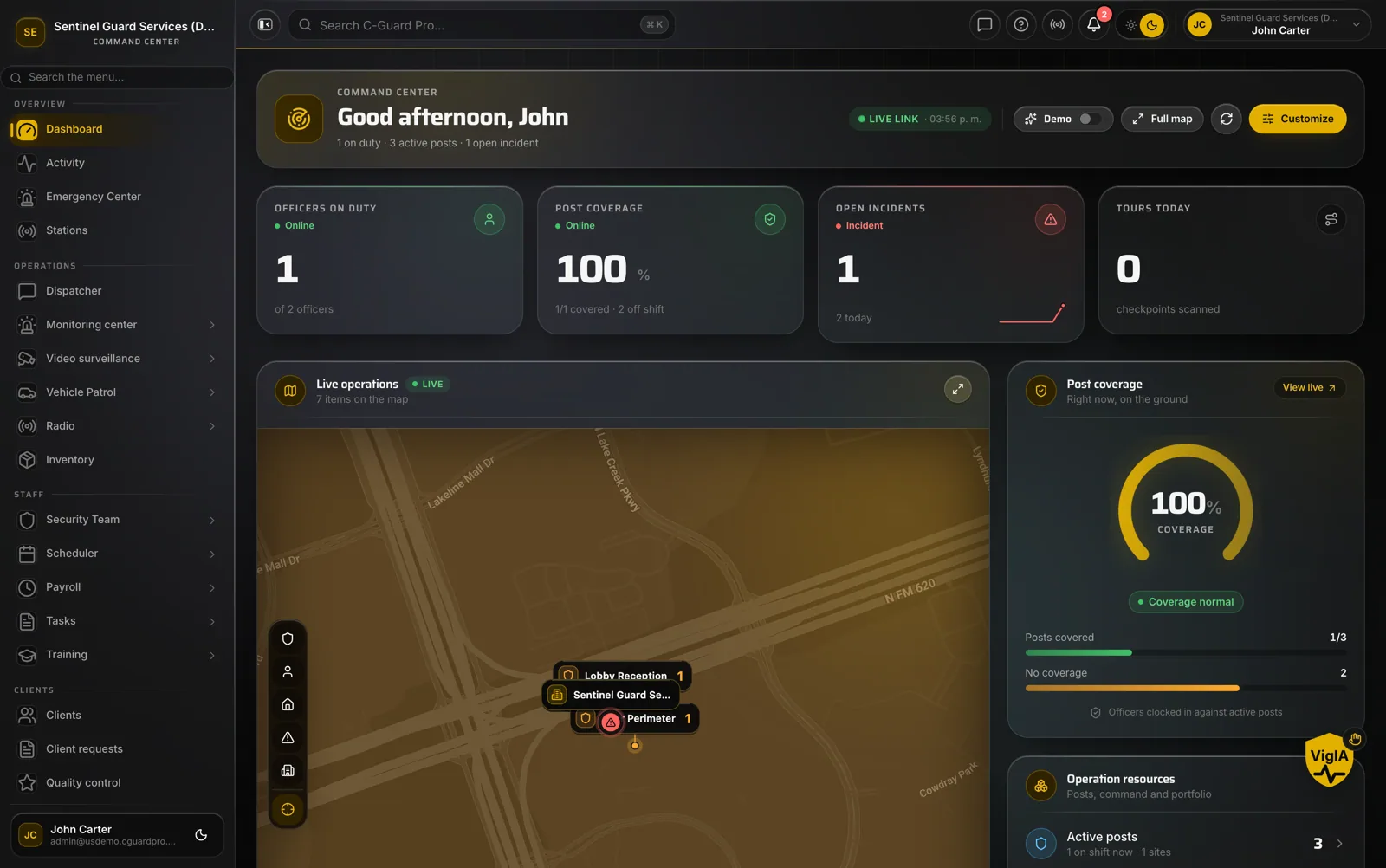
Example of a client portal where branch leaders can review patrol status, incidents, and site coverage quickly.
For multi-branch operations, this matters even more. A client portal helps regional managers see missed checks, delayed responses, or recurring exterior issues before they become larger security problems.
Why should patrols be verified with GPS or QR?
Because a bank entrance security plan depends on evidence, not assumptions. GPS or QR verification creates a time-stamped record that officers reached required locations such as the vestibule, front entrance, parking lot, or drive-up ATM.
GPS guard tracking is the use of location-based data to confirm where a guard was during a patrol or shift. QR checkpoint verification requires the officer to scan a posted checkpoint code at a specific location, creating precise proof that the checkpoint was reached.
When evaluating a provider, ask whether they can show:
- Time-stamped checkpoint history
- Missed checkpoint alerts
- Recent guard location status
- Patrol exceptions by site
- Exportable activity records
If your vendor uses GPS guard tracking, you can hold them accountable for actual branch entry security work rather than relying on handwritten logs or verbal updates.
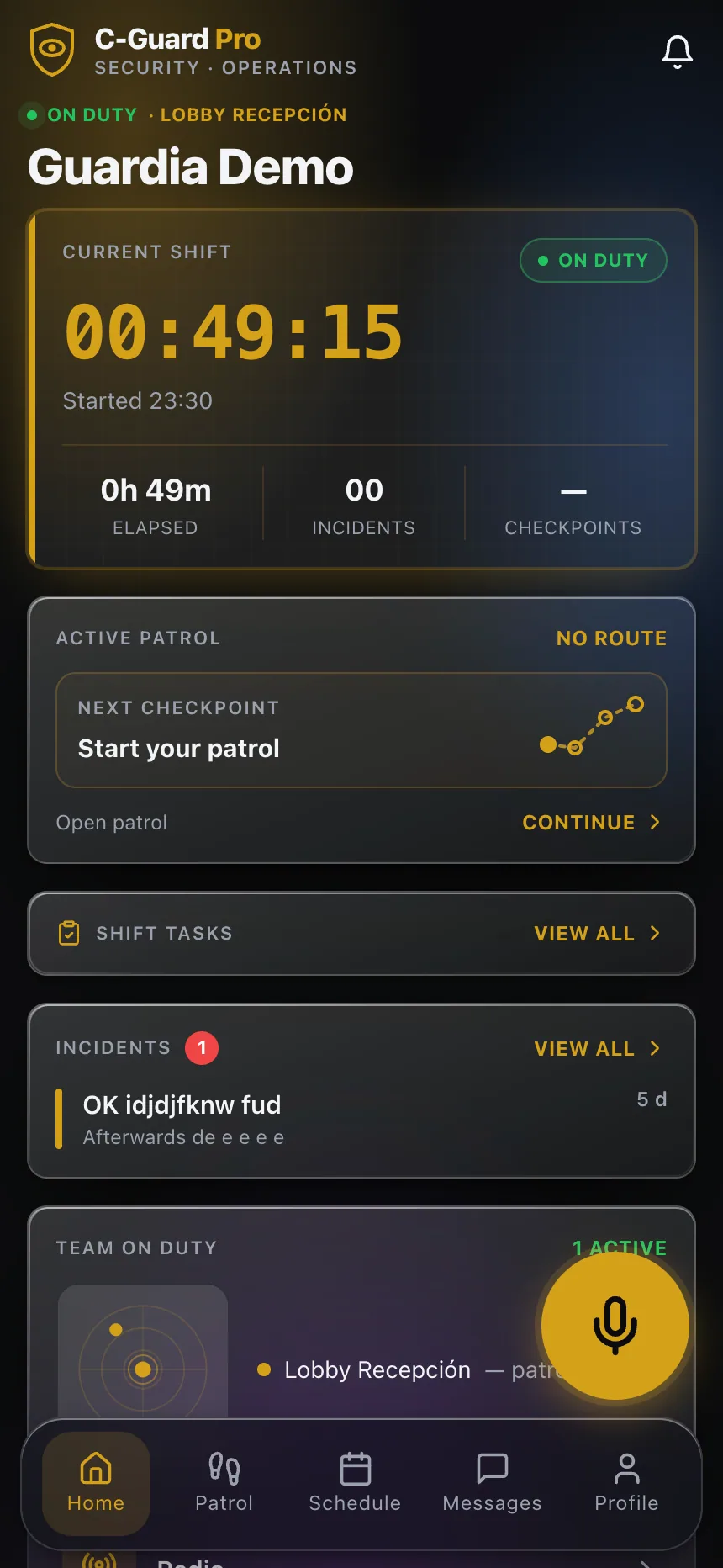
Example of the field app guards use to follow assignments and record patrol activity.
What incidents should trigger immediate alerts?
Your provider should send immediate alerts for any event that could affect customer safety, staff safety, access control, or possible criminal activity. In a bank setting, waiting for a later report is not acceptable for urgent issues.
Examples include:
- Suspicious person monitoring ATM users
- Signs of ATM tampering
- Attempted forced entry at the branch or vestibule
- Aggressive confrontation or threat
- Weapon-related concern
- Broken vestibule door or lock failure
- Unsecured entrance after closing
- Major lighting outage near the ATM or parking lot
- Vandalism affecting safety or access
- Police response to the site
A digital incident report is a structured report completed on a mobile app with time, location, narrative, and supporting photos when needed. For bank branches, those reports should be paired with immediate notifications so the branch manager or regional contact can act quickly.
Frequently asked questions
How do I secure an ATM vestibule and bank entrance?
Secure an ATM vestibule and bank entrance by assigning clear checks for the vestibule door, ATM approach, front entry, and nearby exterior areas at defined times. Require verified patrols through GPS or QR checkpoints, plus immediate alerts for tampering, loitering, or access problems.
Should guards patrol the parking lot and drive-up ATM area?
Yes. If customers or employees use those areas, they should be part of the security plan. Parking lots and drive-up ATMs are common approach points for suspicious activity, so they need documented patrol coverage rather than occasional observation.
What incidents must a bank security vendor report immediately?
Immediate reporting should include ATM tampering, forced-entry signs, suspicious surveillance, threats, weapon concerns, broken vestibule access points, major lighting outages, and any police response. These issues can affect safety or branch operations in real time and should not wait for a later summary.
How can a branch manager verify that checks were completed?
A branch manager should verify completed checks through a client portal showing time-stamped patrol records, completed checkpoints, and incident updates. That is faster and more reliable than calling dispatch or reviewing handwritten logs after the fact.
If you are reviewing providers, require an atm and bank entrance security plan with verified patrols, immediate alerts, and client-side visibility from day one. See what that looks like in a modern client portal for security companies.