Every guard management software demo looks good. That’s not a criticism of any particular vendor — it’s the nature of a demo. A sales engineer has run through the same fifteen-minute path a hundred times, on a account seeded with clean data, hitting every screen in the order that shows the product at its best. You leave impressed, sign a contract, and three months later discover that the workflow your field supervisors actually need — the one that happens at 11 p.m. when an officer calls in an incident and dispatch needs to see it immediately — takes six clicks through a menu nobody showed you. The best questions to ask during a security guard software demo aren’t really questions. They’re a request to take the mouse yourself and run the parts of the job that actually break under pressure.
Why the standard demo doesn’t tell you what you need to know
A vendor-led demo is optimized to answer “does this software have the features we need,” and it answers that question well — every screen exists, every button is there, the feature list checks out. What it doesn’t tell you is how the software behaves when something goes wrong: an officer skips a checkpoint, a shift goes unfilled an hour before it starts, a client calls asking for proof an incident was actually reported at the time it happened rather than backdated the next morning.
Those failure-mode workflows almost never appear in a sales-led walkthrough, not because the vendor is hiding anything, but because a demo script is built to show what the software does well, and every product has rough edges somewhere in the paths that only get used when things go sideways. You find those rough edges by going looking for them, not by watching someone else avoid them.
The first questions to ask during a security guard software demo
The single most useful thing you can do in any demo is ask for the mouse. Tell the sales engineer you want to try logging an incident yourself, from the officer’s side, using a device like the one your officers actually carry. Watching someone else navigate a familiar interface at speed hides every bit of friction a first-time user would hit — and your officers, including the ones who are not comfortable with technology, are all first-time users on day one.
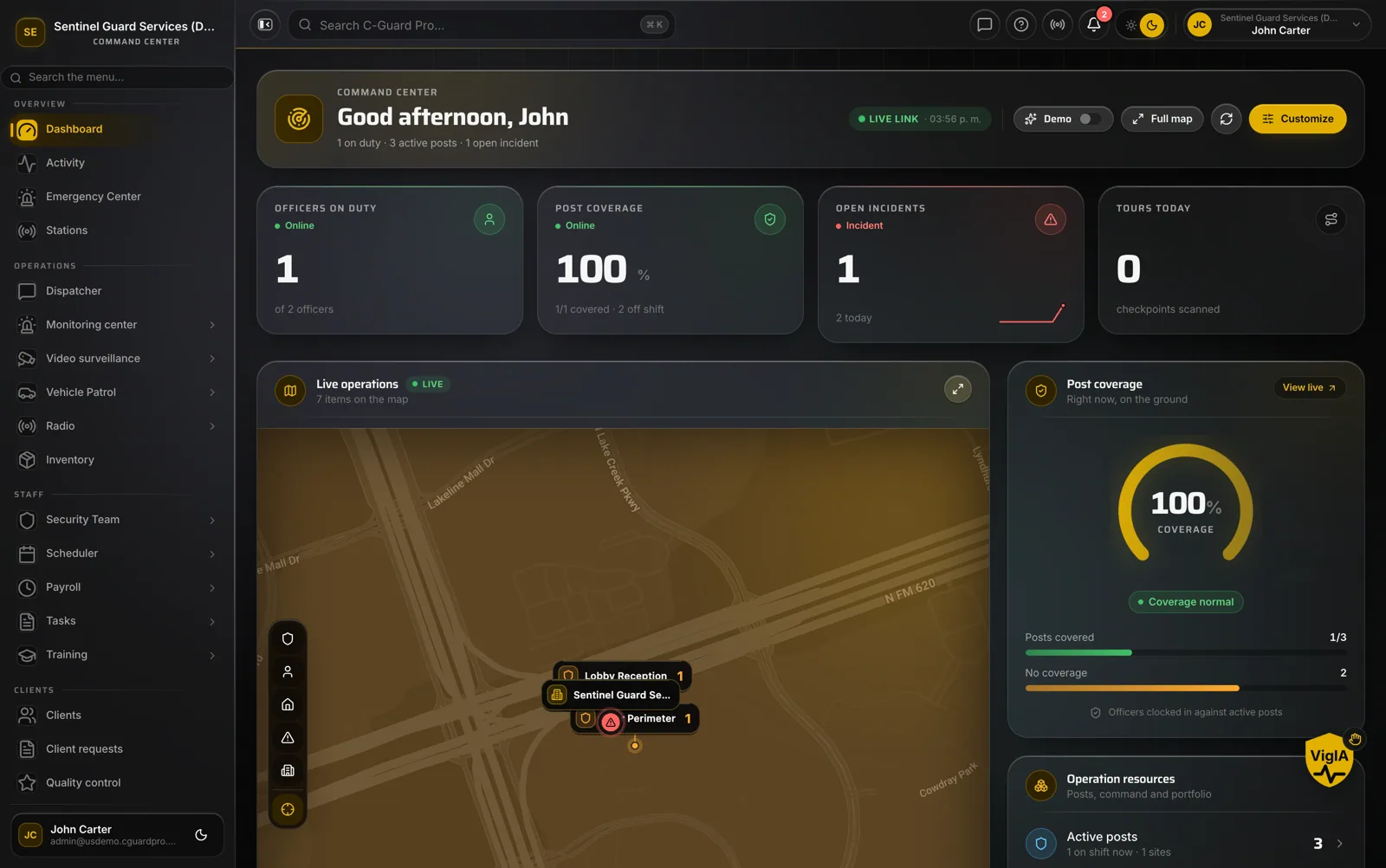
Do the same thing from the admin side. Ask to pull up the dashboard yourself and find something specific — which officers are currently clocked in at a particular site, or the last incident logged in the past hour — without being walked through it first. If you can find it in under a minute on your own, a field supervisor with far less patience for software than you will manage fine. If you can’t find it, that’s the actual signal, not whatever the sales engineer says next.
Break something on purpose
Ask what happens when a checkpoint gets missed. Not “does the system detect missed checkpoints” — that’s a yes-or-no question a sales page already answered. Ask the sales engineer to actually skip one during the demo and show you what a supervisor sees five minutes later. Does an alert appear somewhere a person will actually look, or does it require someone to remember to go check a report? A guard tour system that logs a missed checkpoint quietly in a report nobody opens until the weekly review is functionally the same as a system that doesn’t track checkpoints at all.
Do the same with an incident report. Ask the sales engineer to log a fake incident — a slip and fall, say — from the officer app, with a photo, and then show you the exact screen an account manager would see if a client called forty minutes later asking what happened. Time how long that takes and count the number of taps or clicks along the way. That sequence is the one your business actually depends on, far more than the pretty dashboard the demo opens with.
Ask what happens with no signal
Every demo happens in an office with strong wifi. Almost none of your real posts are like that — a basement loading dock, a parking structure, a rural site with one bar of service. Ask directly: what does the officer’s app do when a checkpoint scan happens with no connectivity? Does it queue the scan and sync once signal returns, or does the officer lose the record entirely and have to explain later why a checkpoint shows as missed when they know they were standing right there? This is the question that separates software built by people who’ve actually run field operations from software built by people who tested it exclusively on their own desk. A vendor who has a clear, confident answer to this one has probably had a client ask them the hard way already.
Ask about the account you’ll actually run, not the average one
Vendor demos default to a clean, mid-size example account because it’s the easiest to make look good. Push past that. If you run twelve-hour shifts on a Panama rotation, ask to see the schedule built that way, not a generic 9-to-5 example. If half your accounts are armed and half unarmed, ask how the system distinguishes them in scheduling and reporting. If you have officers working across five states with different post requirements, ask how post orders differ by site rather than living as one generic template.
The honest answer to some of these questions might be “it doesn’t do that specifically, but here’s the workaround.” That’s a useful answer — better than discovering the gap after you’ve migrated three months of client data and can’t easily walk it back.
Ask what happens after the sale
The demo is run by the person whose job is to close the deal. Ask, directly, who you’ll be talking to in six months when something needs adjusting — a new field added to an incident form, a report format a specific client requires, a bug in how overtime calculates on a Pitman schedule. If the answer is vague, that vagueness is information. A pricing conversation that never mentions support after go-live is a conversation that’s avoiding the part of the relationship that actually determines whether the software works for your company a year in.
What a good demo leaves you with
A demo that’s worth your time ends with you having personally clicked through an incident report, found something specific on the dashboard without help, and watched what happens when a checkpoint gets missed — not just a list of features you were told about. If a vendor resists handing over the mouse, or steers you back to the script every time you go off it, that resistance tells you more than the demo itself does.
If you’d like to run through a real workflow yourself rather than watch a script, explore CGuardPro or get in touch to set one up.