Assigned scheduling: a field supervisor builds the roster and posts it. Shift bidding: officers pick from open shifts, usually by seniority or rating, and the schedule fills itself. Both work. Both also fail in a specific, predictable way that most companies never sit down and weigh before choosing one over the other — they just inherit whatever system the company started with and never revisit it.
Shift bidding vs. assigned scheduling for security guards: what assigned scheduling gets right, and where it breaks
A field supervisor building the schedule by hand can match an officer’s specific skills to an account’s specific needs — the officer who’s good with irritable property managers goes to the difficult HOA account, the one who’s sharp on documentation goes to the site with a pending incident history. That matching is the entire argument for assigned scheduling: it lets someone with judgment place people where they matter most.
It also breaks in a way that’s completely predictable and rarely discussed out loud: officers who feel like they’re always getting the account with the parking garage at 2 a.m., while someone else is always on the daytime lobby post, stop believing the schedule is fair. Whether or not the supervisor’s logic is sound doesn’t matter once officers decide the game is rigged — and once they decide that, turnover on the worst-covered accounts climbs, and the accounts that most needed a stable, experienced officer end up with the highest churn.
The fairness complaint that assigned scheduling can’t answer
The core problem is structural, not personal. Even a completely fair-minded supervisor making genuinely sound placement decisions has no way to prove fairness to an officer who feels overlooked, because the criteria live in the supervisor’s head. Shift bidding solves exactly that complaint by making the process visible: shifts post, officers with seniority or the highest rating choose first, and the outcome is the same regardless of who’s running scheduling that week. Nobody can accuse the system of playing favorites because there’s no discretion left to accuse.
What shift bidding quietly gives up
Here’s the tradeoff nobody puts on the table when they switch: bidding optimizes for the officer’s preference, not for the account’s actual need. Your best-rated officer, the one who handles a demanding client without a single complaint in a year, has every right under a bidding system to pick the easy daytime post at a quiet warehouse instead of staying on the account that needs their judgment most. They earned first pick. They’re allowed to use it on comfort instead of difficulty, and a pure bidding system has no mechanism to stop that — coverage quality on the hardest accounts becomes a function of who happened to want that shift, not who’s actually right for it.
That’s the real shift bidding vs assigned scheduling security guards question, and it isn’t which system is better — it’s which failure mode your company can tolerate less: officers who feel the schedule is rigged, or accounts that quietly lose their best-fit coverage because the officer who’d be great there bid on something easier.
A middle path most companies never try
Some operations run a hybrid without naming it as one: a small set of accounts — the difficult client, the site with an active incident history, the post that needs someone with specific training — get assigned directly by a field supervisor and pulled out of the bid pool entirely, while everything else goes to open bidding. Officers still see a transparent, seniority-driven process for the majority of shifts, which addresses the fairness complaint, while the handful of accounts where the wrong assignment actually costs the company something stay under direct supervisory control. The trick is being explicit about which accounts are carved out and why, so it doesn’t read as the supervisor quietly overriding the bid system whenever they feel like it.
What happens when a new officer has no seniority to bid with
Bidding systems have a startup problem that gets ignored until it causes real turnover: a brand-new officer with zero seniority is guaranteed the least desirable open shift, every single time, for as long as it takes to build standing. That’s defensible in the abstract — seniority has to mean something, and giving new hires first pick would gut the entire logic of the system — but it also means the newest, least experienced officers land disproportionately on overnight and weekend posts, which are frequently the posts with the least direct supervision and the highest chance something goes wrong. A company running pure bidding needs a deliberate answer for how new officers get enough support on those shifts, rather than assuming that seniority sorting itself into place is automatically also sorting risk into place correctly, because those two things aren’t the same thing at all.
Assigned scheduling doesn’t have this exact problem, since a supervisor can choose not to put a brand-new officer alone on the hardest overnight post regardless of tenure, but it reintroduces the same fairness question from a different angle: officers watching a new hire skip past them onto a desirable account because a supervisor liked them, with no seniority logic to point to as the reason. Whichever system a company runs, this is one of the specific moments where the tradeoff actually surfaces in a way officers notice and remember.
Whichever system you run, the roster has to be visible
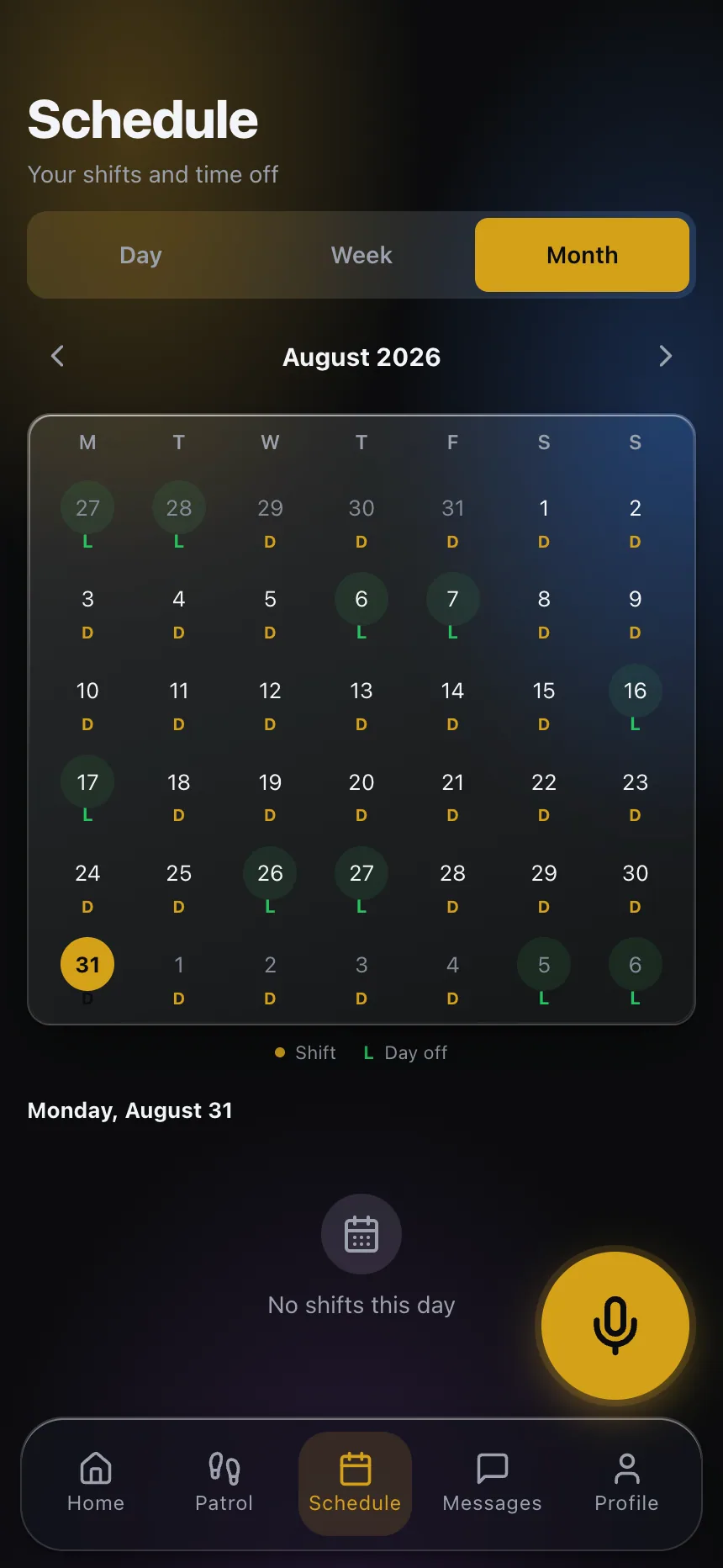
The system matters less than whether officers can actually see it working. A bid system where officers can’t check their standing, or an assigned system where nobody can see why the roster looks the way it does, generates the same complaint either way — that scheduling is a black box. A scheduling system that shows open shifts, seniority or rating standing, and confirmed assignments in one place removes the ambiguity that turns a scheduling disagreement into a grievance, regardless of which model sits underneath it.
The decision worth making deliberately, rather than inheriting, is this: name the two or three accounts where a mismatched officer would actually hurt the company, decide who controls those regardless of the model you use everywhere else, and be honest with your officers about why those specific posts work differently. That’s a smaller, more defensible carve-out than trying to declare one system the winner across an entire roster.
If you want a scheduling system that supports both models without forcing you to pick blind, explore CGuardPro or get in touch.