Every few years, a video of a wheeled or four-legged security robot patrolling a parking lot or a warehouse aisle goes around, usually captioned with some version of “guards are obsolete.” The reality on the ground at facilities that have actually deployed one looks nothing like that headline. The robot does one narrow slice of the job reliably, needs a person to handle everything the slice doesn’t cover, and mostly changes where the officer’s time goes rather than eliminating the need for the officer at all. A serious security guard robot ROI patrol effectiveness conversation starts with that narrower, less exciting reality, not with the video.
What a robot actually does well
Strip away the marketing language and a patrol robot is, functionally, a mobile sensor platform that follows a route without getting tired, distracted, or bored. That’s a genuinely useful capability in a specific kind of environment: a well-lit, structurally simple, mostly predictable indoor space — a warehouse’s main aisles, a parking garage’s straight runs, a data center’s server rows — where the patrol route rarely changes and the main value is consistency over long, monotonous stretches of time.
In that environment, a robot doesn’t skip a round because the last three hundred rounds turned up nothing. It doesn’t get complacent walking the same hallway at 4 a.m. for the tenth night in a row, which is exactly when a human officer’s attention is hardest to keep sharp. That consistency — not any kind of judgment or intelligence — is the actual value proposition, and it’s a real one for the narrow set of environments where it applies.
Robots are also honest, in a mechanical sense, about what they saw. A route that was supposed to be walked either was walked and recorded, or the robot reports it wasn’t — there’s no version of a robot skipping a round and reporting it as complete out of fatigue or convenience, the way a tired human occasionally might.
Where the honest limits start
The same qualities that make a robot reliable in a structured corridor make it nearly useless the moment the environment gets less structured or the situation calls for judgment rather than observation.
Outdoor and unstructured environments are still genuinely hard. Weather, uneven terrain, construction debris, and the sheer variability of an outdoor perimeter or a large surface parking lot push most patrol robots outside the conditions they’re built for. A robot that performs flawlessly indoors on a flat, climate-controlled floor is a different proposition entirely once it’s expected to navigate gravel, rain, or a lot with cars parked at irregular angles.
Judgment calls are where the category runs out of road. A robot can detect that a door is open when it should be closed, or that a person is present in a restricted area after hours. It cannot reliably tell the difference between a maintenance worker with a legitimate reason to be there and someone who isn’t supposed to be, or decide whether a person standing near a loading dock is waiting for a delivery or casing the building. Those distinctions require context a camera and a set of sensors don’t have, and getting them wrong in either direction — a false alarm dispatched as real, or a real problem dismissed as routine — has a real cost either way.
De-escalation isn’t in the feature set. A robot encountering a person in genuine distress, a confrontation between two people, or someone who’s simply lost and needs directions has no path forward beyond recording and, at best, alerting someone else. It can’t have a calm conversation, read a tense situation and back off, or offer the kind of reassurance a person in an unfamiliar building sometimes just needs from another person. That’s not a temporary technology gap closing with the next hardware revision — it’s a category of work that requires a person, full stop.
False positives have a real operational cost. Every sensor-based alert system generates alerts that turn out to be nothing — a plastic bag blowing across a lot that reads as motion, a shadow that trips a thermal sensor. Someone still has to receive that alert, evaluate it, and decide whether to respond, which means a robot doesn’t eliminate labor so much as it relocates some of it from patrol to alert triage, and often adds a layer of monitoring labor that a straightforward walking patrol never needed in the first place.
The hybrid model, honestly framed
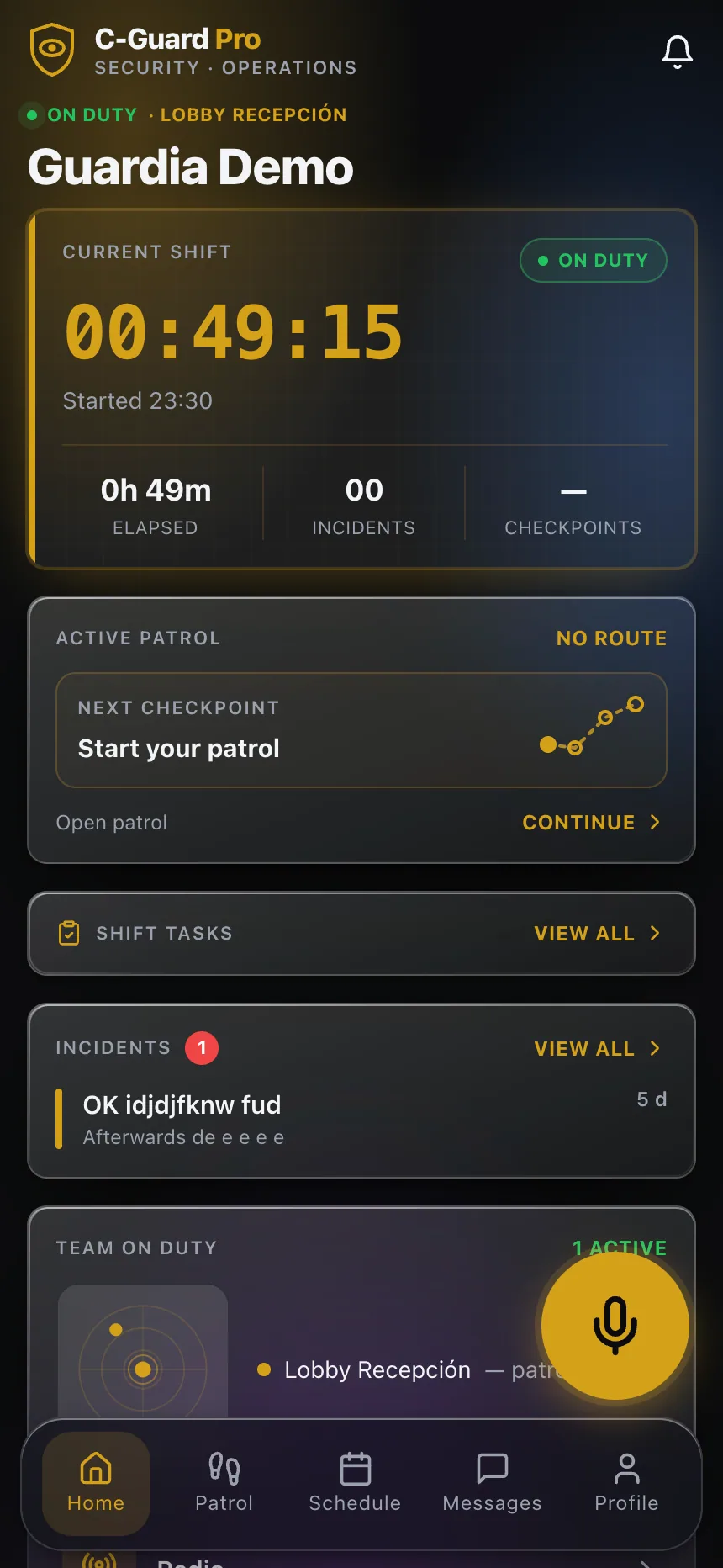
None of this means robots are a bad investment for the right facility — it means the pitch should be a hybrid staffing model, not a replacement one. A robot handling the repetitive, low-variability portion of a route — the long, empty warehouse aisle, the predictable garage loop — frees an officer’s attention for the parts of the job that actually need a person: the lobby, the loading dock during active hours, anywhere a human decision might be required on short notice. Framed that way, the robot is a tool that changes how officer time gets allocated across a site, not a tool that reduces the number of officers a site genuinely needs.
That reframing also changes how ROI should actually be evaluated. The question isn’t “how many guard hours does this robot replace” — that framing tends to overstate the case, because most of what a robot removes is the most monotonous, least judgment-intensive slice of a patrol, not a full officer’s worth of responsibility. The more honest question is whether shifting that slice of the route to a robot lets the remaining officer coverage focus on higher-value tasks — checkpoint verification in the harder-to-automate areas, dispatch response, visitor interaction — rather than splitting attention across everything at once.
What this means for a staffing decision
A facility considering a patrol robot should be honest about which parts of its site actually fit the narrow profile robots handle well, and skeptical of any pitch that frames the purchase as reducing headcount rather than reallocating it. Pairing robotic coverage of the routine, structured areas with vehicle and mobile patrol for the outdoor and unstructured ground the robot can’t reliably cover, plus a live GPS-tracked human presence for anything requiring judgment, is a more honest staffing model than either an all-human or an all-robot pitch — and it’s the model that actually holds up once the video stops being novel and the robot has to work every night for a year.
If you’re weighing how technology fits into a hybrid staffing model at your own sites, explore how CGuardPro’s AI assistant and patrol tools support officers rather than replace them, or get in touch to talk through your specific facilities.