When you are the one paying for security, the choice between a fixed 24/7 guard and a scheduled mobile patrol is really a choice about where your risk lives and what your budget can carry. Get the 24/7 guard vs mobile patrol decision right and you spend money where it actually reduces risk. Get it wrong and you either overpay for a guard watching an empty lot or underprotect a site that needed a constant presence.
There is no universal answer, and any provider who gives you one without asking about your property is selling, not advising. What follows is how to reason through it for your specific site.
What each option actually buys you
A fixed 24/7 post means a guard is physically present at your site around the clock. That constant presence is a deterrent in itself, gives you an immediate human response to anything that happens, and puts someone on site who learns your building, your people, and what “normal” looks like. It is the most protection money can buy, and it is priced accordingly, because you are paying for continuous staffed hours.
A mobile patrol means a guard visits your site on a schedule, checks it, and moves on to other clients. You are sharing that guard’s time with other properties, which is why it costs a fraction of a dedicated post. The trade-off is obvious: between visits, no one is there. A patrol is a series of snapshots, not a continuous watch.
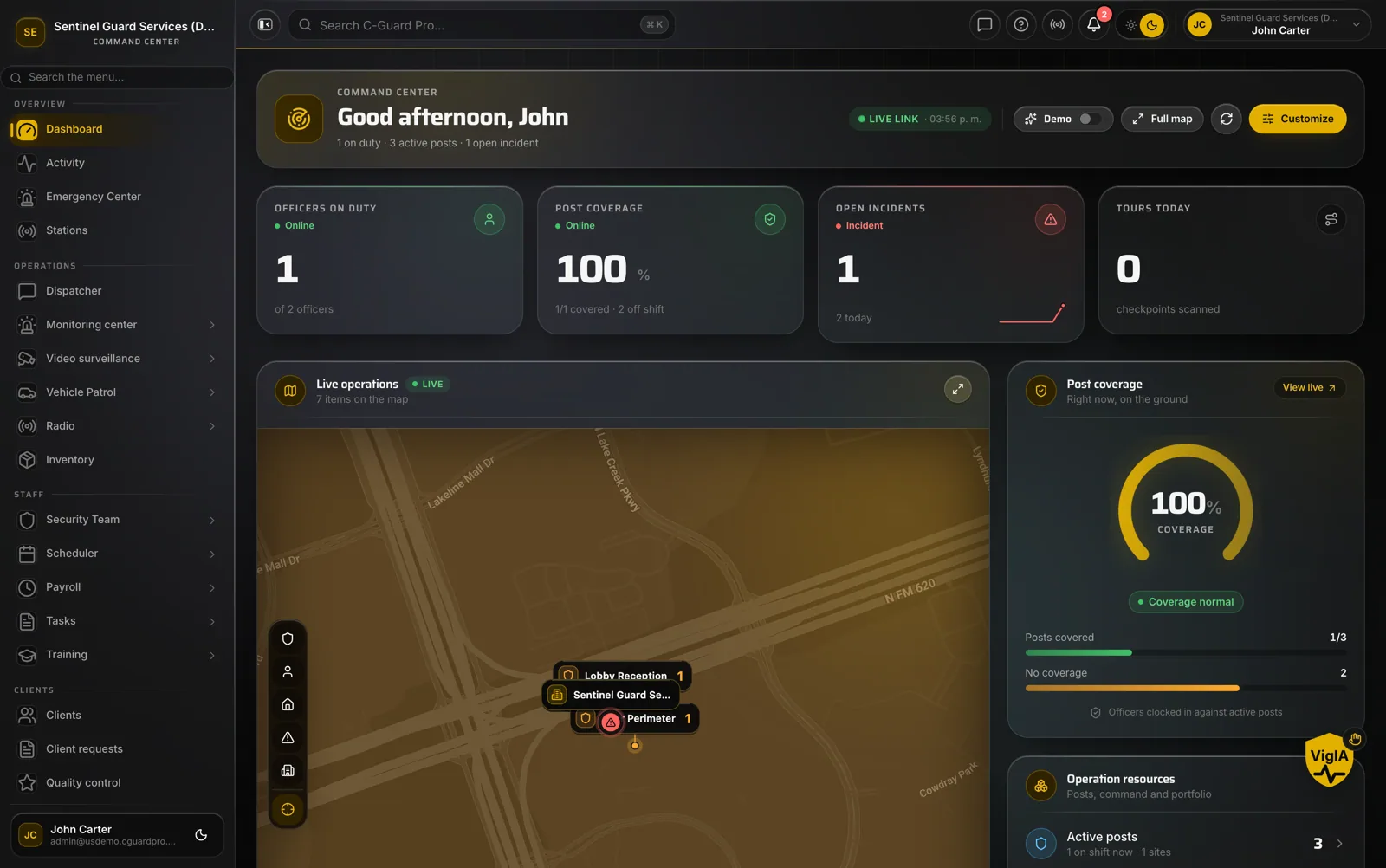 Whether you choose a fixed post or a patrol route, you should be able to see coverage in near real time, not learn about gaps a month later.
Decide by risk, then by budget
Start with risk, not price. Price is a constraint you apply afterward.
Ask yourself what happens in the gap between patrols. If your site holds high-value or dangerous assets, sees frequent incidents, has people on site after hours, or would suffer serious harm from even a short unmonitored window, the gaps in a patrol are the whole problem. That points toward a fixed presence, at least during your high-risk hours.
If your site is empty and locked overnight, holds nothing that draws determined intruders, and mostly needs a visible, unpredictable presence to keep opportunists away, a well-run mobile patrol may cover the real risk at a far lower cost.
A few honest questions to work through with your provider:
- When is my risk highest? Many sites need a fixed guard only during specific windows and a patrol for the rest.
- What is the cost of the thing I am preventing? Compare it against the cost of coverage. Protecting a warehouse of goods justifies more than watching a fenced parking lot.
- How fast can help arrive if something happens between patrols? If response is slow, the case for on-site presence grows.
- Is the deterrent effect enough? For some properties, the visible fact of unpredictable patrols does most of the work.
The hybrid most buyers overlook
The real answer is often neither extreme. A fixed guard during your high-risk hours, say overnight or during a specific operational window, combined with mobile patrols the rest of the time, frequently matches protection to actual risk far better than an all-or-nothing choice. Do not let a provider frame it as a binary if your risk is not evenly spread across the day.
The proof to demand, either way
Here is the part buyers underuse: whichever model you choose, you should be able to verify you are getting it. This is where a fixed post and a mobile patrol converge on the same requirement.
For a mobile patrol, the classic failure is the “drive-by” that never really happened, or a rushed check that skipped half the site. Insist on GPS-tracked patrols so you can confirm the guard was physically at your property, not just logged as present. Pair that with a QR-based guard tour that requires the guard to scan checkpoints around your site, and a two-minute drive-by becomes impossible to fake, because the record shows exactly which points were reached and when.
For a fixed post, the equivalent proof is attendance and internal patrol completion: was the guard actually on shift for the full window, and did they complete their rounds of the building rather than sitting at the desk all night? The same tools apply.
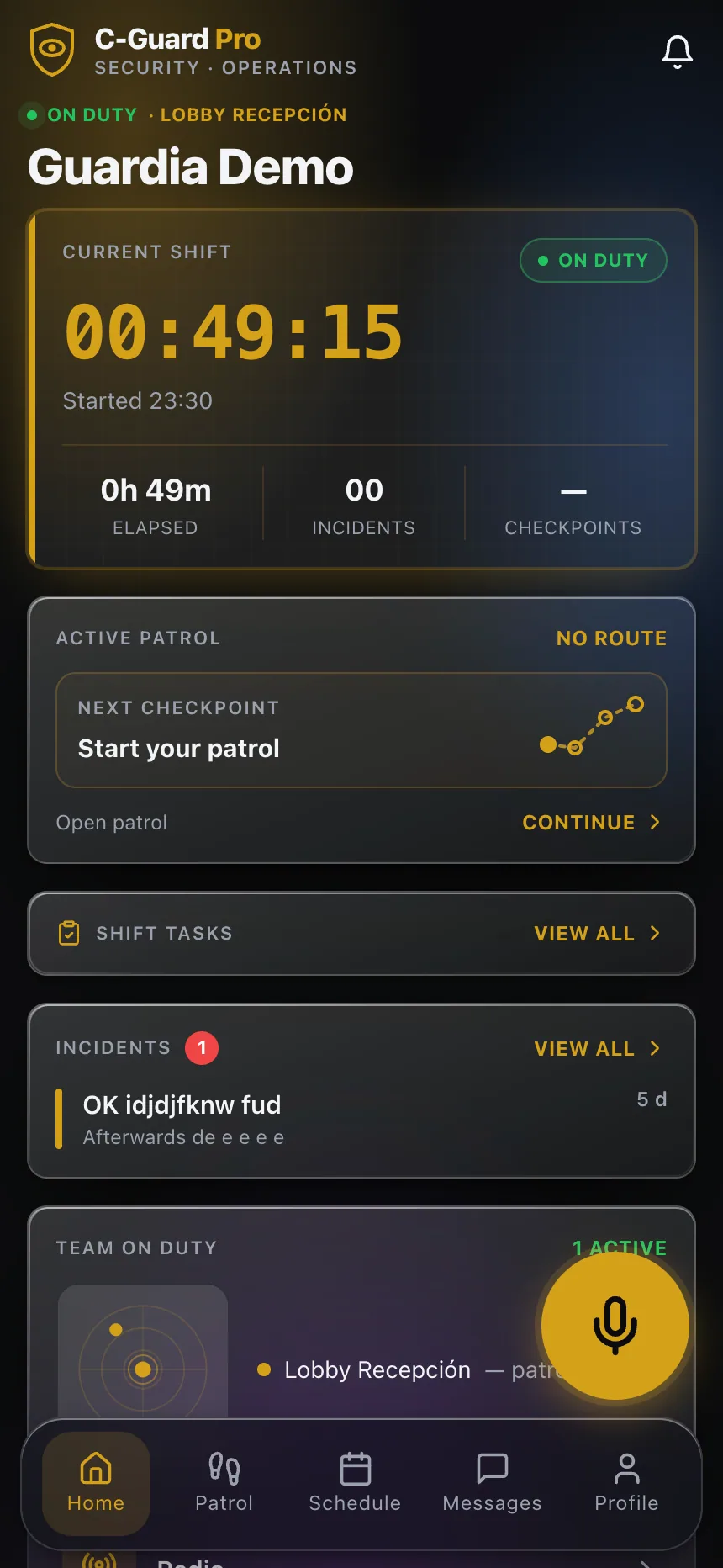 Guards check in, complete rounds, and log location from the app, so “we covered it” is backed by a timestamped trail, not a promise.
Questions to put to your provider
Before you sign for either model, get concrete:
- For a patrol: How many visits per night, at what intervals, and how do you prove each one happened? Are visit times randomized so they cannot be predicted and gamed?
- For a fixed post: How do you verify the guard is present and alert for the whole shift, and that they patrol the interior rather than staying put?
- For both: Can I see coverage myself in near real time, or do I have to wait for a report?
A provider confident in their delivery will welcome these questions. One that gets defensive about GPS or checkpoint proof is telling you how their patrols actually run.
Match the model to the risk, then verify it
The 24/7 guard vs mobile patrol decision comes down to how much of your day carries real risk, what a lapse would cost you, and what your budget can sustain. Most buyers land on a fixed presence for their vulnerable hours and patrols for the calm ones, and the smartest ones insist on GPS and checkpoint proof so the coverage they pay for is the coverage they actually get.
If you want to see what verifiable coverage looks like from the buyer’s side, take a look at the CGuardPro client portal and the live picture it gives you of every shift and patrol.