An officer finds a duffel bag under a bench in a lobby, no owner in sight, and the first instinct almost every untrained person has — officer or not — is to pick it up, unzip it, and look inside to figure out whether it’s a problem. That instinct feels responsible. It’s also exactly the behavior a suspicious package protocol HOT method for security guards exists to override, because the moment you’ve moved or opened the item to check, you’ve already done the one thing that turns an unattended bag into a worst case if it happens to be one.
The H.O.T. method is a simple three-question framework — Hidden, Obviously suspicious, Typical — for assessing an item without touching it. It gets taught as an acronym, which makes it sound like a memory trick, but the acronym isn’t really the point. The point is training officers to do the opposite of what feels natural: stop, look, back off, and hand the decision to someone else.
The Suspicious Package Protocol HOT Method for Security Guards, and Why the Natural Response Is Wrong
Most officers who find an unattended item aren’t panicking — they’re trying to be useful. Checking the bag feels like due diligence, the same instinct that makes someone pick up a dropped wallet to see whose it is. The problem is that a suspicious item is, by definition, one you can’t identify the contents of from the outside, and the entire value of any distance is lost the second you close it.
This is why suspicious package training has to work against instinct rather than with it. Telling an officer “don’t touch it” once, during onboarding, competes against years of the opposite habit — see something out of place, deal with it. The H.O.T. framework works because it gives the officer a concrete set of questions to run through instead of an urge to act, which is a much easier thing to follow under stress than a general instruction to “stay calm.”
What the three questions actually assess
Hidden. Is the item placed somewhere that suggests it was deliberately concealed — behind a planter, under a stairwell, tucked against a wall out of normal sightlines — rather than left in an obvious spot where an owner would expect to find it again? An item in the middle of a walkway is far more likely to be an honest mistake than one pushed into a gap where it wouldn’t be seen.
Obviously suspicious. Are there visible indicators that go beyond “unattended” — wires, an odor, leaking substance, excessive tape, or anything that doesn’t match what the container looks like it should hold? This question is deliberately about what’s visible from a safe distance, not what you’d learn by opening it.
Typical. Is this the kind of item you’d expect to see in this location, left by the kind of people who use this location? A single unattended laptop bag in an office lobby at 5 p.m. reads very differently from the same bag left overnight in a stairwell of a building that closed hours earlier. Context does most of the work here — the same object can be routine in one setting and worth escalating in another.
None of these questions requires touching the item, opening it, or getting close enough to read a label. That’s deliberate. An officer trained to run through Hidden, Obviously suspicious, and Typical from ten feet away has a structured reason to keep their distance instead of an unstructured urge to get closer and look.
Assessing is not deciding — that part matters
The H.O.T. framework tells an officer whether an item warrants concern. It does not tell the officer what to do about it beyond one thing: don’t handle it, and get it in front of someone with the authority and training to make the real call. That’s the part of the training that gets glossed over when the acronym becomes the whole lesson. An officer who correctly identifies an item as hidden, obviously suspicious, and out of place, then decides on their own to move it to a safer corner “just in case,” has undone the entire point of the exercise.
The assessment exists to inform an escalation decision — clear the immediate area, notify dispatch and the client contact, and depending on the site’s post orders, contact law enforcement or the item’s owner if that’s a realistic first step for a genuinely low-concern find. What the officer should never do is treat a positive assessment as license to act unilaterally. This is where clear post orders matter as much as the training itself — an officer needs to know, before the moment happens, exactly who gets called first for this specific site, because that’s not a decision to work out in real time while standing near an item you’ve just decided might be a problem.
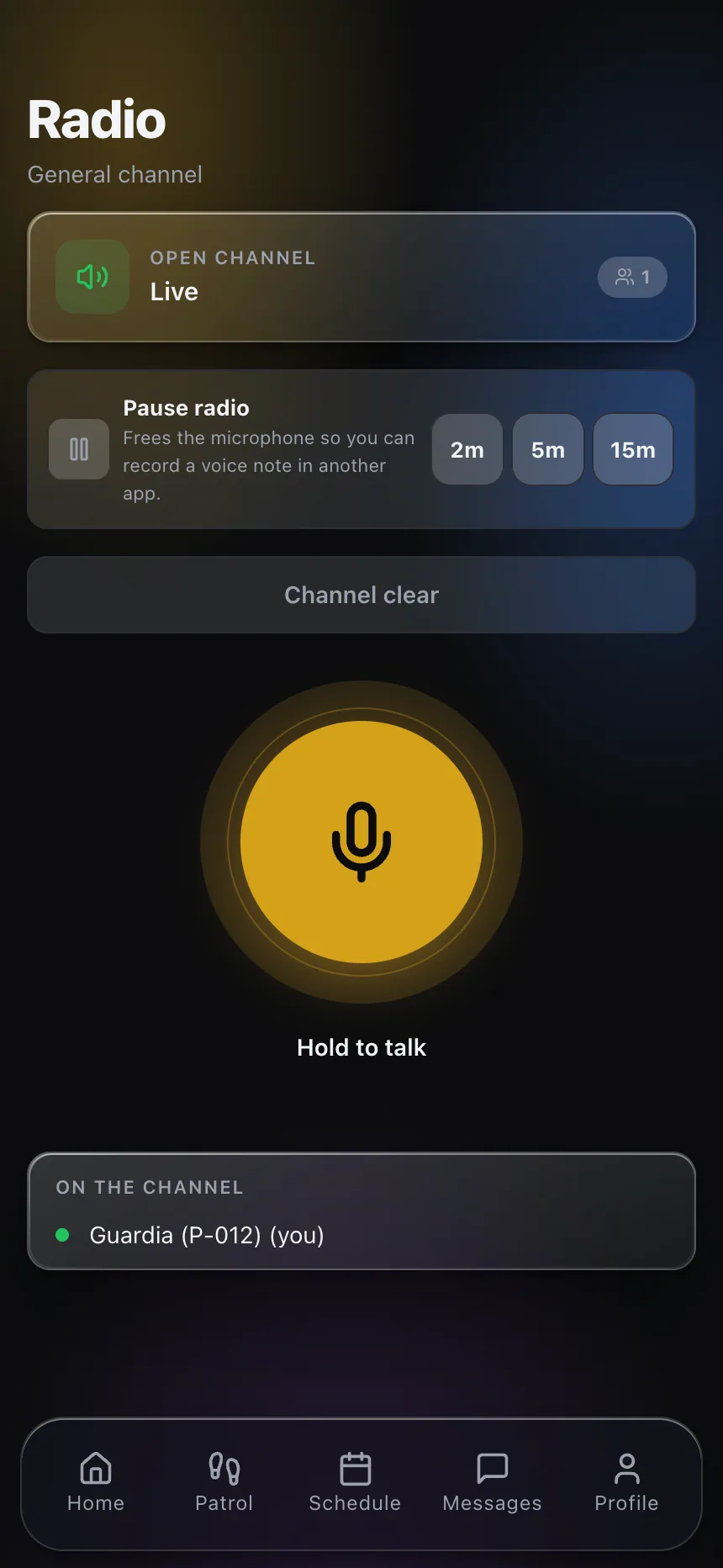
Communication in that first minute also has to be calm and specific. “There’s a bag under the bench in the east lobby, no owner visible, I’m clearing the area and standing by” gives dispatch something to act on immediately. A vague call that the situation is “wild” or “extremely concerning” without describing what was actually seen forces dispatch to ask follow-up questions while the officer is standing closer to the item than necessary. Reliable radio communication between the officer on scene and dispatch is what turns a correct assessment into a fast, appropriate response instead of a slow one.
Building this into training that actually sticks
A single slide in onboarding covering the H.O.T. acronym does not produce an officer who reliably backs away from a bag under stress. What does is repetition through scenario walk-throughs — describing a specific find, having the officer verbalize the three questions out loud, and practicing the radio call before it’s ever needed for real. Post orders should spell out exactly who the officer contacts for that specific site, in what order, because “call it in” means something different at a hospital lobby than it does at a warehouse loading dock.
If your post orders don’t currently include a clear unattended-item and suspicious-package escalation path by site, that’s a gap worth closing before an officer has to improvise one. Our post orders template is a starting point for building that structure into every post’s documentation rather than leaving it to memory.
The value of the H.O.T. method was never really the mnemonic. It’s that it gives an officer something concrete to do with their hands and their attention besides reaching for the item — and a reliable way to hand the real decision to the person whose job it actually is. If you want to see how CGuardPro supports incident logging and dispatch communication for moments like this, explore the platform or get in touch.