The clues that a security contract will disappoint you are usually visible during the sales process — you just have to know what to watch for. Providers are on their best behavior when they’re courting you, so the red flags when hiring a security company aren’t dramatic; they’re small evasions, vague answers, and things a good provider offers freely that a weak one avoids. If the courtship phase already feels like pulling teeth, the relationship after you sign will be worse.
The red flags that predict a bad contract
1. Vague pricing with no breakdown
A single hourly number with no explanation of what’s inside it is a warning. What are officers actually paid? How much goes to supervision, training, insurance, and overhead? When a provider won’t break it down, it’s often because the wage is thin — and a poorly paid officer is a distracted, short-tenured one. Cheap bids frequently hide exactly the costs that determine whether coverage is any good.
2. No technology, or hand-waving about it
Ask how you’ll see what happens on your site, and watch how they answer. A confident provider walks you through a client portal where you can view live status, patrols, and incidents. A weak one talks about “detailed reporting” without showing you anything, or promises a monthly email summary. The gap you feel in that moment doesn’t close after you sign — it widens.
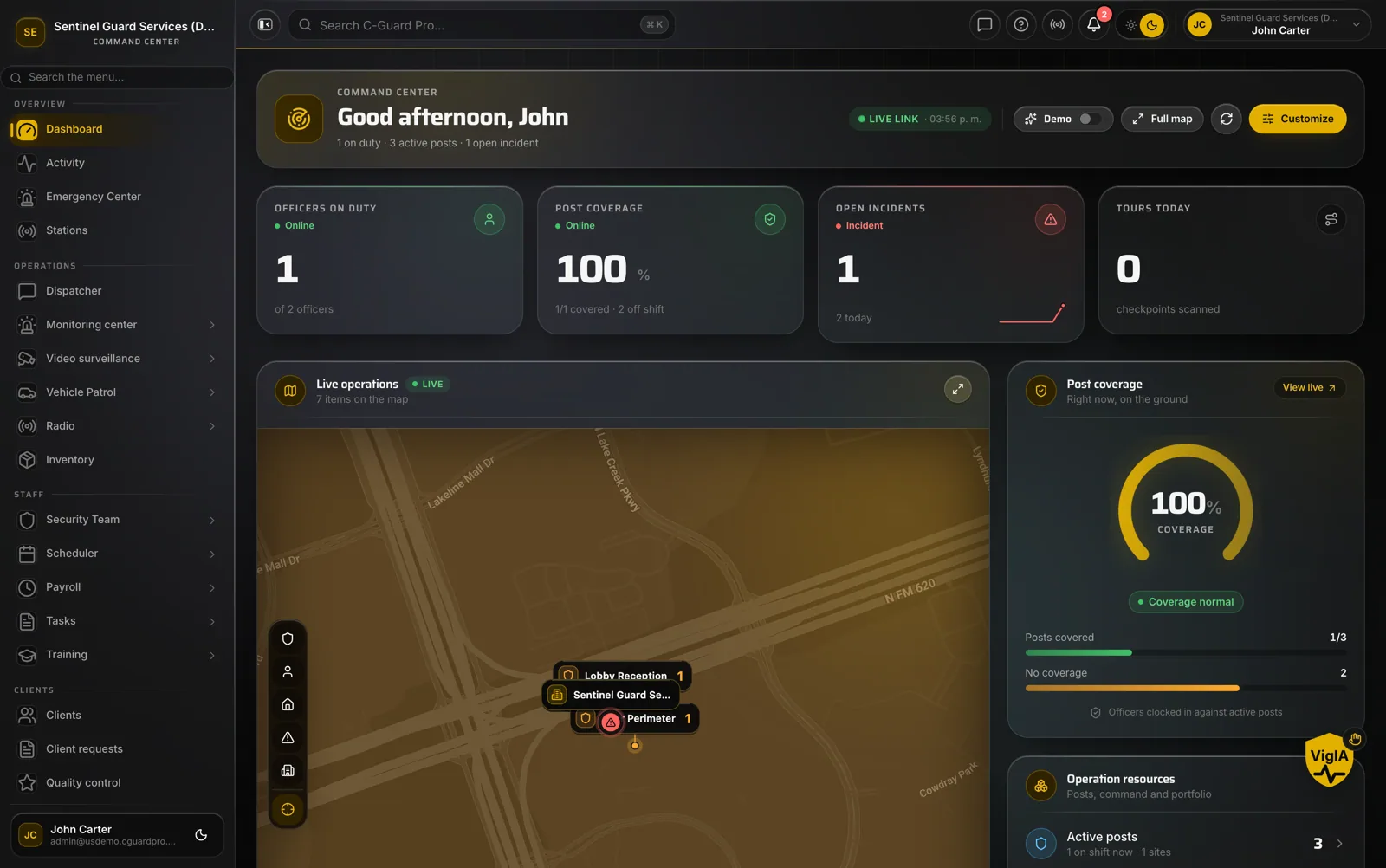 If a provider can’t show you a live view like this during the pitch, you’ll be buying blind after you sign.
3. Patrols “proven” on paper
If the answer to “how do you verify patrols?” is a clipboard the officer signs at the end of the shift, treat that as fiction. Paper logs can be filled in from a chair. A serious provider uses a QR/GPS guard tour system that stamps each checkpoint with time and location. No verifiable patrol proof is one of the clearest red flags when hiring a security company, because it means you can never actually confirm the work you’re paying for.
4. Reluctance to share references
A provider proud of their work offers references before you ask — including a long-tenured client and one in your sector. Hesitation, a single carefully-coached contact, or “our clients are confidential” for everything are all telling. The best providers know their clients are their strongest sales asset.
5. Dodging the insurance question
If a provider gets vague when you ask about general liability, workers’ comp, and bonding — or hands over a certificate but resists you verifying it with the insurer — slow down. Coverage requirements vary by state and change over time; confirm the specifics with a qualified advisor (this isn’t legal advice). But the evasion itself is the red flag, regardless of the details.
6. No answer for the 3 a.m. call-off
Ask what happens when a scheduled officer doesn’t show at 3 a.m. A provider running real guard scheduling software can describe the backfill process and the window they commit to. A provider who says “we handle it” is telling you your post will sometimes sit empty.
7. All promise, no proof of response
“We respond immediately” is worth nothing if response isn’t recorded. Ask whether duress and incidents are timestamped and logged. A provider with a proper panic button flow and same-day reporting can show you the record; one who can’t is asking you to take response on faith.
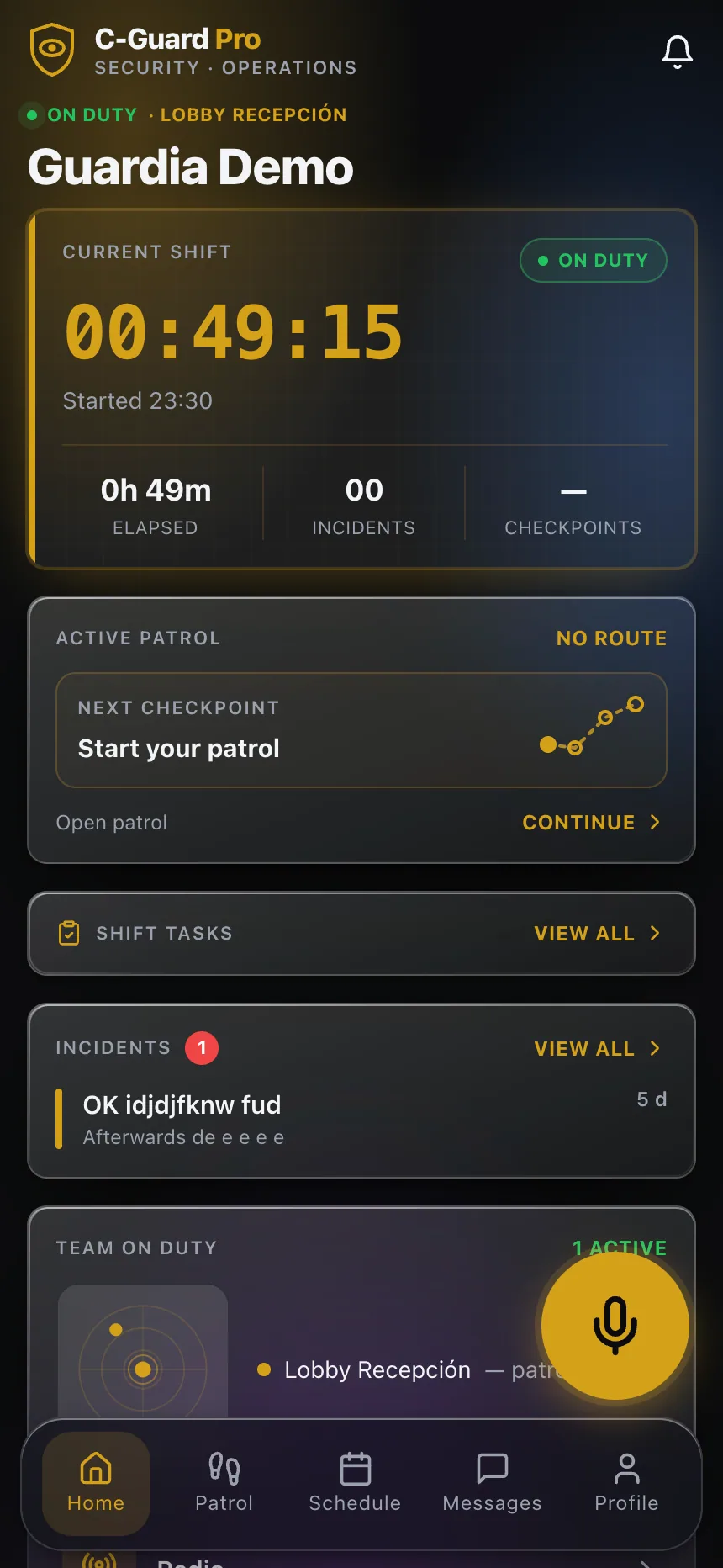 A provider who can show you the officer’s app — real check-ins, real tasks — is one whose promises have proof behind them.
Turn the red flags into a test
The counter to every red flag is the same: ask to see it work. Don’t accept descriptions — request demonstrations.
- Show me the client portal, live, with an anonymized account.
- Show me a real logged incident, from the field, with timestamps.
- Show me how a patrol is proven, not described.
- Walk me through a real call-off and how the post got covered.
A provider built on visibility welcomes these tests and passes them easily. A provider hiding thin service gets uncomfortable — and that discomfort is the most honest data you’ll get in the entire sales process.
Trust the pattern, not the pitch
Any single red flag might have an innocent explanation. A pattern of them — vague pricing, no visible technology, paper patrols, dodged insurance questions, no plan for a call-off — is a forecast. It tells you exactly how the contract will feel once the sales team hands you off to operations.
Take the salesperson’s enthusiasm as a given and go looking for what they’d rather not show you. The providers who have nothing to hide make that easy.
See what a provider should be able to show you in the client portal, and use it as your benchmark in every sales conversation.