A shoplifting call goes out and three officers key up at once, all trying to relay the same thing, and the one detail dispatch actually needed — which exit the subject is heading toward — gets lost under the overlap. Nobody on that channel did anything wrong on purpose. They just never learned, or never kept up, the habits that make a shared radio channel usable under pressure. Security guard radio etiquette isn’t a memorization problem. Most officers who cause channel chaos know the ten-codes fine. What they haven’t built is the muscle memory around timing, brevity, and restraint that keeps a channel functional when three things are happening at once.
The channel doesn’t break from missing codes
Ask any field supervisor what actually clogs a radio channel during a real event and the answer is rarely “the officer used the wrong code” or “they didn’t know the phonetic alphabet.” It’s simpler and more mechanical than that: someone keyed up before listening, someone repeated themselves louder instead of asking for a repeat, someone held the channel open with a story instead of a report. A ten-code glossary fixes vocabulary. It does nothing about the sequencing problem, and the sequencing problem is what actually takes a channel down when it matters.
This is worth separating clearly, because a lot of radio training time gets spent on the wrong half of the problem. Codes are easy to test and easy to post on a laminated card. Discipline is harder to teach because it only shows up as a habit under load, and by the time it’s missing, the channel is already unusable for the officer who has something urgent to say.
What proper two-way radio procedure actually looks like on a real channel
These are the habits that separate a channel that works from one that doesn’t. None of them require new equipment or a longer glossary.
- Listen before keying up. A half-second of silence check prevents the two-second collision that follows when two officers transmit on top of each other.
- Think the sentence before you press the button, not while it’s already open. Dead air with the channel keyed blocks everyone else exactly as much as talking does.
- State who you are and who you’re calling first. “Dispatch, unit four” tells the listener whether to keep listening before the content even starts.
- Keep the transmission to one idea. A report with three unrelated updates stapled together is three transmissions pretending to be one, and the middle one gets missed.
- Say “say again” instead of repeating louder. Volume doesn’t fix a garbled signal or a word lost to static; a clean repeat does.
- Wait for the acknowledgment, not just for the sound of your own voice ending. Talking into silence and assuming it landed is how instructions get missed.
- Give position and direction, not narrative. “Northeast corner of the lot, subject moving toward the loading dock” beats a paragraph of what led up to it.
- Use plain language when precision matters more than brevity. A code that half the channel doesn’t remember correctly is worse than the plain phrase it replaces.
- Step off the channel for anything that isn’t operational. Personal chatter, jokes, and side conversations belong off the air, not squeezed between real traffic.
- Assume every word is heard by someone you didn’t intend it for, including the client. The channel is not a private line, and it often is not even private to your own company.
The channel is not a private conversation
That last habit deserves its own paragraph, because it’s the one that causes the most damage when it’s ignored and the least amount of training time is spent on it. A radio channel shared across a shift, a site, or a client account is functionally a party line. Complaints about a supervisor, commentary about a client’s staff, or venting about a slow night all travel exactly as far as the operational traffic does — to every radio on that channel, and depending on how the system is set up, potentially into a recorded log. An officer who wouldn’t say something in front of the property manager should not say it on a channel the property manager’s own security desk can sometimes monitor. This isn’t a hypothetical: client complaints about “unprofessional radio traffic” are one of the more common ways an account manager first learns a channel has drifted.
Enforcing it without a supervisor riding every transmission
None of this holds up if enforcement means a field supervisor listening to every exchange and correcting officers in real time — that doesn’t scale past a couple of sites and it makes the supervisor the bottleneck. What works instead is putting radio discipline where officers already look for their job’s rules: in the post order for that specific site, stated as a short, concrete expectation rather than a general reminder to “use the radio professionally.” An officer who reads “acknowledge all dispatch calls within the transmission, keep radio traffic operational only” in their actual post orders treats it as part of the job, not as a suggestion from a supervisor who isn’t there tonight.
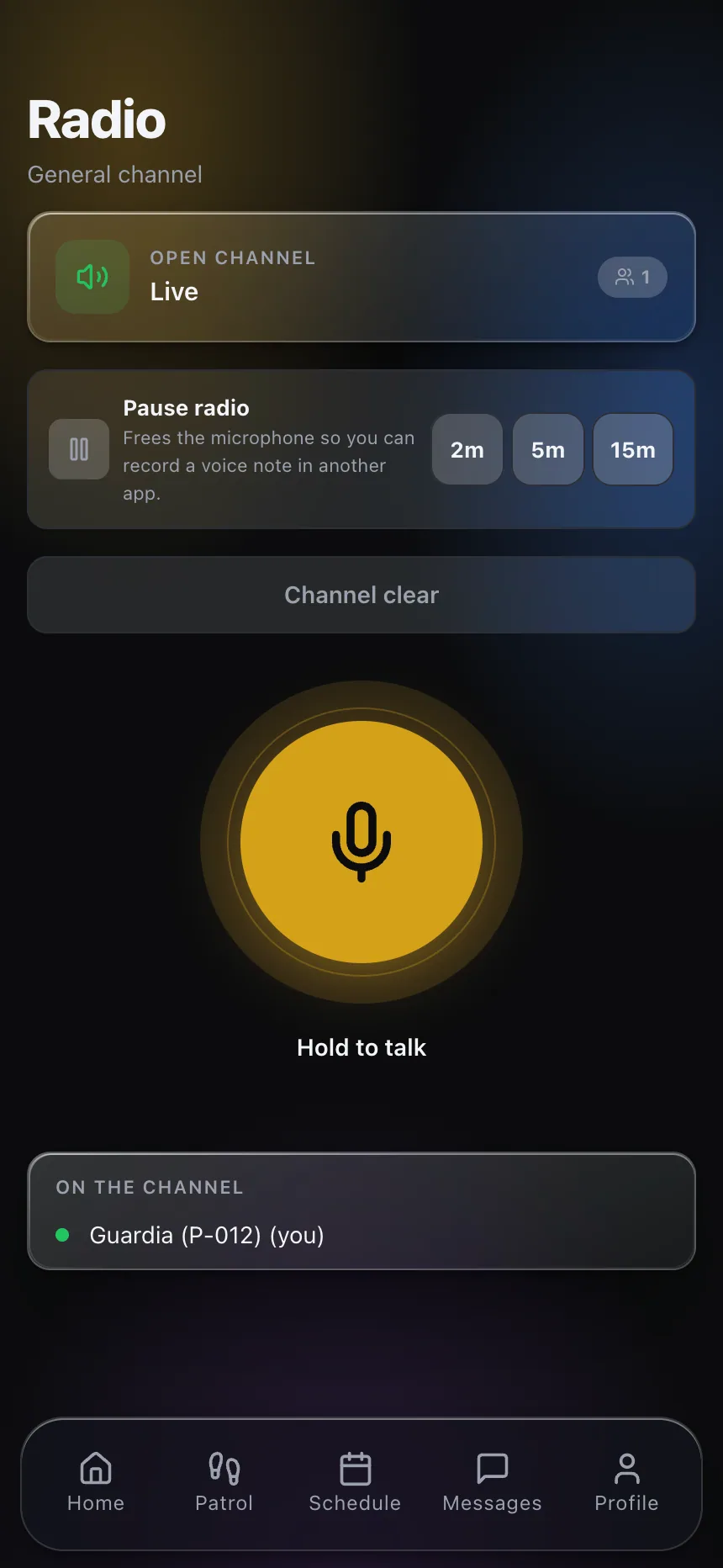
The other lever is the channel itself. A dispatch setup where every officer reaches the same push-to-talk line instantly, without dialing or waiting for a callback, removes a lot of the pressure that causes bad habits in the first place — officers stop crowding the channel with repeats and check-ins when they trust the line works and someone is listening. Discipline is easier to hold onto on a channel that behaves predictably than on one where officers have learned, from experience, that they might need to call twice to be heard.
None of these ten habits require a rewrite of how your company runs radios. They require deciding they matter enough to put in writing, checking new officers on them the same way you’d check any other post-specific skill, and building your communication tool so following the habits is the easy path rather than the annoying one.
Where new officers pick up the bad habits
Most channel discipline problems trace back to the same source: a new officer’s first exposure to the radio is listening to whoever happens to be on shift that week, not a deliberate walkthrough of how the channel is supposed to work. If the veteran officers on a given site are sloppy, the new hire learns sloppy, because that’s the only model available. This is why radio habits tend to be site-specific in practice even when the company’s stated policy is the same everywhere — a well-run post trains its habits into every new arrival by example, and a loosely run one lets bad habits propagate the same way.
The practical fix is to treat radio procedure as something a new officer is actually checked on during their first shifts on a post, the same way a supervisor would check that someone knows the post’s access-control procedure or its emergency contacts. A five-minute conversation at the start of a new assignment — how we key up here, what stays off this channel, who to call if the dispatch line seems dead — does more to prevent channel chaos six months later than any amount of after-the-fact correction once bad habits are already set.
If you want to see how post-specific radio expectations and live push-to-talk radio communication sit together in one app, alongside the rest of a site’s post orders, explore CGuardPro or get in touch.