An officer’s phone rings at 1 a.m. because the graveyard shift at a warehouse called in sick, and by 1:20 that officer is dressed and driving. Whether that stretch of time between the call and the arrival gets paid — and how much of the time before the call even gets paid — depends on a distinction a lot of scheduling teams treat as interchangeable and isn’t: on-call versus standby. Getting on-call vs standby pay security officers classification wrong is rarely noticed the night it happens; it’s noticed months later, in a complaint.
On-Call vs Standby Pay Security Officers: The Real Test
Companies use the two terms as synonyms because in casual conversation they mean the same thing — an officer who might get called in. But the classification that actually determines pay obligations doesn’t turn on what you call the arrangement. It turns on how restricted the officer’s time actually was while waiting for the phone to ring.
An officer who has to stay within a fifteen-minute radius of a specific site, can’t have a drink, has to keep the phone on a specific setting, and has to be in uniform-ready condition the whole time is in a materially different position than an officer who’s simply told “keep your phone on, we might call.” The first officer has effectively surrendered the evening. The second one went to a movie and missed the first call because the theater was loud.
That distinction — not the label on the schedule — is what determines whether the waiting time itself should be compensated, separate from the time actually worked once the officer arrives. Getting it backward, by calling a highly restrictive arrangement “standby” because that’s what the software field is labeled, is exactly the kind of gap that turns into a wage and hour complaint months later when an officer who felt tethered the entire night compares notes with one who wasn’t.
Why the distinction gets muddled in practice
Scheduling software and staffing agreements often use “on-call” and “standby” as fixed dropdown options without defining what either one requires of the officer at that specific site. A client contract might specify “one officer on standby overnight” without either party spelling out whether that officer can leave the property, sleep, or drink a beer with dinner — and the actual restrictions imposed in practice, not the word used in the contract, are what a wage claim will look at.
The safer approach is to write down, per post and per shift, exactly what an officer on an on-call or standby rotation is and isn’t allowed to do while waiting: how far they can travel, how quickly they must respond, whether they can engage in other paid work, whether they need to remain sober and dressed. That written restriction — not the label — is the actual policy, and it should be something you can produce if anyone ever asks how the classification was decided.
Where this actually costs a company money
The failure mode isn’t usually the officer who’s paid too much. It’s the officer classified as “standby, unpaid until called” who was, in practice, restricted enough that a wage claim later succeeds in arguing the waiting time itself should have counted as hours worked. By the time that claim surfaces, it’s rarely about one officer or one night — it’s about however long that classification was applied across the roster, because a scheduling pattern, once set, tends to repeat itself unexamined for months.
The other quieter cost is scheduling confusion that has nothing to do with pay and everything to do with coverage: a supervisor believes an officer is “on standby” and therefore reachable within minutes, while the officer believes they’re “on-call” in the loose sense and free to be unreachable for a stretch. When the phone actually needs to be answered, that mismatch is what turns a covered callout into an uncovered post.
The question that should be asked before the label is chosen
Before anyone decides what to call an arrangement, the honest question is simpler than the terminology: could this officer reasonably use this time as their own? If the answer is genuinely yes — they can run errands, sleep, have dinner out, respond within a loose window — that looks like the less restrictive end of the spectrum. If the answer is no — they have to stay near the site, stay sober, respond in minutes, remain dressed — that looks like the more restrictive end, regardless of which word ends up on the schedule.
Keeping a written record of which restrictions applied to which shift, tied to the actual roster rather than a verbal understanding between a supervisor and an officer, is what lets a company demonstrate later that the classification matched the reality at the time — not a reconstruction built after a complaint is already filed.
Making the classification visible on the schedule itself
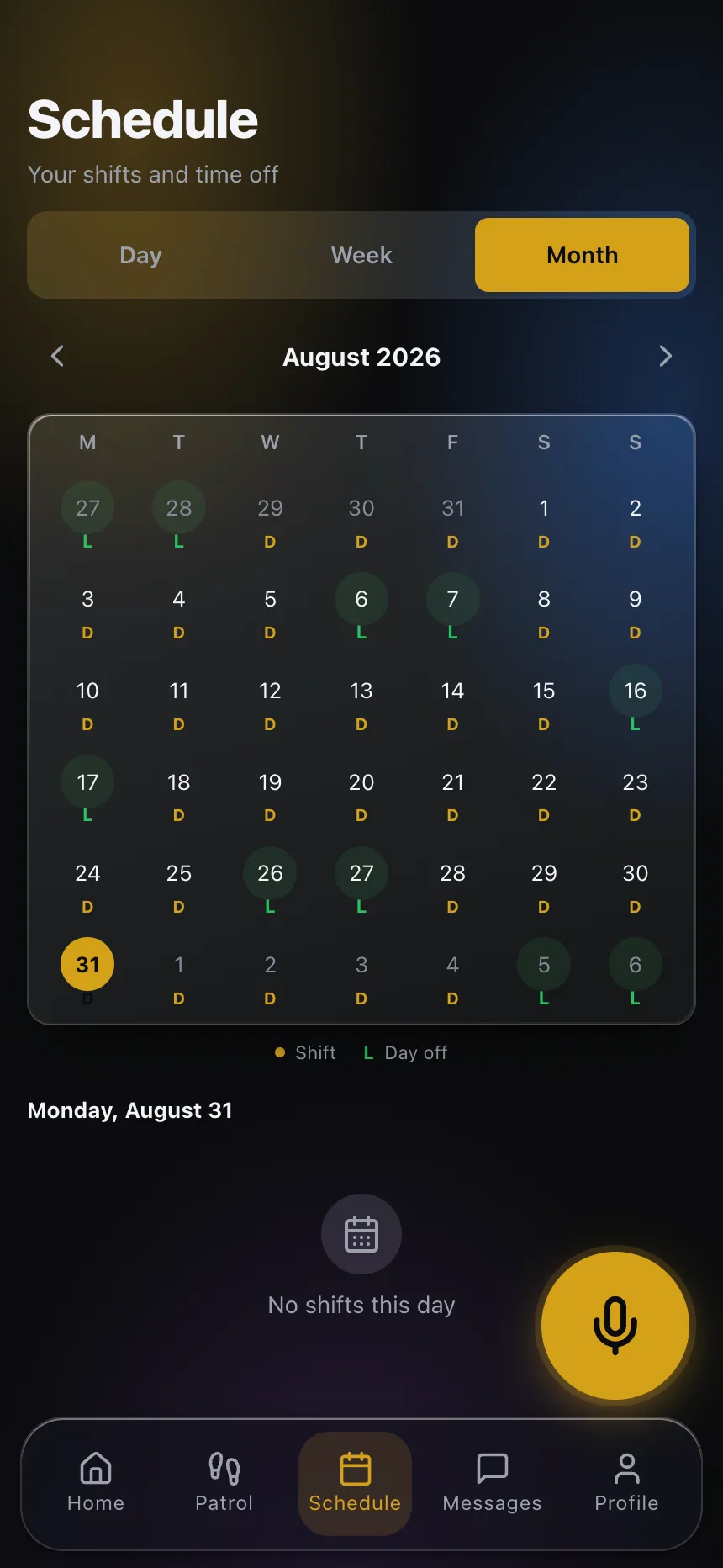
The least reliable place to keep this distinction is a policy document nobody re-reads once a schedule gets busy. Scheduling software that lets you tag a shift as on-call or standby as a distinct assignment type — with the specific restrictions attached to that tag, not just a label — makes the classification something a supervisor sees every time they build a roster, rather than something they’re trusting themselves to remember correctly under pressure. It also produces a record, tied to the actual schedule rather than a separate memo, of which restriction applied on which night, which is exactly the kind of documentation that matters if a classification is ever questioned months later.
A note on the legal side
Wage and hour rules covering on-call and standby time — what must be paid, at what rate, and under what conditions — vary by state and by jurisdiction, and they can also be shaped by the specific contract language between the staffing company and the client. Nothing in this article states what any specific law requires. Verify how these classifications apply to your operation with your state labor agency, the appropriate federal authority, and with employment counsel before setting policy — this is a description of a scheduling and documentation practice, not legal advice.
Building the habit into the schedule, not into a memo
A policy memo that defines the difference between on-call and standby is only as good as whether anyone checks it against a real schedule six months later. The more durable fix is building the restriction into how shifts get labeled and assigned in the first place, so that a supervisor filling a callout slot sees, at the moment of assignment, what that slot actually requires of the officer — not a category they have to remember from a document they read during onboarding.
If you want to see how on-call rotations and shift assignments get tracked against a real roster, explore CGuardPro or get in touch.