Ask an operations manager running six client sites and one running sixty what their biggest headache is, and you’ll get two different answers to what sounds like the same question — the kind of gap that any security guard scheduling software multiple locations tool has to solve for, and most don’t. The six-site operator will talk about individual coverage gaps — a callout on a Tuesday, an officer who no-showed, a shift that needs filling in the next hour. The sixty-site operator will talk about something else entirely: not being able to see, at a glance, which of those sixty sites has a problem right now, because the volume of individual events has outgrown any one person’s ability to track them by memory and a phone.
That’s the part owners underestimate when they’re scaling. The jump from a handful of sites to dozens isn’t a straight line where everything just gets “more of the same, but bigger.” It’s a point where the bottleneck moves. Below a certain site count, the constraint is filling individual shifts — a scheduling problem, solvable with a decent scheduler and a supervisor who knows their officer pool. Above it, the constraint becomes something closer to air traffic control: a single dispatcher or ops manager holding the status of every site in their head at once, and that head has a limit no software license fee changes.
Where the single-site mental model breaks
A company running a few sites can operate on tribal knowledge. The ops manager knows every officer by name, knows which sites run tight and which have slack, and can mentally reconstruct “who’s covering what” without needing a system to tell them. That mental model works fine until it doesn’t — and the failure isn’t gradual, it’s a cliff. Add site number twenty, or forty, and the same manager who used to carry the whole operation in their head is now guessing, or worse, confidently wrong about coverage they haven’t actually verified in days.
The tell that a company has crossed this line is usually a specific kind of incident: a site goes uncovered, or a callout goes unfilled, not because nobody was available to cover it, but because nobody realized there was a gap until the client called to ask where their officer was. That’s not a staffing failure. It’s a visibility failure — the information that a gap existed was somewhere in the system, in someone’s inbox or a supervisor’s notes, but it never surfaced to the person who needed to act on it before the client noticed.
What security guard scheduling software multiple locations actually requires
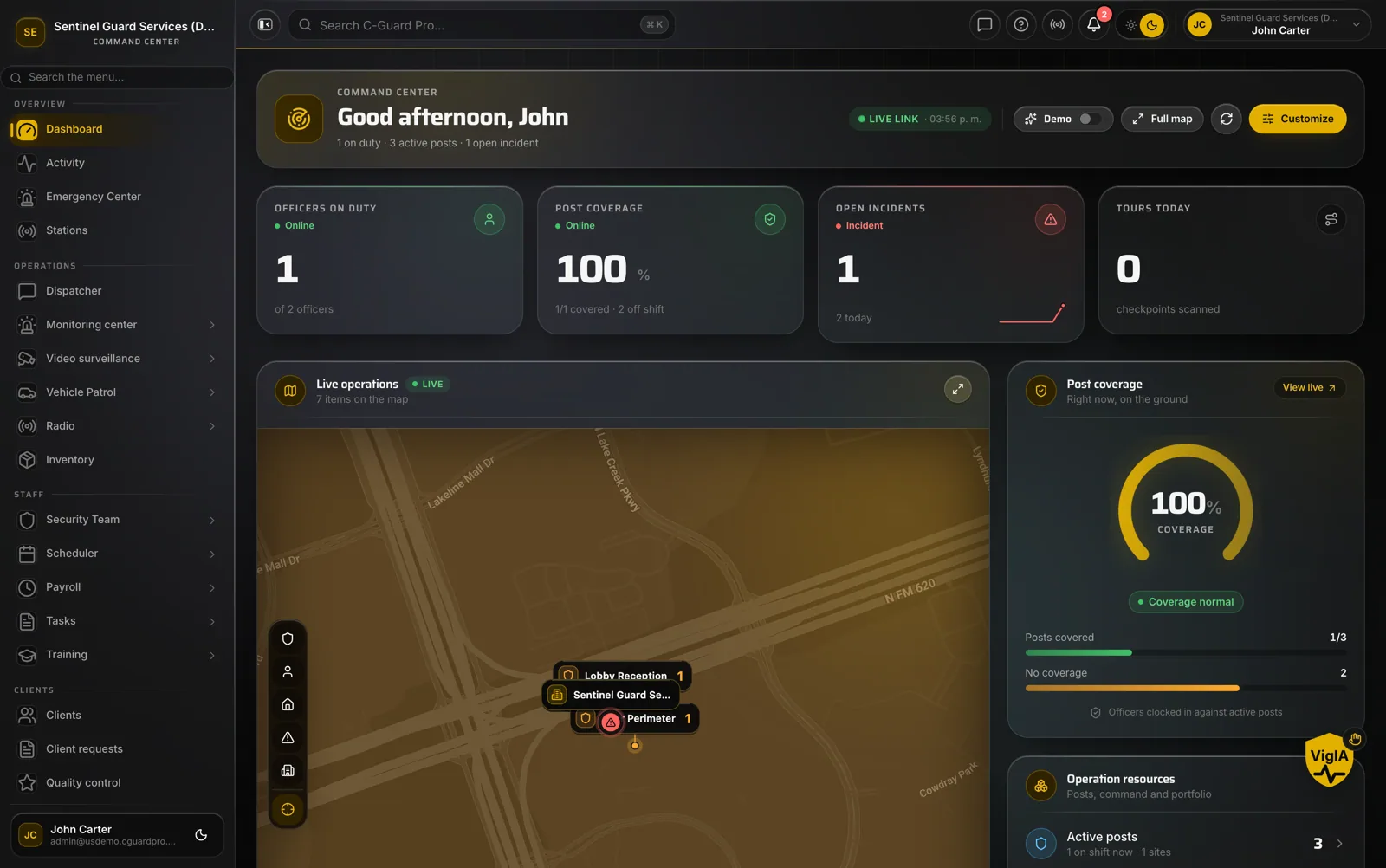
Solving this isn’t about a bigger spreadsheet. A spreadsheet that worked for eight sites doesn’t get better at sixty — it gets unreadable, because the format that made sense for a short list of sites a single person could scan visually becomes noise at scale. What a multi-site operation actually needs is a live, consolidated view: which posts are covered right now, which have an officer checked in and on time, which have a gap opening in the next window, across every site at once, not site by site in separate tabs or separate phone calls to separate supervisors.
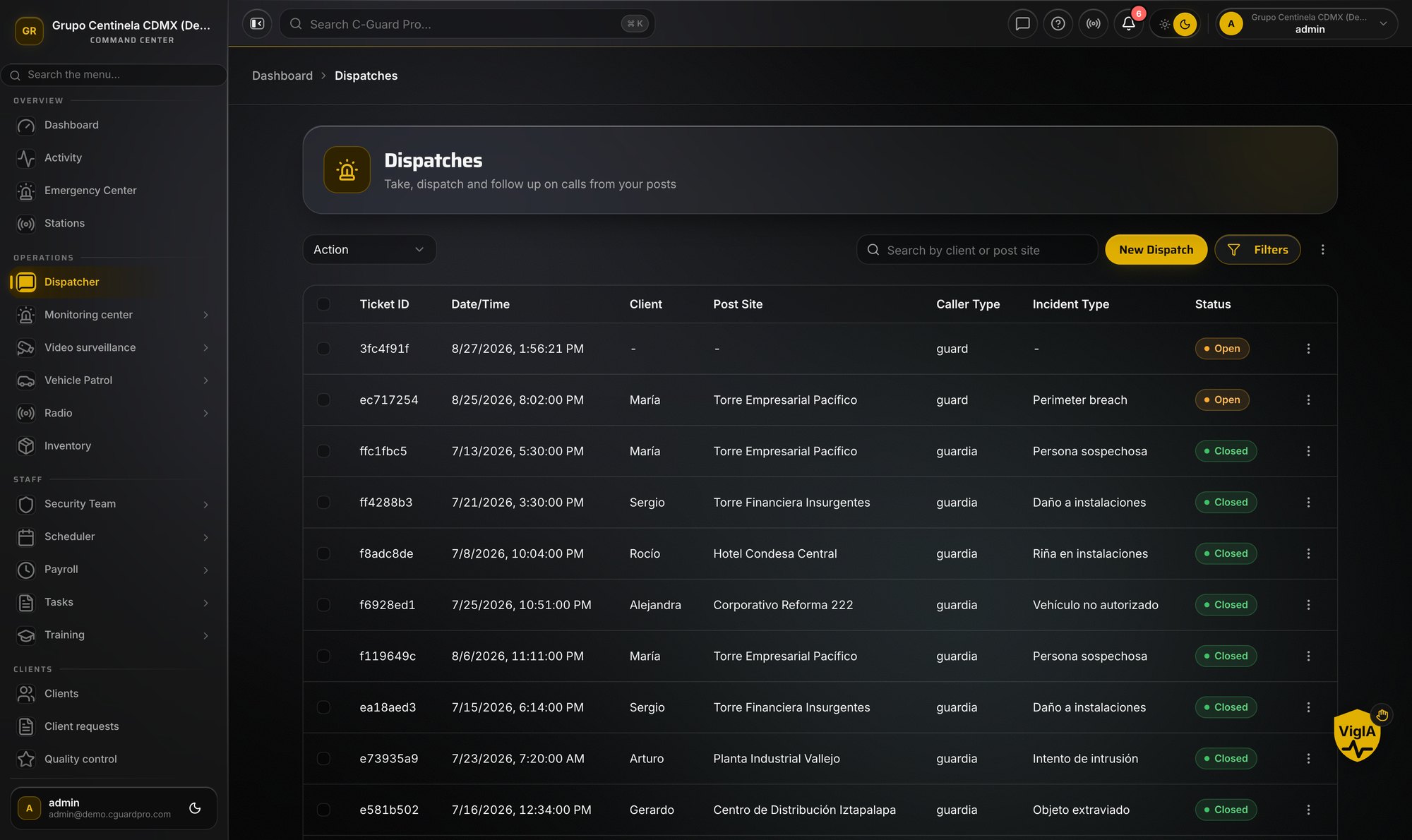
This is also where the shape of dispatch itself changes. A small operation’s “dispatch” is often just the owner’s cell phone. At scale, dispatch becomes a distinct function — one person or a small team whose entire job is watching that consolidated view and reacting to it, which only works if the view itself is trustworthy and current. A dispatch function built on a system that shows real-time coverage, rather than relying on supervisors to call in status updates, is what actually closes the gap between “a shift is uncovered” and “someone knows a shift is uncovered.”
The scheduling problem doesn’t disappear — it changes shape
None of this replaces good scheduling. If anything, scheduling discipline matters more at scale, because a scheduling error that would be caught by an attentive small-team manager can sail through unnoticed across sixty sites unless the system itself flags conflicts, double-bookings, and understaffed shifts automatically. The difference is what scheduling has to plug into: at a handful of sites, a schedule is mostly a standalone document. At scale, it has to feed directly into the live coverage view dispatch is watching, so a schedule gap and a real-time coverage gap are the same piece of data, not two separate things someone has to reconcile by hand.
Reporting and communication scale the same way
Coverage isn’t the only thing that stops scaling linearly. The routine reporting an operation generates — daily activity logs, incident write-ups, post-shift notes — is manageable one site at a time when a single supervisor reads every report from their small handful of accounts. At dozens of sites, that same volume of reports becomes something nobody actually reads cover to cover anymore; it gets skimmed, or worse, filed without review until a client specifically asks about an incident. That’s a quieter failure than an uncovered post, but it carries its own risk — a pattern developing at one site (repeated late clock-ins, a series of minor incidents that individually look unremarkable) goes unnoticed precisely because no one is looking across sites for it.
A reporting system that’s searchable and consistent in format across every site — rather than each supervisor keeping their own version of a log — is what lets an operations manager actually spot cross-site patterns instead of drowning in per-site paperwork. The same goes for incident reporting: a format that’s the same whether the incident happened at site three or site fifty-three is what makes it possible to review incidents in aggregate, rather than site by site, when you’re trying to spot where training or staffing needs attention.
Communication also has to change shape
Radio communication works well for a handful of sites where one channel, or a small number of channels, covers everyone relevant to a given conversation. At significant scale, an all-hands channel becomes noise for anyone not directly involved in a given site’s issue, and a private, per-site channel structure becomes necessary just so a dispatcher can reach the right supervisor without every other site hearing a conversation that has nothing to do with them. Multi-site operations need that channel structure built in from the start, not bolted on once the noise problem is already undermining response times.
None of this means every company should build sixty-site infrastructure from day one — that’s its own mistake, over-engineering a process a six-site operation doesn’t need yet. The point is to recognize the specific moment the bottleneck shifts in your own operation, and to build cross-site visibility before a client finds the gap for you, not after.
If you want to see what a consolidated, real-time coverage view looks like across multiple sites, explore CGuardPro or get in touch.