“Everything’s fine.” That’s the report most buyers get from their guard company — a reassuring phrase and maybe a slide with a big green checkmark. It tells you nothing. Fine according to what? Measured how? You can’t manage a service you can’t measure, and you can’t measure one on vibes. The fix is to agree on a short set of security guard service KPIs up front, and to insist on seeing them live rather than in a polished quarterly deck.
Good KPIs do two jobs. They turn a fuzzy promise (“reliable coverage”) into something you can verify, and they give the provider a clear, fair target. A capable company welcomes them, because measured performance is their best case for keeping your business. A weak one resists, which is exactly why you push.
The KPIs that actually matter
Skip the vanity metrics. Focus on the handful that map directly to whether your property is being protected.
Patrol completion rate
The percentage of scheduled rounds that were actually walked, hitting the checkpoints that matter, at roughly the frequency in your contract. This is the core measure of whether you’re getting active security or just a seated presence. Insist it be backed by time-stamped proof, not a signed sheet.
Response time
How long from an alert — a panic button, an incident, an alarm — to a guard acting on it. And separately, how fast the provider’s management responds when you raise a concern. Slow response is usually the first symptom of a service quietly falling apart.
Incident closure
Not just how many incidents occurred, but how many were logged, handled per your post orders, and properly closed out. A low incident count can mean a safe site — or a site where nobody’s reporting anything. Closure quality tells you which.
Attendance and coverage
Were posts staffed on time, for the full scheduled hours, with no unfilled gaps? Pay special attention to shift changes and overnight, where lapses cluster and exposure is highest.
Keep the list this tight. Four or five KPIs you check consistently beat twenty you’ll never look at.
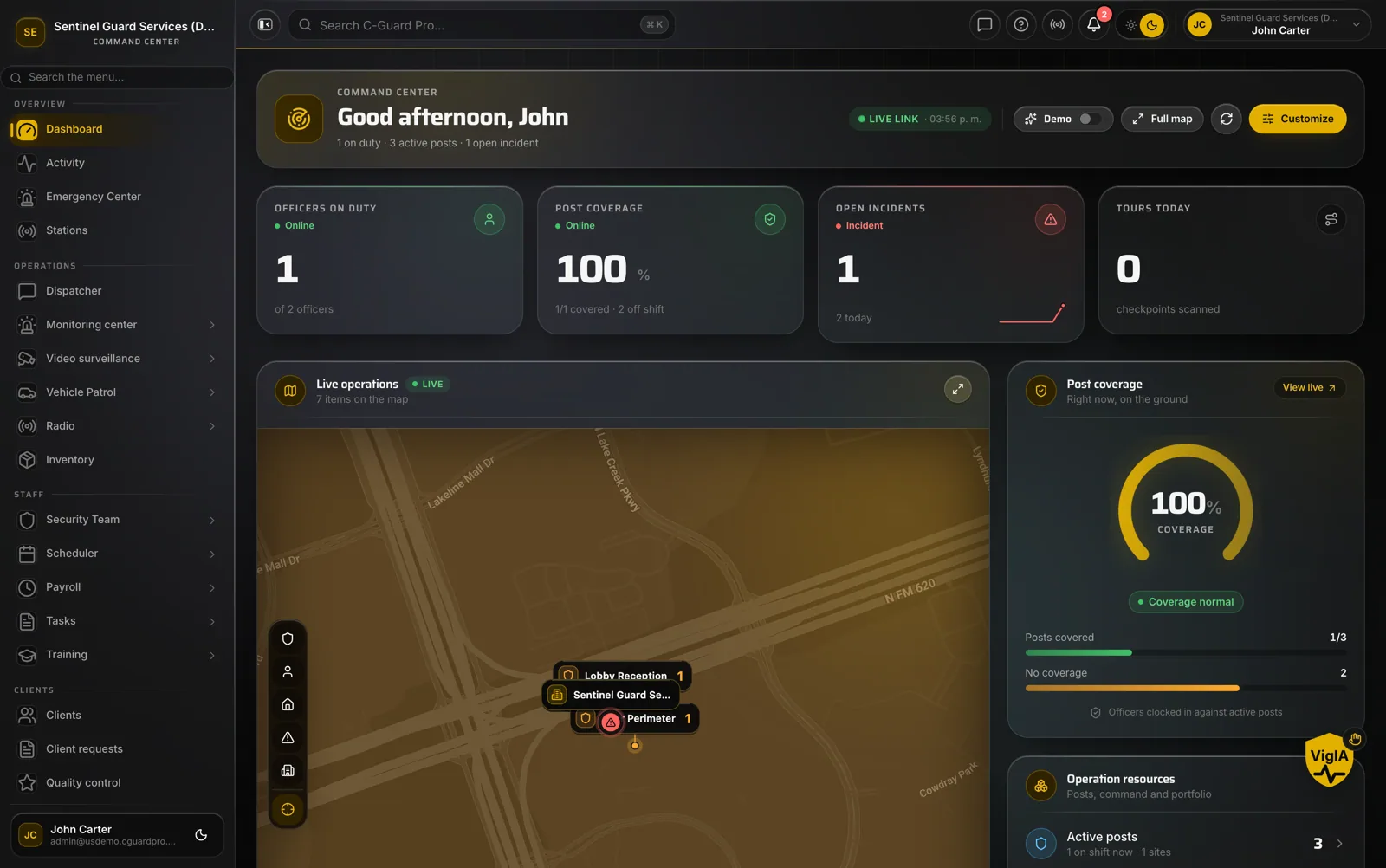 The KPIs that matter, live: patrol completion, coverage and open incidents on one screen instead of a quarterly slide.
Why “live” is the word that matters
Here’s the trap. A provider can agree to every KPI above and still keep you in the dark — by reporting them monthly, in numbers they compile themselves, arriving after the period they describe is over.
That’s retrospective reporting, and it fails you twice. First, you can’t act on a missed-patrol number from last month; the risk it represented has already passed. Second, when the provider assembles the figures, you’re trusting their arithmetic on their own performance. The incentive to round up is obvious.
Demanding security guard service KPIs live changes both problems. When you see patrol completion as rounds happen and attendance as guards clock in, you catch a slipping post on Tuesday morning, not in next month’s summary. And because it’s the same data the provider works from, they can’t hand you a flattering version.
How to see them live, not on a slide
Ask any prospective provider a direct question: “Can I open a screen and see these numbers myself, any time, without asking you for a report?” The right answer is a client portal where the KPIs update as the work happens.
Underneath, each KPI maps to something the provider’s system captures automatically:
- Patrol completion comes from QR guard tour or GPS checkpoint records — each scan is a data point, so the rate is real, not estimated.
- Attendance comes from digital clock-in and clock-out, so coverage gaps are visible instantly.
- Incidents are logged the moment they occur, so counts and closure status are always current.
- Response is traceable end to end: alert fired, who acted, elapsed time.
The screenshot below is the guard’s side of that flow — the check-ins and reports that become your live numbers.
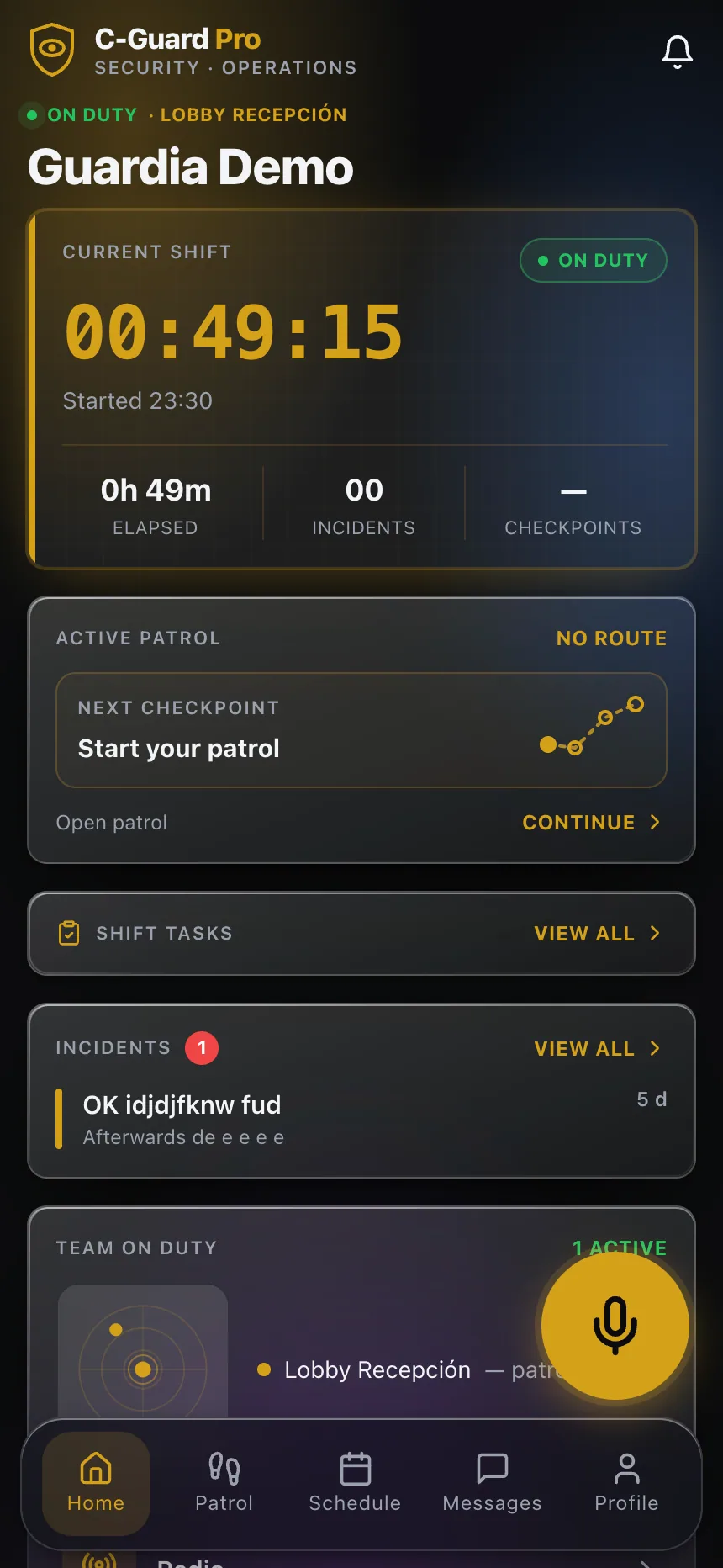 Every guard action — a clock-in, a completed round, a logged incident — becomes one of your KPIs the instant it happens.
Put the KPIs in the contract
A KPI you agreed to verbally is a KPI the provider can forget. Write the targets into the agreement, along with how you’ll measure them and what happens if they’re consistently missed. Keep the language fair — a provider who’s held to reasonable, transparent targets they can see too will usually meet them.
A note of caution: don’t over-index on any single number. A patrol completion rate near perfect but incident reports that are vague and generic is a warning, not a win. Read the KPIs together, and treat a strange pattern as a prompt to ask questions, not as proof of anything on its own.
Measure what protects you
The right security guard service KPIs — patrol completion, response time, incident closure, attendance — turn “everything’s fine” into something you can actually check. Agree on them up front, write them into the contract, and above all insist on seeing them live rather than in a slow slide deck.
If you want to see what those KPIs look like from the buyer’s chair, take a look at the client portal a modern provider should be able to show you today.