It’s 4:40 a.m. and the officer scheduled for the 6 a.m. relief at a distribution warehouse hasn’t answered dispatch. When she finally calls back at 5:15, she says her kid was running a fever and she couldn’t leave until her sister got there. Is that excused? Nobody in the room actually knows, because the company has a plan for what happens when a post goes uncovered — a callout list, a supervisor who can roll a truck, a client notification script — but no written answer to the much smaller question underneath it: was this absence okay, the exact question a security guard attendance point system exists to answer before anyone has to guess.
That gap is where most attendance problems live. Companies build detailed callout coverage plans because an empty post is an emergency that demands a same-night answer. They skip the policy that decides, after the fact, whether the absence itself was legitimate — and without that decision documented consistently, every call-off turns into a negotiation between whichever supervisor happens to be on duty and whichever officer happens to be calling in.
Two documents doing two different jobs
Coverage and excusal are not the same problem, and conflating them is the first mistake. The coverage plan answers “who fills this shift in the next ninety minutes.” The call-off policy answers “does this absence count against this person, and by how much.” A supervisor scrambling to find a warm body at 5 a.m. has no bandwidth to also make a fair, consistent call about whether the reason given meets a written standard — and if the policy doesn’t already exist on paper, they’ll make one up on the spot, differently every time.
Officers notice inconsistency faster than almost anything else a company does. If one supervisor excuses a same-morning call-off because he likes the officer, and another docks a different officer for an identical situation the following week, the policy isn’t a policy — it’s whoever answered the phone. That perception of favoritism does more damage to retention than the absence itself.
Building a security guard attendance point system that holds up
A workable security guard attendance point system starts by separating absences into a small number of categories, each carrying a different weight, and writing that down before you need it — not after the fifth appeal.
What typically counts as excused
Most operations recognize a short list of categories as excused when documentation or advance notice supports them: pre-approved time off requested and confirmed on the schedule, verified jury duty or court appearance, bereavement, and documented illness or injury reported with real advance notice rather than minutes before the shift starts. The common thread isn’t the reason — it’s whether the officer gave the company a fair chance to cover the post.
What typically counts against the point total
No-call/no-show sits at the top of the severity list, because it leaves a post physically uncovered with zero warning. A same-day call-off with no supporting documentation ranks below that but still above a call-off given with real lead time. The point system exists to reflect that gradient — a called-in absence with meaningful notice should never carry the same weight as vanishing without a word — without needing to attach a specific numeric penalty to each tier for this to work as a concept your supervisors can apply consistently.
Where legally protected leave fits in
Not every absence that looks like a call-off is actually one. An officer out for a serious medical condition, a workplace injury, or a covered family circumstance may be exercising a legal right to leave rather than simply calling off, and treating that absence as a normal point-system entry can expose the company to real legal risk. This is exactly the kind of question where a generic blog post cannot give you a safe answer: which leave categories are protected, what documentation an employer can require, and how those protections interact with an attendance point system vary by federal law, by state, and by company size, and they change. Build a step into your call-off intake process where a supervisor flags anything that might qualify as protected leave and routes it to whoever handles HR and compliance before it gets logged as a normal point, and confirm your specific obligations with employment counsel rather than guessing from a policy template. None of this is legal advice.
Escalation that supervisors can actually follow
The value of a point system isn’t the arithmetic; it’s that it converts a subjective argument (“you’re always calling off”) into a documented pattern a supervisor can point to. Set thresholds for what happens as points accumulate — a conversation, a written warning, a review of continued placement on the account — and apply the same thresholds to everyone. The moment an owner or account manager overrides the threshold for one officer without a documented reason, the system stops being a system.
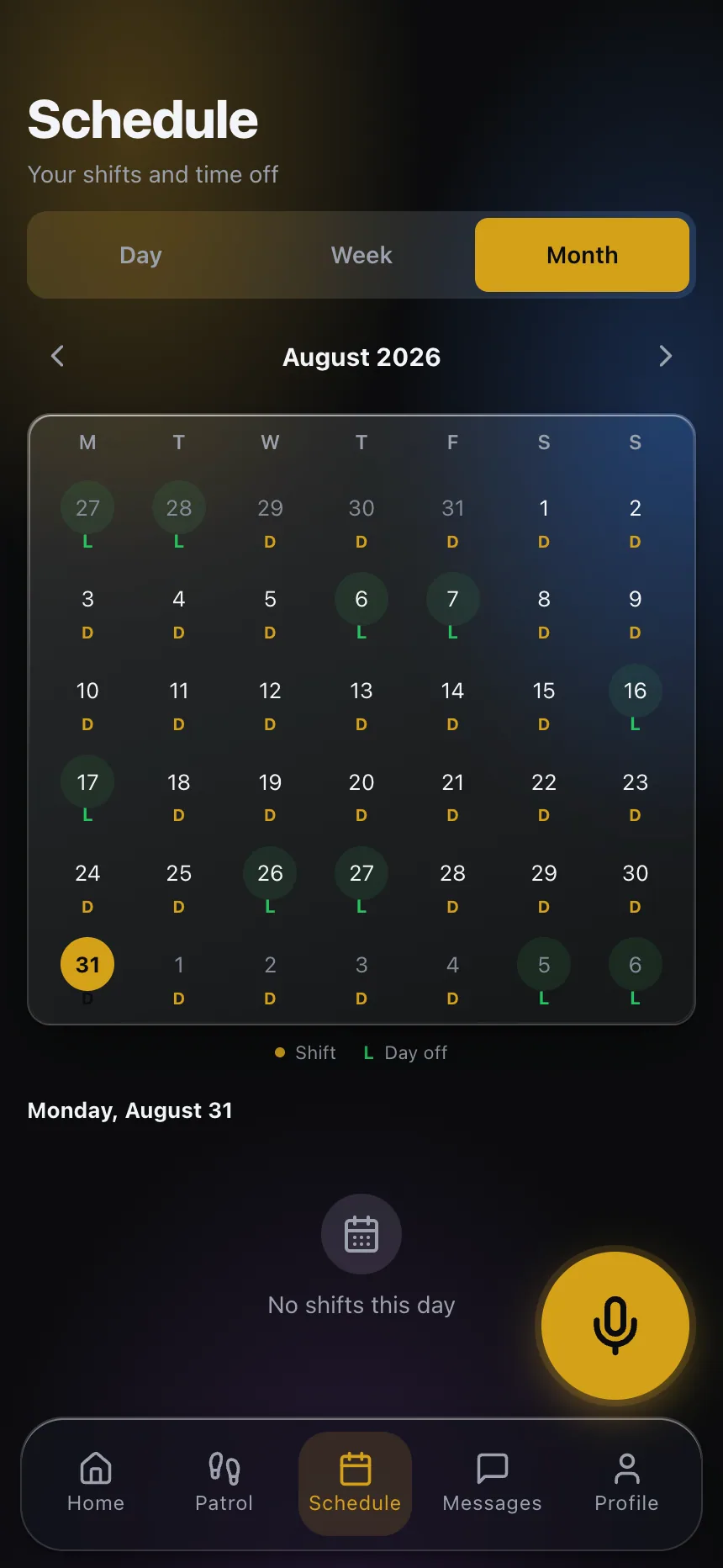
Publishing the schedule and the attendance record where officers can see them changes the conversation before it starts. When an officer can check their own point total on their phone the same way they check their next shift, disputes shift from “nobody told me” to “let’s look at the record together.” A guard scheduling software platform that keeps schedules, swaps, and call-offs in one place gives both sides the same facts.
Where the coverage plan takes back over
Once the call-off is logged and categorized, the operational problem resurfaces: someone still has to stand that post. This is where the callout list, the flex pool, and the supervisor’s authority to pull from another account come in — and it’s worth keeping that plan genuinely separate from the excusal decision. An officer who called off for a legitimate, well-documented reason should never feel like getting covered was a favor; the coverage plan should function the same way regardless of whether the absence was excused or not, because the client’s post doesn’t care why it’s empty.
Enforcing it consistently across supervisors
The hardest part of any attendance policy isn’t writing it — it’s getting every supervisor across every shift to apply it the same way. Geofenced time and attendance removes one entire category of argument, because a punch either happened at the post or it didn’t; there’s no supervisor judgment call about whether someone was “basically on time.” Pair that objective clock-in record with guard time and attendance reporting that a supervisor can review without having to reconstruct who said what, and the point system stops depending on memory.
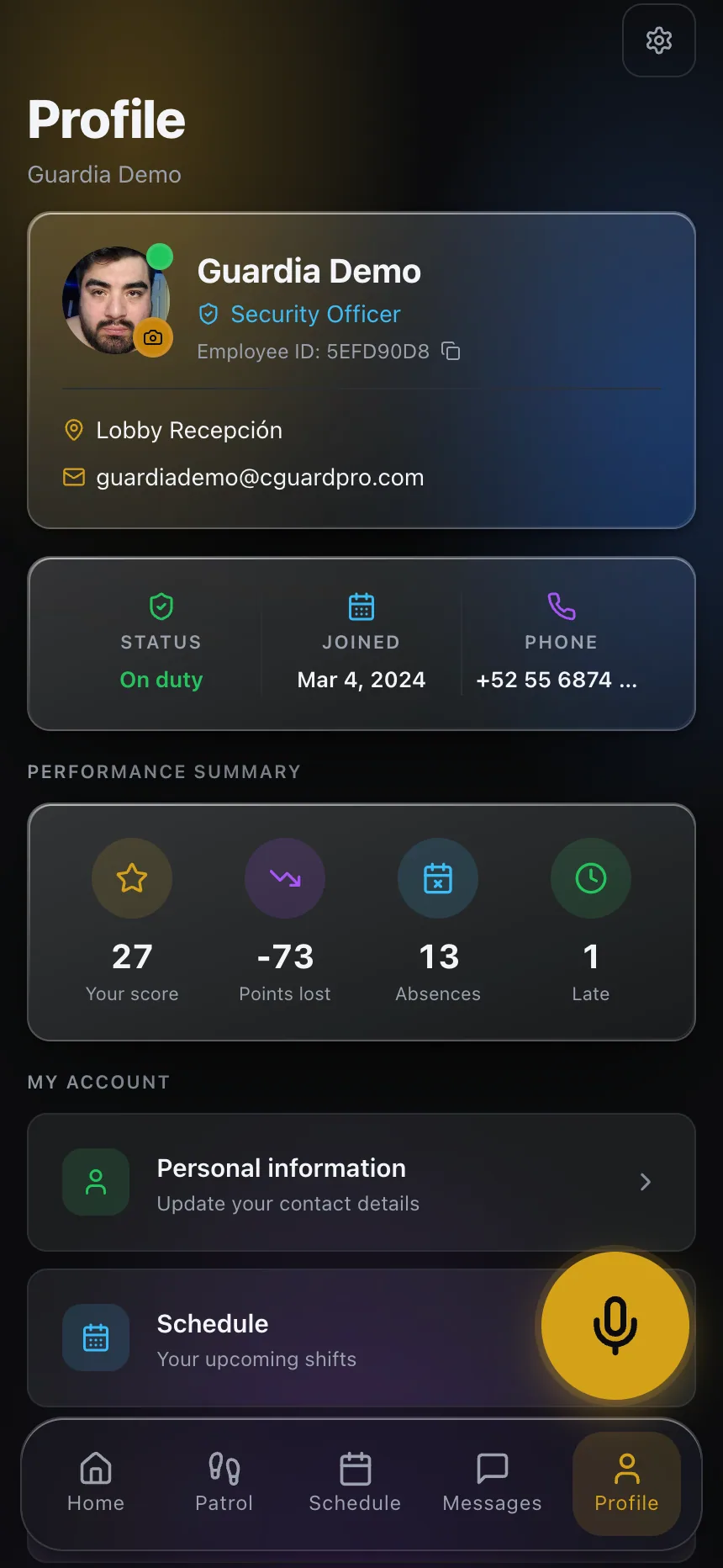
The security guard app that officers use for their schedule is also where they should see their own attendance standing, right on their profile — not because transparency is generous, but because a policy nobody can check isn’t actually enforced, it’s just threatened.
The real payoff
A clear, written call-off policy doesn’t reduce absences by itself. What it does is remove the argument. When the categories are defined in advance, when the point thresholds are the same for every officer on every account, and when the record is visible rather than buried in a supervisor’s notebook, a call-off stops being a negotiation and becomes exactly what it should be: a data point in a pattern everyone can see.
If you want to see how scheduling, attendance, and the field record work together in one system, explore CGuardPro or get in touch.