Ask a scheduling coordinator why their company runs a four-week cycle instead of a two-week one and the honest answer is usually “that’s what we’ve always done,” not a reasoned decision about the accounts they staff. The two-week vs four-week scheduling cycle security operations settle on gets treated as an administrative preference — how often does someone want to sit down and build a new schedule — when it’s actually a question about risk: how long a wrong assumption about coverage gets to run before someone catches it.
What a longer cycle actually buys you
The case for four weeks is real, not just inertia. Officers get more predictability — they can plan childcare, second jobs, and time off around a schedule that doesn’t change every two weeks. Rebuilding a schedule takes real coordinator time: confirming availability, resolving conflicts, communicating the new rotation to everyone on it. Doing that half as often frees up hours that go toward actual supervision instead of paperwork.
A longer cycle also smooths out short-term noise. A coordinator building two weeks at a time reacts to whatever’s happening that week — a callout, a client complaint, a temporary coverage bump — and those reactions can turn into permanent schedule changes that outlive the situation that caused them. A four-week view makes it easier to see that a staffing pattern is a blip rather than a trend before locking it in.
What it costs you
Here’s the part that gets skipped in the “convenience” framing: a longer cycle means a bad assumption about coverage compounds for longer before anyone corrects it. If a site’s actual traffic pattern changes — a new tenant with different hours, a construction phase that ends, a seasonal shift in foot traffic — a two-week cycle catches that within two weeks. A four-week cycle can run for most of a month before the schedule gets rebuilt around what’s actually happening at the site, and in that gap you’re either overstaffing (a cost the client eventually asks about) or understaffing (a coverage gap the client notices first).
The same logic applies to a new officer who isn’t working out at a specific post. On a two-week cycle, that gets caught and corrected at the next build. On a four-week cycle, it’s a longer stretch of a client seeing someone who isn’t the right fit, and a longer stretch before the account manager hears about it if nobody escalates in between.
The two-week vs four-week scheduling cycle security teams should actually use: the variable that decides it
The right cycle length isn’t a company-wide policy decision — it’s a per-account question, and the deciding factor is how often the coverage requirement at that site actually changes, not how often the office wants to do paperwork.
A stable post — a single officer, fixed hours, a site whose traffic pattern hasn’t changed in a year — doesn’t benefit much from rebuilding the schedule every two weeks. The coverage need isn’t changing, so there’s nothing new to react to, and a four-week cycle just reduces admin overhead with no real downside.
A site with volatile needs is the opposite case. A retail property that shifts hours seasonally, a construction site where the schedule needs to track project phases, an account still stabilizing after a recent contract start where you’re actively adjusting post coverage based on what the first few weeks show you — those need the shorter feedback loop a two-week cycle gives you. Locking in a month of coverage at a site that’s still finding its actual staffing need means living with whatever you got wrong for up to four weeks.
There’s a middle case worth naming separately: accounts with high turnover or frequent callouts. A longer cycle on a volatile roster means more schedule changes happening inside the cycle rather than at the rebuild — which defeats the predictability that was the whole argument for going longer in the first place. If you’re constantly patching a four-week schedule with swaps and last-minute fills, you’re not actually getting a four-week cycle; you’re getting a four-week schedule that gets rewritten anyway, just without the discipline of a scheduled rebuild.
Running different cycles across your book of business
Nothing requires picking one cycle length for the whole company. A firm running twenty accounts might reasonably run four-week cycles on its stable, long-tenured sites and two-week cycles on new contracts, seasonal accounts, and anything currently short-staffed. The administrative cost of mixed cycles used to be the argument against this — juggling different rebuild dates by hand is a real burden on a coordinator working from spreadsheets.
That cost mostly disappears with guard scheduling software that tracks each account’s cycle independently and flags upcoming rebuild dates automatically, instead of relying on a coordinator to remember which account is due when. The coordinator still makes the judgment call on cycle length per site; the system just removes the bookkeeping penalty for making different calls on different accounts. It’s also worth confirming the cycle you pick lines up cleanly with how you run payroll and billing — a mismatch between the scheduling cycle and the pay period is its own source of reconciliation headaches, separate from the staffing question this article is about.
Watch the signal a shorter cycle actually gives you
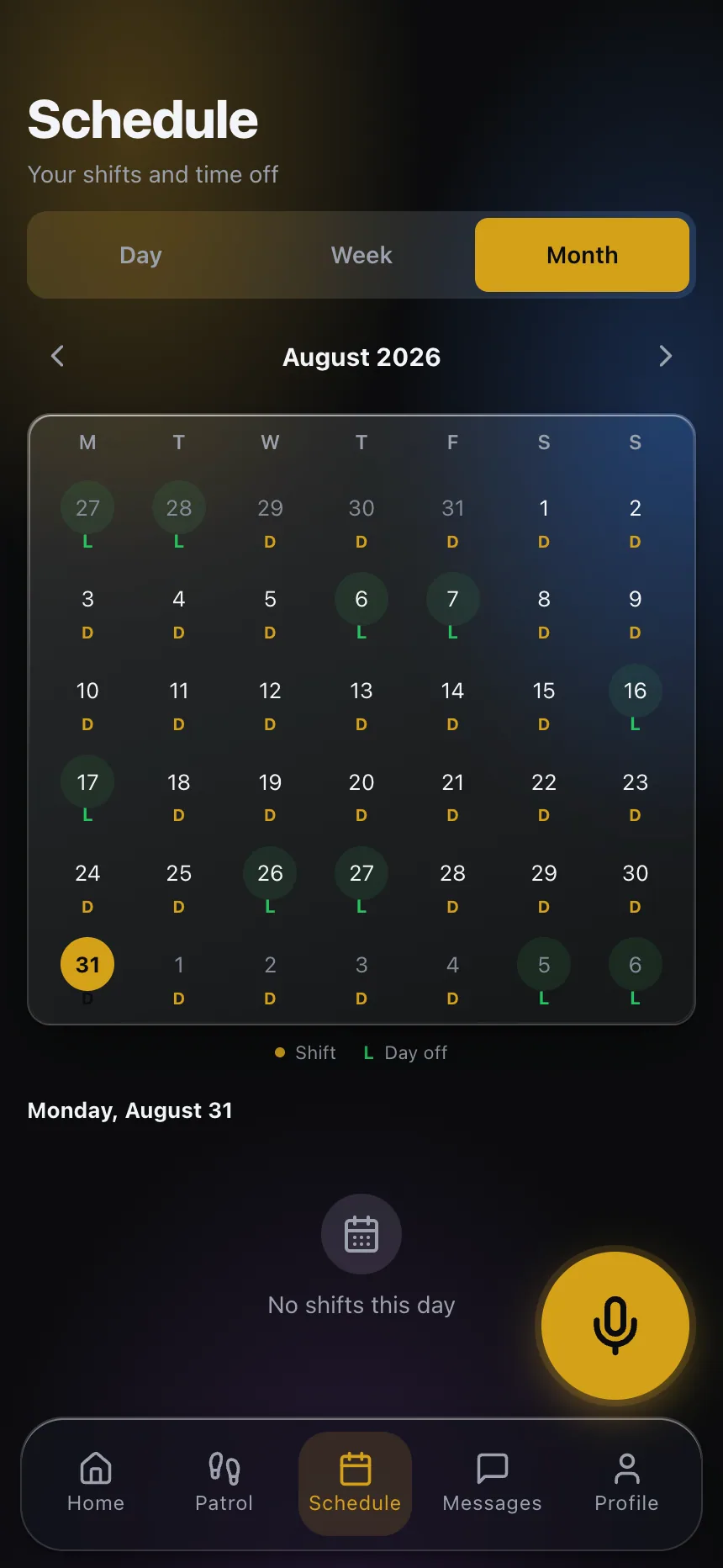
The other benefit of a two-week cycle that rarely gets mentioned: it forces a regular look at attendance patterns before they calcify. A coordinator rebuilding every two weeks is checking who actually showed up, who’s been late, and where callouts have clustered, twice as often as one rebuilding every four. That’s a natural checkpoint for catching a pattern early instead of discovering it a month in. Pairing that rebuild with real time and attendance data — actual clock-ins against the schedule, not a coordinator’s memory of who’s been reliable — makes the two-week cycle’s shorter feedback loop worth more than the extra admin time it costs.
Changing an account’s cycle length without disrupting coverage
Switching a stable account from two weeks to four, or pulling a volatile one back down to two, isn’t something to do mid-cycle without warning. Officers who’ve built their personal schedules around a known rhythm — when they’ll find out next month’s shifts, when they can commit to a second job or a class — notice a sudden change in cadence, and it reads as instability even when the underlying reason is sound.
The cleaner way to do it is a short bridge cycle: publish one transitional schedule that’s shorter or longer than either standard length, explain to the crew why the account is changing cadence, and start the new cycle length cleanly from the following build. That one conversation costs less goodwill than officers discovering the change by noticing their next schedule looks different with no explanation attached.
The decision, stated plainly
Default to a longer cycle where the coverage need is genuinely stable and a shorter one wherever it isn’t — including new accounts, volatile sites, and anywhere the roster is still shaking out. Reviewing cycle length by account, and being honest about which of your sites are actually stable versus just familiar, will do more for your staffing accuracy than picking one policy and applying it everywhere out of habit.
If you want to see how per-account scheduling cycles work in practice, explore CGuardPro or get in touch.