Security software for utilities
and critical infrastructure
A utility's security footprint is a main plant or control center with a staffed desk, and dozens of substations, pump stations and yards that nobody staffs at all. Guards check fences, padlocks and control-house doors on mobile patrols, escort contractors through restricted areas and respond when an intrusion alarm trips at two in the morning. CGuardPro keeps every one of those duties on record. Trusted by 600+ security companies worldwide.
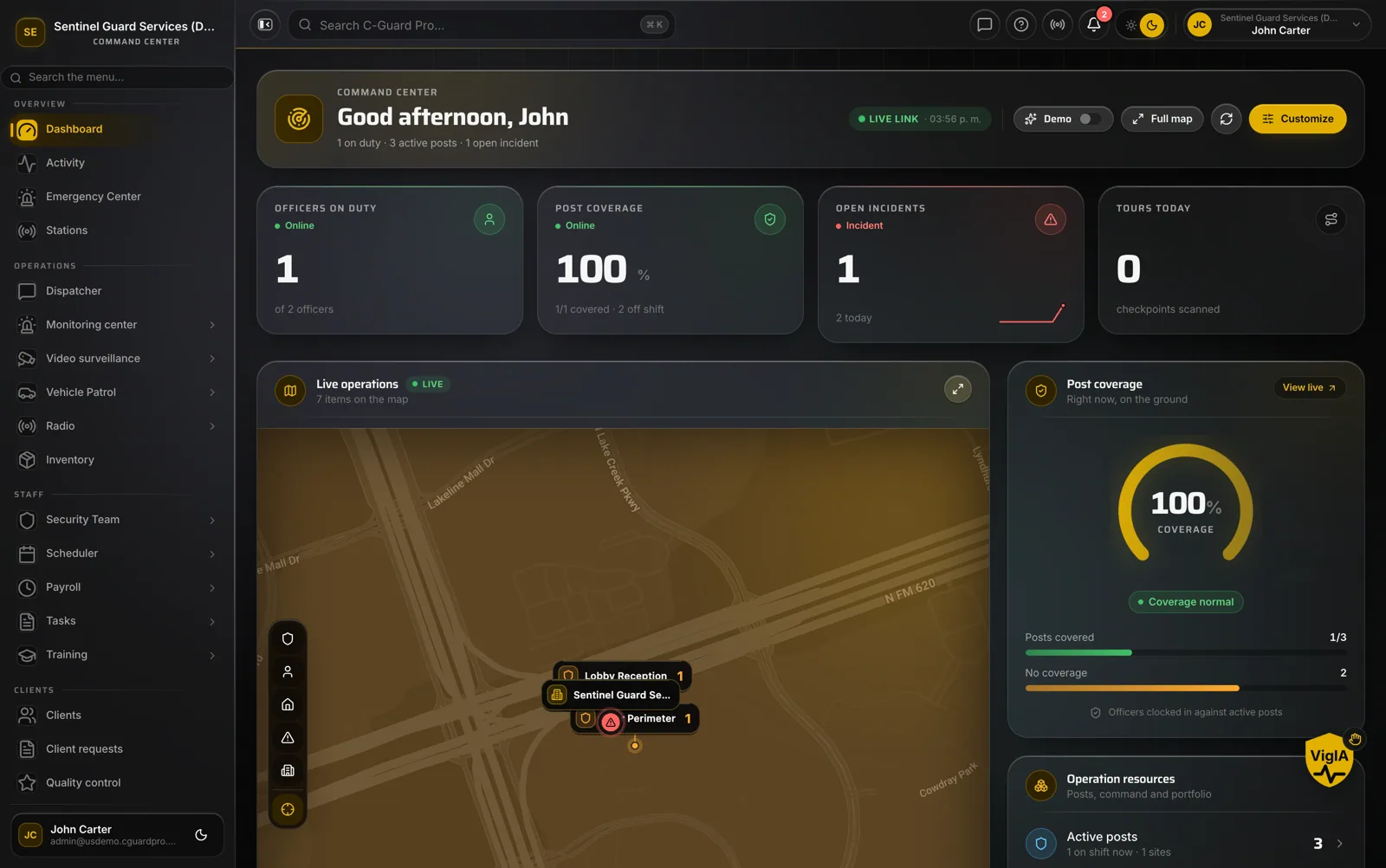
Real product screenshots
Short answer
Utility and critical infrastructure security software has to cover remote, mostly unmanned sites as carefully as the main plant: substation checks, perimeter patrols, escorted visitors and fast response to alarms. CGuardPro verifies QR or NFC checkpoint scans with time and position, logs visitors with entry, exit and the escort, puts geofences on remote posts, receives intrusion alarm signals, and raises alerts on missed tours. It does not certify NERC CIP compliance.
At a glance
- Typical sites
- Transmission substations, generation plants, control centers, water and wastewater plants
- Federal framework (power)
- NERC CIP-006 visitor control and CIP-014 physical security plans
- Key records
- Verified patrols, visitor and escort log, alarm cases, incident reports
- Alerts
- Missed tours, uncovered posts, geofence exits, panic button, unacknowledged alarms
- Compliance
- CGuardPro is not a NERC CIP tool and certifies nothing
What makes utility contracts demanding
Remote sites, one officer, long distances
A mobile officer may check ten substations in a night. If the route is not verified site by site, nobody can say which fence was actually looked at.
Visitors need escorts and records
Contractors, line crews from other companies and inspectors all need access to restricted areas. The utility's compliance team wants to know who came, who escorted them, and when they left.
Alarms that nobody acknowledges
An intrusion alarm at an unmanned site is only useful if someone acknowledges it and sends a patrol. Missed alarms are the worst kind of finding after an incident.
How a utility operation runs on CGuardPro
Checkpoints at each remote site
QR codes or NFC tags on the control-house door, the gate and the fence corners. Each scan is verified server-side with time and position, and a checkpoint can require a photo of a lock or fence section.
Visitor and escort log
Each entry records the person, company, who authorized and escorted them, the vehicle and its plate (read from a photo) and the exit time. The utility keeps the records its own program requires; CGuardPro exports them to CSV, Excel or PDF.
Geofences and lone-officer safety
Each site can carry a radius or polygon geofence; dispatch sees geofence exits and missing clock-ins, and an officer in trouble can press the panic button or call on push-to-talk.
Alarm signals into one queue
The alarm receiver takes signals in Contact ID, SIA DC-09 and Surgard format. Each signal becomes a case that operators acknowledge, dispatch and resolve, and unacknowledged cases escalate.
What the utility gets
- Verified patrols of substations, plants and fence lines
- Visitor and escort log with entry and exit times
- Geofences, uncovered-post alerts and panic button for lone officers
- Alarm receiver with acknowledgment deadlines and escalation
- Incident reports with photos, category and severity
- Client portal limited to the utility's own sites
Frequently asked questions
Which federal rules shape physical security at electric utilities? +
For the bulk electric system, NERC Reliability Standards apply. CIP-006 requires a documented visitor control program for applicable BES Cyber Systems, including logging visitor entry and exit and keeping those logs for at least 90 calendar days. CIP-014 requires transmission owners to protect certain critical transmission stations, substations and primary control centers with a documented physical security plan. The standard is being revised; check the version in force on NERC’s site. Which sites and assets are in scope is decided by the registered entity, not by its guard contractor.
Is CGuardPro a NERC CIP compliance tool? +
No. CGuardPro does not certify NERC CIP compliance and does not connect to access control systems. It records what the officers did — patrols, visitor and escort entries, incidents and alarm responses — and the utility decides whether and how to use those records in its own compliance program.
What about water and wastewater plants? +
The same tools apply: perimeter and building patrols, visitor logs, alarm response and geofenced remote posts. Water utilities have their own federal and state obligations; CGuardPro does not certify those either.
Will it work at sites with poor coverage? +
Mostly. Incidents, visitor entries and tour start and end queue on the phone and upload when coverage returns; a checkpoint scanned offline is stamped by the server when it arrives. Clock-in needs a live connection.
How much does it cost? +
USD 5 per user per month (anyone with a login), one plan with every feature, plus a one-time implementation of USD 299.99, with a 7-day free trial.
Map your substation route with us
Book a demo and we set up a mobile route across several remote sites, log an escorted contractor and run an alarm case from signal to resolution.