An officer who’s written a hundred slip-and-fall reports can write a bad vehicle accident on property security guard documentation entry on the first try, because the two incidents don’t share a shape. A slip-and-fall report is built around a person, a surface, and a moment. A parking lot collision is built around two vehicles, their final resting positions, and the sightlines that existed before impact — and if the officer reaches for the same mental template, the report that comes out is missing exactly what an insurance adjuster is going to look for first.
Why the templates can’t be the same
A slip-and-fall report answers: what was the surface condition, was there a warning, when was the area last inspected, who saw the fall. None of those questions transfer to a vehicle collision. What replaces them is spatial: where was each vehicle before the collision, where did each one end up, what does the damage pattern on each vehicle say about the direction and speed of impact, and — critically — what could each driver actually see from where they were.
That last one is the piece that gets skipped most often, and it’s usually the piece that matters most for a liability determination. A collision at a blind corner formed by a delivery truck, a row of shrubs, or a poorly placed dumpster enclosure is a different story than the same collision on an open, well-sighted lane. The officer who only records “vehicle A struck vehicle B near the north exit” has told the adjuster nothing about who could have seen whom in time to stop.
What vehicle accident on property security guard documentation needs to capture, in order
Vehicle position, twice. Where each vehicle came to rest matters, but so does the direction each was traveling and where they were relative to marked lanes or stop signs before impact — reconstructable from tire marks, debris field, and any witness who saw the approach, not just the aftermath.
Damage location on each vehicle. Front-left versus rear-right tells a very different story about who had the right of way. This is one of the most useful things an officer’s photos can capture that a written description can’t — a close, well-lit photo of the point of impact on both vehicles, not just a wide shot of the two cars sitting there.
Sightline conditions. What was actually visible from each driver’s position in the moments before the collision — parked vehicles, landscaping, signage, lighting if it happened after dark. This is the piece that most separates a useful report from a routine one.
Witness positioning, not just names. Where a witness was standing when they saw the collision determines whether they could actually see what they’re describing. A witness in the building lobby forty feet away with a partial view through glass is a different kind of witness than one standing at the adjacent pump island.
Time and sequence. Not just a timestamp on the report — the sequence of what the officer did after being notified, when they arrived on scene, when police were called if applicable, and when each photo was taken relative to vehicles being moved. If a vehicle gets moved before it’s photographed, that has to be noted, because it changes what the photos can and can’t prove.
Photos do more work here than in most incident types
In a slip-and-fall, a photo of the surface is supporting evidence. In a vehicle accident, photos are close to the entire case: the resting position of both vehicles from multiple angles, the damage on each, the debris field, skid marks if visible, and the surrounding sightline obstructions exactly as they existed at the time — not cleaned up, not with vehicles already moved to clear a lane. An adjuster reconstructing fault from a written narrative alone is working with far less than an adjuster who can see the actual geometry of the scene.
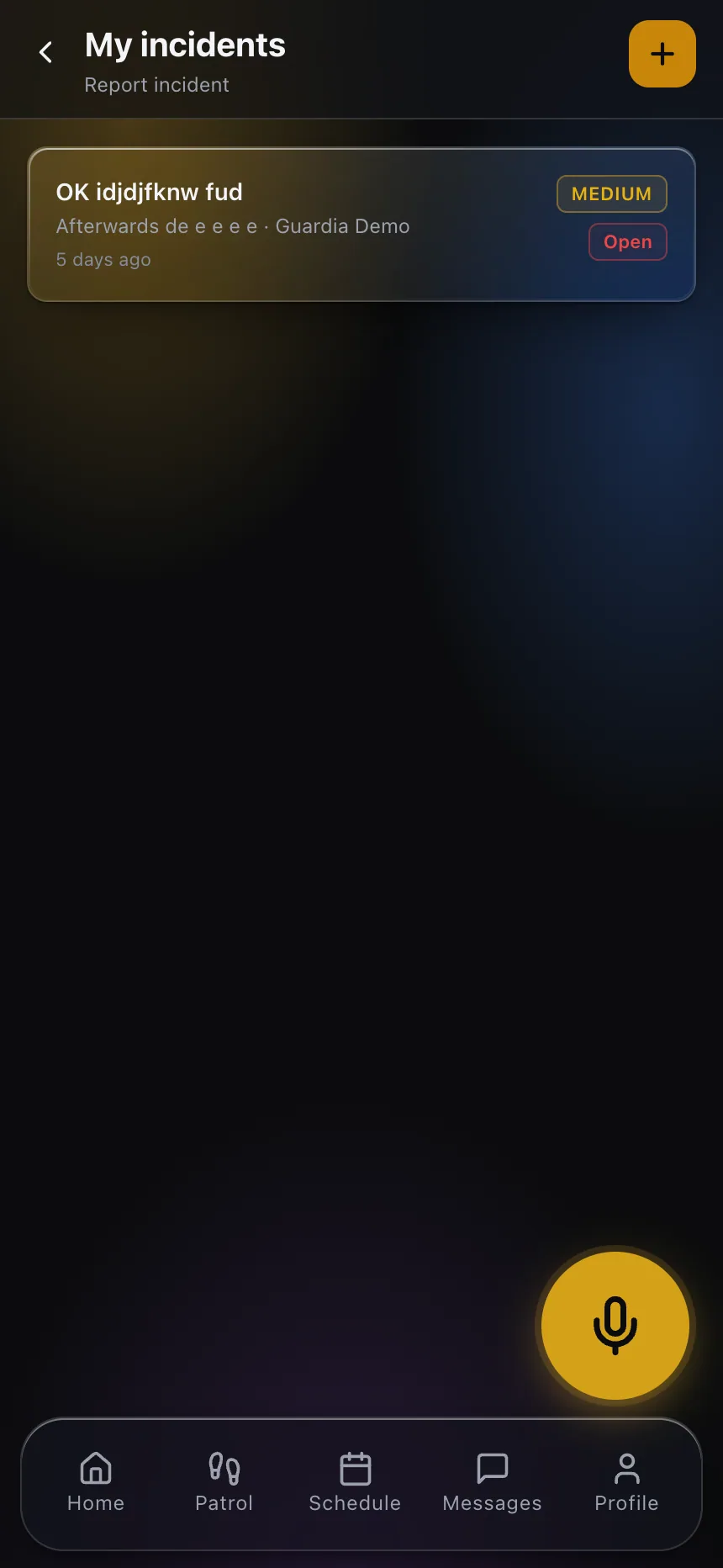
This is also where a mobile incident reporting system earns its keep over a paper form: photos attach directly to the report at the moment they’re taken, geotagged and timestamped, instead of living on someone’s personal phone and getting emailed in later with no record of when they were actually captured.
The sequence of who gets called, and in what order
A vehicle accident report is also, implicitly, a record of the officer’s own response sequence, and getting that order wrong is its own liability problem. The immediate priority is checking for injuries and calling for medical help if there’s any doubt, before anything else happens — before photos, before moving vehicles, before taking statements. Once that’s settled, whether local police need to be called depends on the severity and on the property’s own policy, and that’s worth having spelled out in advance rather than left to the officer’s judgment in the moment, because “should I have called police” is a bad question to be asking for the first time during an actual accident.
Only after safety and any required police notification is handled does documentation become the priority — and that ordering should show up in the report itself, with timestamps that make clear the officer didn’t stand around taking photos while someone needed help. An adjuster or a company’s own risk manager reading the report later should be able to reconstruct not just what happened to the vehicles, but that the officer’s priorities were correct throughout.
Where this connects to the rest of the shift
A vehicle accident report doesn’t replace the daily activity report for that shift — it supplements it. The DAR should reference the incident and its report number rather than duplicating the details, so a supervisor reviewing the day’s log sees that something happened without having to reconstruct it twice. And if the property is one where a client or a property manager expects to be notified of vehicle incidents specifically — not every incident, just this category — that’s a routing rule worth setting up through the client portal rather than relying on someone remembering to make the call.
None of this replaces training your officers on what your specific insurer or legal counsel wants documented for a vehicle claim — those preferences vary by carrier and by state, and it’s worth confirming the exact report format your company’s insurer expects before the first accident happens rather than after.
If your current incident reporting doesn’t separate vehicle accidents from your general incident template, that’s a gap worth closing before you need it. Get in touch to see how a purpose-built report type looks in practice.