The call comes in as “power’s out on the west side,” and by the time dispatch confirms it with the property manager, every card reader on that wing has gone dark, the camera feed is frozen on a still frame from before the outage, and the officer standing post at that door no longer has any electronic way to know who’s allowed through it. Most companies have a power outage protocol for security guards that starts and ends with “confirm the generator kicked on, log the time, move on.” That covers the building’s systems. It does not cover the post, because the post depends on doors, cameras and readers that just stopped doing their job.
What actually goes dark
Walk through what an outage takes with it before you write the plan. Card access fails to a locked or unlocked state depending on how each door was wired — and on a large property those states are rarely uniform, so a plan that assumes “doors fail locked” is often wrong for a third of them. Cameras go dark unless they’re on a dedicated battery backup, and even then most backups are sized for minutes, not hours. Intercoms at gates and stairwells drop. Elevator phones drop. None of that is a generator problem; a generator that comes on in ninety seconds still leaves ninety seconds where the electronic layer of the property doesn’t exist.
That’s the gap a patrol plan has to close, and it’s a different job from checking mechanical systems. Checking the generator is maintenance. Covering the gap is security.
Elevators deserve their own line in the plan, separate from doors and cameras, because they carry a different kind of risk. A stalled elevator can trap someone, and the officer’s first move during an outage should be confirming, quickly, whether any cars were occupied when power dropped — not something to discover twenty minutes into a tour of the parking structure instead. Exterior lighting is the other item that gets skipped because it isn’t “security equipment” in the usual sense. Parking lot fixtures tied to the same circuit as everything else go dark along with the cameras watching that lot, and a tenant walking to their car in the dark, with no camera coverage and no obvious officer presence, is exactly the kind of complaint that reaches the property manager the next morning regardless of whether anything actually happened.
A power outage protocol for security guards needs more than a generator line
Write the plan around the assumption that electronic monitoring is offline, not around the assumption that it will come back quickly. That means naming, in advance, which doors get a physical check and how often until confirmed restoration — not “increase patrols,” which tells an officer nothing at 2 a.m., but a list: exterior doors that normally rely on card readers get walked every fifteen minutes, interior doors that fail locked can wait for the top of the hour, stairwell doors that fail open move to the fifteen-minute list.
This is exactly the kind of instruction that belongs in post orders rather than in an officer’s memory, because outages don’t happen on a schedule and don’t wait for the officer who wrote the checklist last time to be on shift. If the plan lives in the post orders the app puts in front of whoever is working that post, it survives staff turnover. If it lives in a supervisor’s head, it doesn’t.
Which doors, how often
The honest version of this section is short because it depends entirely on the site: which doors are exterior, which fail open versus locked, which lead somewhere a stranger could do real damage in fifteen minutes versus somewhere they’d just be lost. A distribution warehouse and a hospital wing need completely different lists. What both need is the same discipline — the list gets written during the site survey, not improvised during the outage, and the walking frequency scales with how bad an unnoticed fifteen minutes would be at that specific door.
Generators buy time, not certainty
There’s a habit of treating “the generator’s on” as the end of the incident. It isn’t. A generator that’s running still leaves you blind on anything not wired to emergency power, which on most properties is most of the cameras and none of the exterior lighting people actually rely on to feel safe walking to their cars. The patrol plan has to keep running at outage tempo until someone with authority — the property manager, the client’s own facilities team — confirms the building is back to normal, not until the generator noise starts.
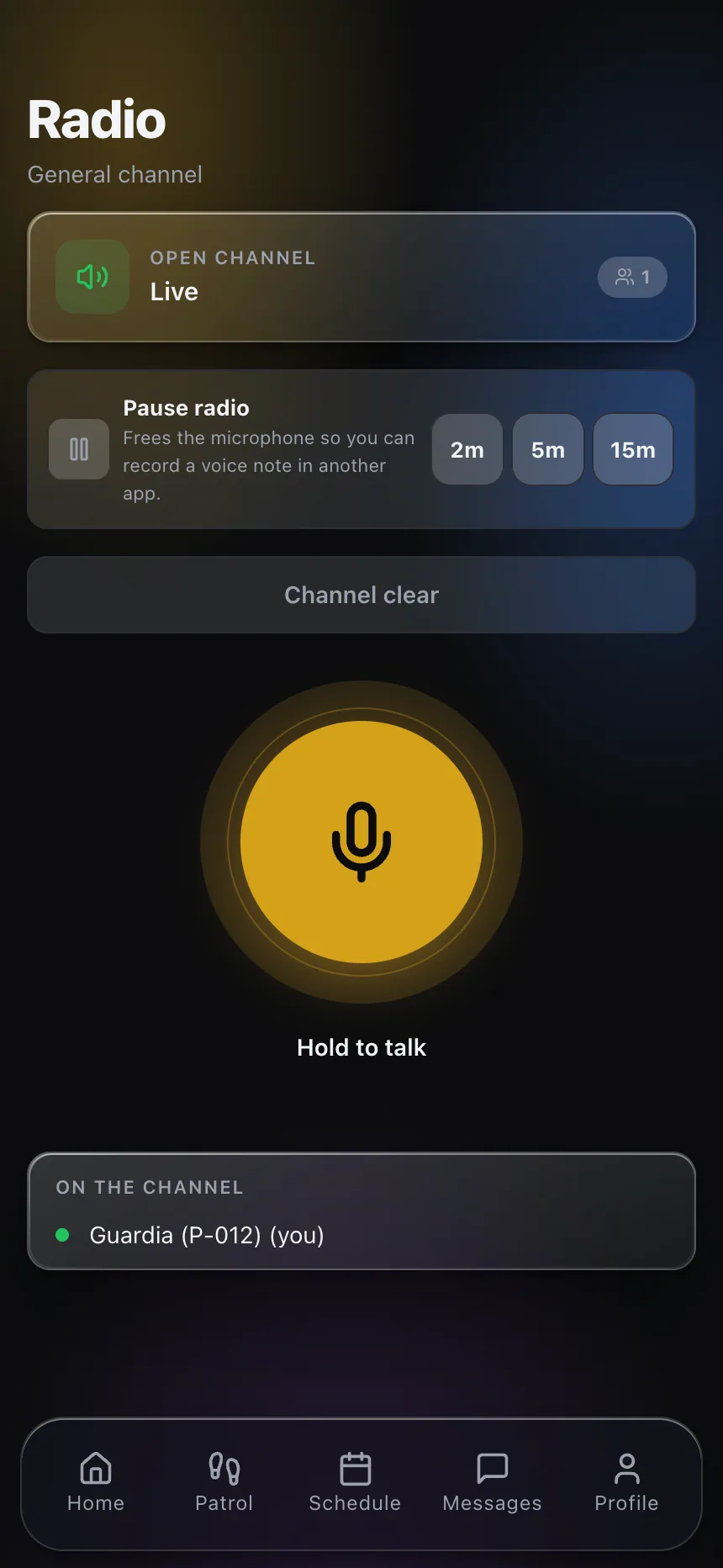
This is also where communication earns its keep. An officer covering a dark wing on foot needs a live way to reach dispatch and other officers without depending on the same infrastructure that just failed. A push-to-talk line on the phone the officer already carries works without new hardware. Whichever channel you use, confirm before the outage, not during it, that it actually works when the property’s own power and networking are down.
Test it before you need it
A door-check list that only exists on paper is untested. Walk it once, on a normal day, with the power on — time how long it actually takes to cover every door on the list at the stated frequency, and be honest about whether one officer can do it while also handling routine calls, visitor traffic and anything else the post normally requires. Outage response competes with everything else already on the officer’s plate; a plan that assumes an officer who is otherwise free is a plan that will slip the first time it’s actually needed. If the frequency isn’t realistic for a single officer, that’s a staffing conversation to have with the client before an outage forces it, not during one.
It’s also worth confirming, in the same walkthrough, that the backup radio channel actually reaches every part of the property an officer might be checking — a basement mechanical room or a stairwell that’s normally fine on the primary channel can behave differently on a backup, and the outage itself is the worst possible time to discover a dead zone.
Write it into post orders before you need it
The failure mode isn’t a company without a generator or without radios. It’s a company that has both and still gets a confused, ad-hoc response, because nobody wrote down what “patrol during an outage” actually means for that specific site before the outage happened. The plan needs the door list, the frequency, the backup comms channel, and a clear line for when the officer escalates instead of just continuing to walk — a stairwell door propped open by someone during the confusion is a different call than a reader that’s simply dark.
Once power is back, the daily activity report for that shift should capture the outage window on its own — start time, doors checked, anything found — separate from routine notes, because that’s the record the property manager will ask for afterward and the one your account manager will want in front of them before the client raises it first.
If you want to see how outage-response tasks and radio checks work together in the app your officers already carry, explore CGuardPro or get in touch.