Ask most account managers why a site is patrolled by truck, by golf cart, or on foot, and the honest answer is usually “that’s what we had.” A company that already owns three patrol trucks puts a truck on the new logistics account. A company that just bought carts for a residential contract puts carts on the next HOA that signs. Choosing a patrol vehicle for a large site should start from the site’s actual geometry and risk points, not from what’s sitting in the lot — because the wrong mode doesn’t fail loudly. It quietly erodes coverage in ways that only show up months later, when something gets missed that a different patrol mode would have caught.
What each mode actually buys you
Vehicle patrol covers distance. A truck or SUV crosses a large perimeter, a multi-acre lot, or a distribution yard in a fraction of the time a walking officer needs, which matters enormously on sites where the total area is the problem — a self-storage facility, a large industrial park, a construction site spanning several city blocks. The tradeoff is contact. An officer behind a windshield sees less, smells nothing, hears nothing over an engine, and — critically — is far less approachable. A tenant who would flag down a walking officer to mention a broken gate will not chase down a truck.
Cart patrol sits in between, and it’s the mode most often mismatched to a site because it looks like a reasonable compromise on paper. Carts are quiet, cheap to run, and fast enough to cover a surface lot or a campus quad efficiently. But a cart is built for exterior, paved terrain. It does nothing for interior corridors, stairwells, or parking structures — anywhere the vehicle can’t physically go — and an officer who’s used to covering ground on a cart tends to under-patrol the interior spaces that require getting off and walking, because the cart makes speed the path of least resistance.
Foot patrol is the slowest mode and the only one that produces real contact: a hand on a door to confirm it’s locked, a conversation with a tenant, a checkpoint scanned inside a stairwell a vehicle will never enter. It’s also the mode that scales worst. An officer on foot covering a fifteen-acre site simply cannot complete enough laps in a shift to matter, no matter how motivated they are.
None of these is a universally correct answer. Each is correct for a specific set of site characteristics, and most companies never run that match explicitly.
Choosing a patrol vehicle for a large site: matching mode to shape
The variable that matters most isn’t total acreage — it’s the ratio of open exterior ground to enclosed interior space, and where the site’s actual risk points sit.
A warehouse or logistics yard with a large exterior perimeter, trailer staging, and limited interior square footage is a vehicle-first site: the exterior is where theft and unauthorized access happen, and covering more of it more often beats slow, thorough coverage of a mostly empty interior. A vehicle patrol running frequent, verified laps of the fence line and gates does more for that site than an officer on foot ever could.
A multi-building office campus or a school with several structures connected by walkways is closer to cart territory for moving between buildings, but the risk points — entry doors, stairwells, after-hours occupancy — sit inside those buildings, which means the cart gets the officer to the building and foot patrol has to take over from there. Treating the cart as the whole patrol, rather than the transportation between foot segments, is exactly the mismatch that erodes coverage without anyone noticing.
A hospital or an office tower with a compact footprint and a lot of interior complexity is a foot-first site almost by definition. There’s no exterior ground worth covering by vehicle, and the risk — a wandering patient, an unauthorized visitor, a propped fire door — lives entirely in corridors a truck will never see.
A large construction site usually needs both, on a schedule: vehicle sweeps of the perimeter and material laydown areas at a lower frequency, foot checks of active work areas and equipment cages at a higher one, because theft risk and safety risk don’t sit in the same place.
The failure mode nobody flags in a proposal
The reason this mismatch survives so long is that it doesn’t show up as a missed patrol. The vehicle patrol still completes its route, still logs its laps, still looks fully staffed on paper. What’s missing is the contact and the interior coverage the site actually needed — and that gap only becomes visible after an incident happens somewhere the assigned patrol mode was never going to reach.
This is where checkpoint verification earns its keep regardless of which mode you choose. A QR guard tour system that requires a scan at each checkpoint doesn’t just prove an officer was near a location — reviewed as a set, the checkpoint timestamps show whether the actual coverage pattern matches what the site needs. A vehicle patrol whose scans cluster entirely around the perimeter, with nothing logged from the interior stairwells that were part of the route on paper, is telling you the mode is wrong before an incident forces the conversation.
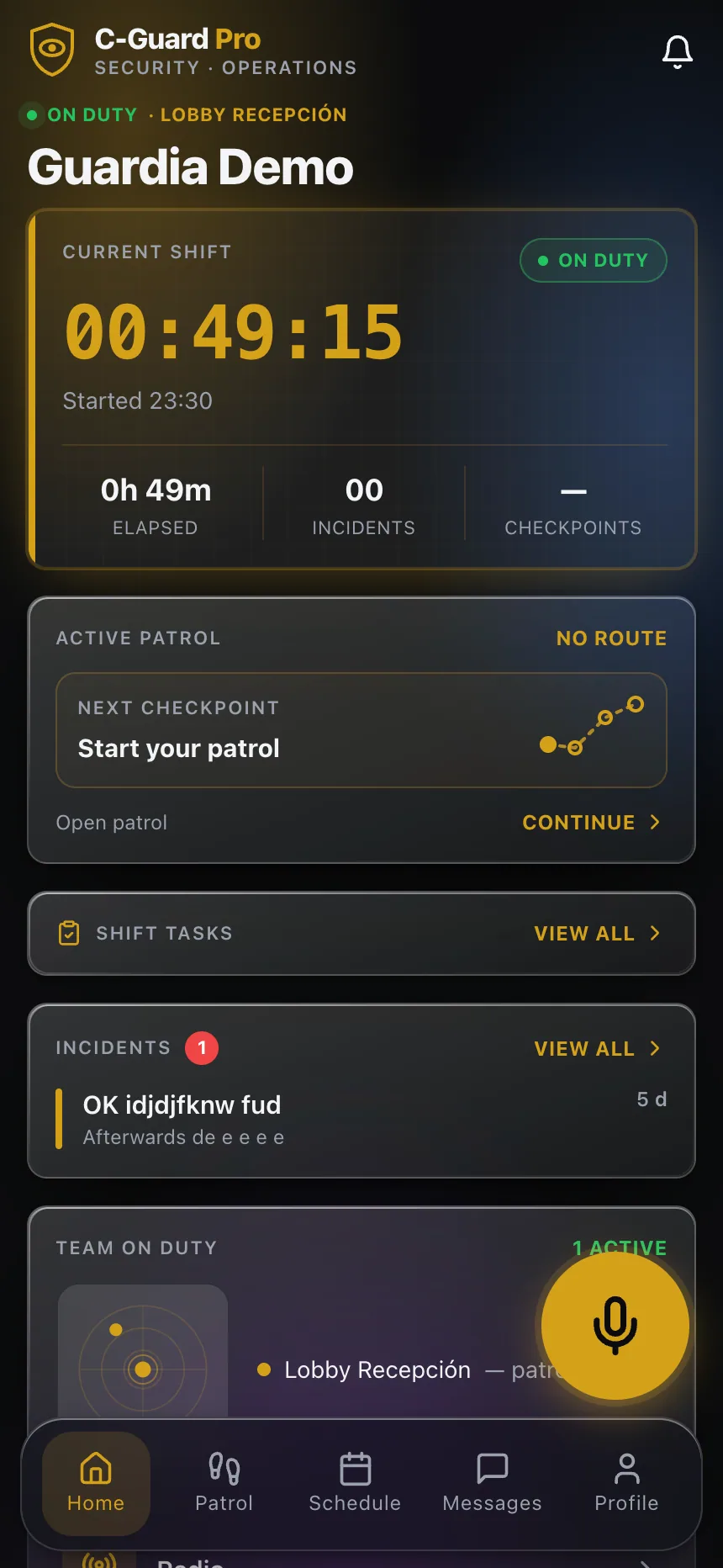
The officer’s own view of the shift matters here too. When a route mixes modes — drive the perimeter, park, walk the interior — the assignment has to say so explicitly rather than leaving it to whoever’s on shift to decide how much of the route to drive versus walk. An officer handed a vague “patrol the site” instruction will default to whichever mode is easiest, which on a mixed site is almost always the vehicle, for the same reason a cart tends to absorb the whole patrol on a campus account. Spelling out which checkpoints require a foot approach, right there on the shift’s own checklist, removes that judgment call from the officer entirely.
Building the mix into the proposal, not the fleet
The fix isn’t buying every mode of transportation for every account — it’s deciding the mix at the proposal stage, based on the site walk, rather than defaulting to whatever the company already owns. A site with both large exterior ground and dense interior risk points needs a route that specifies both modes and when each applies, not a single officer assigned a single conveyance and left to improvise the rest.
That’s a harder conversation to have with a client than “we’ll patrol your site,” because it means describing tradeoffs instead of promising blanket coverage. It’s also the conversation that prevents the call two months in, after a break-in in a stairwell nobody on a cart ever walked, asking why the patrol didn’t catch it.
If you want to see how checkpoint scans and patrol coverage look across a mixed-mode route, explore CGuardPro or get in touch.