Search “is a security guard company a profitable business to start” and you’ll land on a dozen blog posts confidently citing a margin range, a market size, and a growth rate — all of them repeating each other, none of them citing a source you could actually check. If you’re the person deciding whether to quit a supervisor job at a bigger firm and go out on your own, that folklore is worse than useless, because it lets you skip the two questions that actually determine whether this works: how long can you survive before revenue covers payroll, and where is your first real contract coming from.
This post is written for that person — not the owner three years in optimizing bill rate, but the one still staring at the decision. If a security guard company is a profitable business to start, the profitability doesn’t come from the industry; it comes from surviving your own first six months.
Why the numbers you’re reading aren’t real
Most of what circulates about margins and market size in this industry traces back to marketing copy from software vendors, franchise sellers, and industry associations with something to sell you — repeated by blog after blog until it reads as consensus. None of it is independently audited, and none of it accounts for the fact that “security guard company” spans everything from a two-person special-events crew to a five-hundred-officer regional operation with its own training academy. Averaging across that range and reporting one number is not analysis; it’s a rounding error with a byline.
Ignore the percentage. The honest version of the question isn’t “what’s the average margin in this industry” — it’s “what does my specific version of this business need to survive, and do I have that.”
What actually eats your runway
The obstacle nobody warns you about clearly enough is the gap between when you start paying officers and when the client actually pays you. You post officers to a site, they work the pay period, you run payroll — and the client invoice you sent doesn’t clear for weeks after that. Every week you’re staffed but unpaid is a week you’re financing the client’s operation out of your own pocket, and that gap doesn’t shrink just because you land a bigger contract. It grows, because a bigger contract means a bigger payroll running through the same lag.
Licensing, insurance, bonding, uniforms, and basic scheduling and reporting infrastructure all come due before your first invoice does. None of that is optional, and none of it is a one-time cost you clear and forget — insurance renews, licenses renew, and the software or spreadsheets you use to track hours and post orders either scale with you or become the reason you lose your second contract to a competitor who looked more organized on the walkthrough. It’s worth pricing out how much security guard software actually costs at the size you’re starting, rather than assuming you’ll bolt it on later once you can afford it.
The founders who make it through the first year are usually the ones who under-estimated how much cash they’d need to carry payroll through that lag, not the ones who guessed wrong about the industry’s margin.
The underbidding trap on your way to that first contract
Desperation to land any contract at all pushes a lot of new owners toward a bid rate that barely covers pay rate, taxes, insurance, and overhead, on the theory that a thin margin now buys the track record needed to bid better later. Sometimes that works. More often, it locks the new company into a client relationship where there’s no room to absorb a callout, no room to invest in even basic scheduling and reporting tools, and no leverage to push back when the client asks for more coverage at the same rate a year in. A property manager who got you at a rock-bottom bid rate has very little incentive to let you raise it later — you’re the vendor who was cheap, and that’s the relationship you set on day one.
The honest version of the pricing decision isn’t “what’s the lowest number that wins the bid,” it’s “what’s the lowest number I can sustain long enough to actually deliver the service and still have room to reinvest.” A contract you can’t service well is not a foothold — it’s a liability wearing the shape of revenue, and it will cost you the very reputation you were trying to build.
The anchor contract problem
A security company with no contracts isn’t a business, it’s a license and a plan. The real turning point is the first anchor account — one contract substantial enough that its own revenue can carry your fixed costs, your first field supervisor, and enough breathing room to bid on the second contract without panic.
Getting that first account is harder than it looks from outside, because property managers and account managers buying guard services overwhelmingly prefer a vendor who is already running somewhere, even if that somewhere is small. Which means your very first client is often the hardest sale you’ll ever make, and it usually comes from a relationship — a former employer’s client you can legitimately compete for, a property manager you worked a site for as an officer, an industry contact — rather than a cold pitch.

Once you have that first account, the operational bar goes up immediately. A client evaluating whether to renew, expand, or drop you is watching for exactly the things a bigger competitor already does well: officers clocking in where they’re supposed to, checkpoints actually getting scanned, incidents documented the same day rather than reconstructed from memory a week later.
Is a security guard company a profitable business to start for you, specifically
The honest framing isn’t “is this industry profitable” — it’s a smaller set of questions you can actually answer about your own situation. Do you have enough capital, saved or financed, to run payroll for several pay periods before client invoices catch up? Do you have a realistic path to one anchor contract, through a relationship rather than a cold list? Are you prepared to be the field supervisor, the scheduler, and the salesperson simultaneously for longer than you’d like, because you can’t afford to hire those roles out before revenue justifies them?
If the answer to those is yes, the industry’s supposed average margin is irrelevant — your business will be profitable or not based on your own execution, the same as any services business with thin working capital and a payroll-heavy cost structure. If the answer is no on the runway question specifically, that’s the one to solve before you file paperwork, not after.
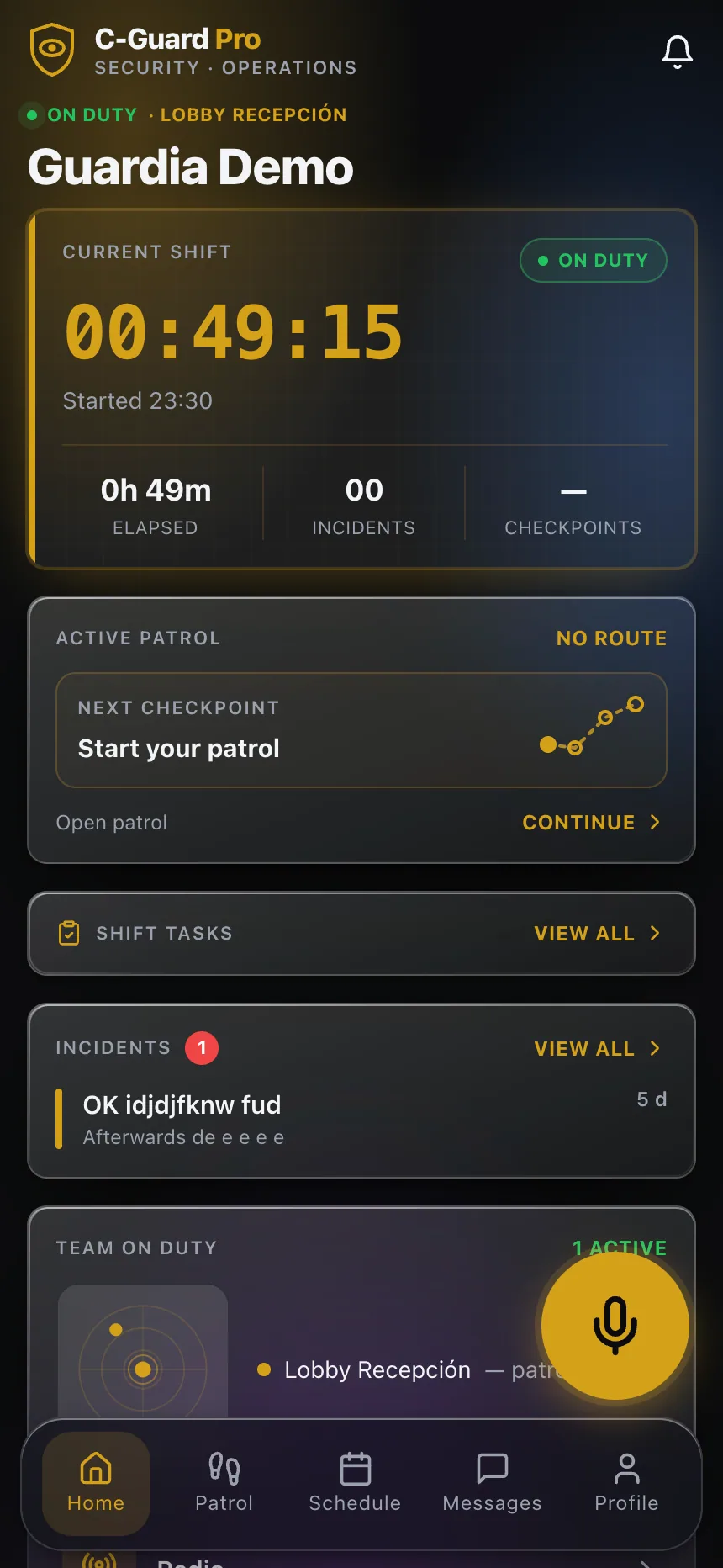
Software isn’t what makes this decision for you, but it does remove one variable from the list of things that can go wrong once you’ve committed: a scheduling and payroll and billing system that makes a two-person startup look as organized on a client walkthrough as a company twenty times its size. If you want to see what that looks like before you’re staffing your first post, explore CGuardPro or check pricing.