Ask most people what a security officer contributes to workplace violence prevention and you will get an answer about the moment of crisis — the officer who intervenes, restrains, ejects. That is the least likely and least useful part of the job. The contribution that actually reduces harm happens weeks earlier, in a paragraph of a daily activity report that nobody thought was important: the terminated employee who has come back to the parking lot three times, the visitor who will not give a name, the escalating argument at the loading dock that ended without anyone getting hurt.
Officers see the run-up. Whether that observation reaches anyone who can act on it is an operational design question, and most operations design it badly.
This article is general operational guidance, not legal advice. Workplace violence prevention program requirements vary considerably by state, by industry, and by client contract — some jurisdictions and sectors have specific written-plan, training and recordkeeping obligations, and general workplace safety duties may apply regardless. Verify what applies to you and your clients with the appropriate regulator and with counsel before you build a program around anything here.
Where the officer sits in the system
A contract security officer is not the client’s HR department, not a threat assessment professional, and not law enforcement. Being clear about that is not modesty — it is the thing that makes the officer useful.
The officer’s job in workplace violence prevention is threefold: observe, report accurately and quickly, and control access. Everything else belongs to someone with more authority, more information and more legal standing. An officer who understands this reports the terminated employee in the lot immediately. An officer who thinks it is his job to handle it goes and confronts the man, and now you have an incident instead of a report.
Access control is prevention
The least dramatic function is the most protective one. Knowing who is in the building, having a badge process that actually gets enforced, escorting terminated employees off property, disabling access on the day of separation rather than the following week — these are prevention. They are also the things that erode quietly when nobody is watching, because enforcing them creates friction with people who are usually harmless.
A useful rule for officers: the badge rule does not have exceptions for people who seem important. The single most common access failure in the trade is an officer waving through a well-dressed, confident person who says he is expected.
Warning behaviors officers are positioned to see
Threat assessment professionals talk about behaviors of concern rather than profiles, for a good reason: profiles do not work and they generate discrimination. Behaviors are observable, describable and reportable.
The categories an officer is genuinely well placed to notice:
Boundary probing. Someone testing access repeatedly — trying different doors, showing up at shift change, asking officers about camera coverage, schedules or who works late.
Fixation. Repeated appearances tied to one person or one grievance. Waiting in the lot. Asking after a specific employee by name without an appointment. Leaving notes.
Escalation in tone. The same person, each visit angrier, more specific, less willing to leave when asked.
Leakage. Statements about consequences, retribution or specific people, made to whoever is nearby — sometimes the officer, because officers are perceived as neutral.
Post-termination presence. Anyone recently separated who keeps returning to property they no longer have a reason to be on.
Domestic spillover. A partner or ex showing up at an employee’s workplace, especially where an employee has mentioned a protective order or asked officers to watch for someone.
None of these predict anything on their own. Their value is cumulative, which is exactly why the reporting path matters more than the observation.
Why the reporting path fails
Officers under-report low-grade concerns for reasons that are entirely rational:
- Nothing happened, so it feels like it does not warrant a report
- The report takes fifteen minutes on a paper form at the end of a twelve-hour shift
- Last time an officer reported something similar, no one responded and it felt like wasted effort
- The officer is not sure whether he is allowed to write down what someone said about a named employee
Three of those four are fixable by operations, and the fourth is fixable by training.
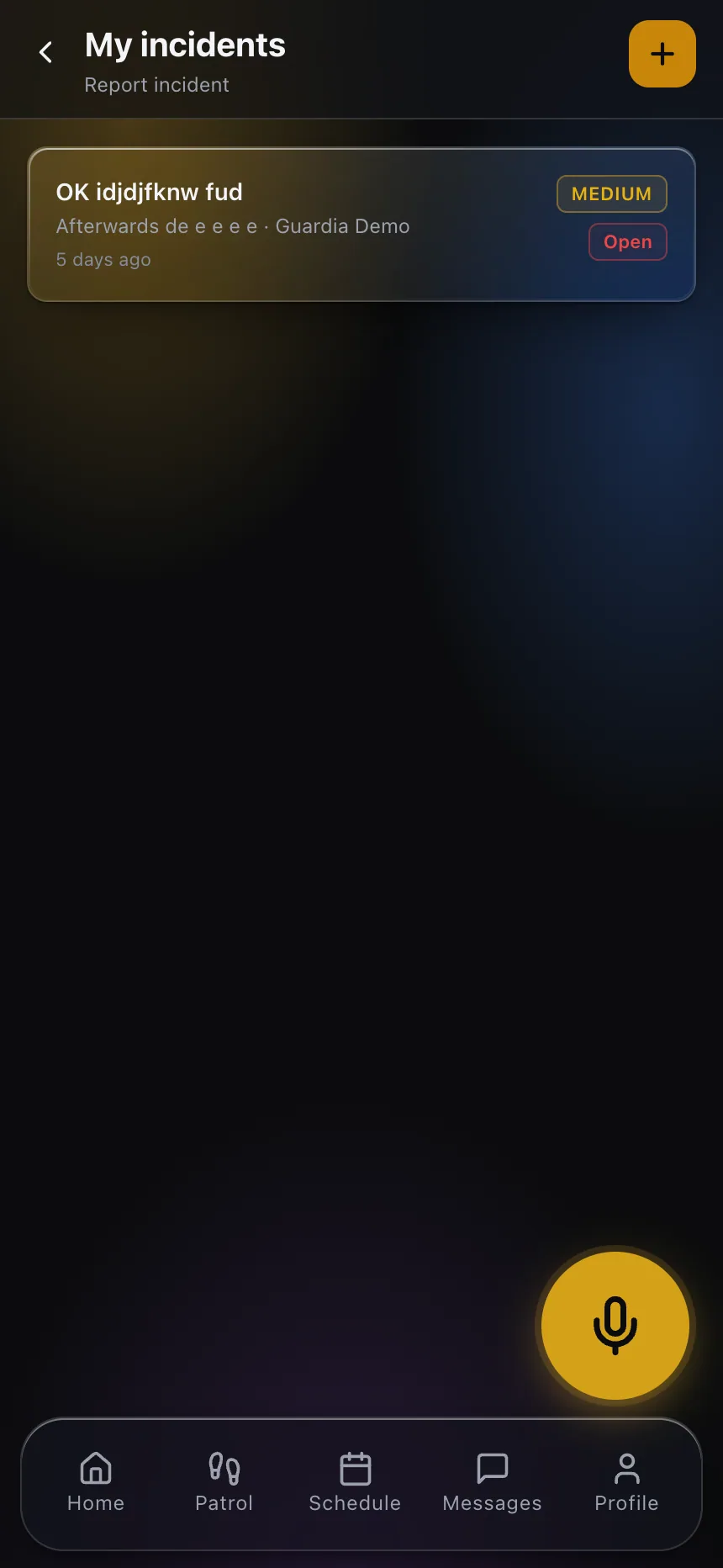
Make reporting cheap. If logging an observation takes two minutes on a phone at the moment it happens — with a timestamp, a location, and a photo if appropriate — you get the observation. If it takes a paper form in the guard shack at 0630, you get a shrug. Structured daily activity reports filed from the post are not an administrative nicety here; they are the mechanism that turns three separate officers’ vague unease into one visible pattern.
Make patterns visible. A single “unknown male in lot, departed when approached” is noise. The same entry from three officers across two weeks is a signal — but only if someone can see all three in one place. That is a supervisory review habit, not a technology feature: somebody has to read the reports.
Close the loop. Officers report more when reports visibly go somewhere. Even a brief acknowledgment — “we passed this to the client, they are aware” — sustains reporting behavior far better than silence.
Train the language. Officers should write what they observed and heard, in behavioral terms, without diagnosing anybody. “Subject stated he would ‘be back for’ the shift manager” is a report. “Subject appeared mentally unstable” is a liability.
The limits of a guard’s authority
Post orders should state these plainly, because the alternative is an officer improvising in a moment where improvisation is expensive.
Officers observe and report. Unarmed contract officers typically have no more authority than any other private citizen, and what an officer may lawfully do — detain, use force, carry, remove someone from property — varies substantially by state, by license type, by whether the officer is armed, and by the terms of the client contract. Do not assume; verify with your state regulator (in Texas, the Department of Public Safety’s Private Security Program administers the licensing scheme) and with counsel, and then write the answer into the post orders in language an officer can act on.
What should be unambiguous in every set of post orders:
- The officer does not physically intervene in a violent incident except in defense of self or others, within whatever the client contract and applicable law permit
- The officer does not attempt to disarm anyone
- The officer does not chase
- The officer calls 911 first and dispatch second when there is a weapon or an injury
- The officer does not counsel, mediate or negotiate an employment dispute
Officers who are told clearly what they are not responsible for make better decisions than officers left to guess.
Communication under duress
The practical constraint in a real event is that the officer often cannot talk. Reaching for a handheld and speaking into it while a hostile subject watches is not a neutral act.
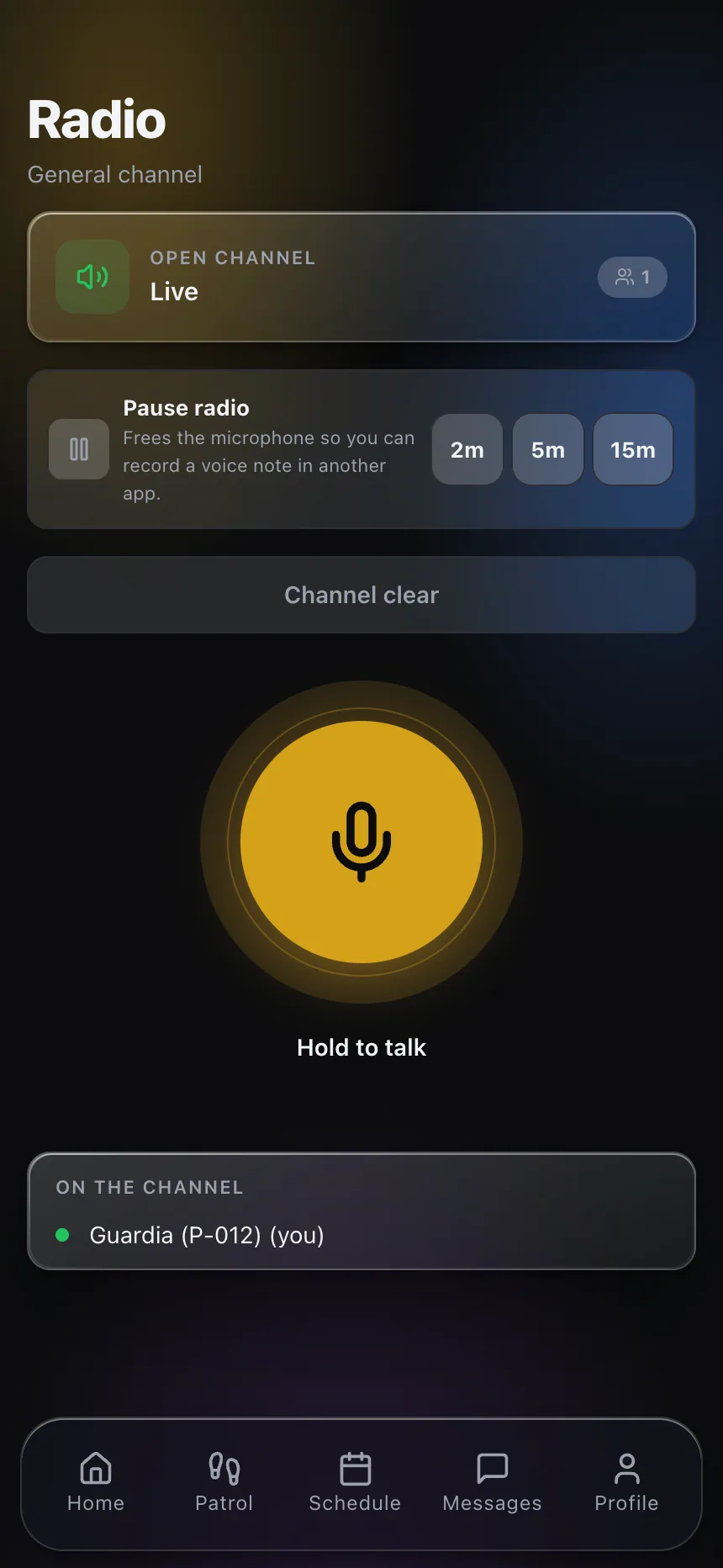
Two channels solve two different problems. A push-to-talk channel is the right tool when talking is safe and speed matters — hands stay free, and dispatch hears the situation develop. A silent panic alert is the right tool when talking is not safe: it reaches dispatch with position attached and no audible transmission. Officers need to have practiced both, because deciding which one to use is not something anyone does well for the first time under stress.
What a workable program looks like from the contractor’s side
You cannot write a client’s workplace violence prevention program for them. You can make your piece of it reliable:
- Post orders with explicit behavior-reporting instructions and explicit limits of authority
- Reporting that takes minutes, not the end of a shift
- A named client contact for concerning-behavior reports, in the contact tree, with an after-hours alternate
- A supervisory review that actually reads low-grade reports weekly, looking for repetition
- Recurring de-escalation and reporting training, documented
- A post-incident debrief that asks whether anything was reported beforehand and what happened to it
That last question is uncomfortable and worth asking every time. In most serious events that get reviewed afterward, someone had noticed something. The failure was almost never observation. It was the path between observation and someone with authority to act.
If you want to see how field reports, alerts and supervisory review fit together in one operation, explore CGuardPro or get in touch.