Every security company says its officers are trained in de-escalation. Most mean that someone sat through a slide deck during orientation, signed a roster, and has not thought about it since. Real de-escalation training security operations can rely on is a set of specific, practiced behaviors — where you stand, how you sound, what you offer, and when you disengage — reinforced by supervisors who ask about it after every difficult contact. Without that reinforcement, the class is a compliance artifact and the officer improvises under stress, which is exactly the condition the training was supposed to prevent.
This post describes general communication technique for contract security. It is not legal advice and it is not use-of-force instruction. What an officer may lawfully do, what training their license requires, and what their employer and the client permit vary by state, by license type and by contract. Use-of-force policy must come from your own counsel, your regulator and a qualified trainer — never from an article.
What de-escalation is actually for
De-escalation is not about being nice, and it is not about winning. It is about buying time and reducing the chance that a situation ends in an injury, a lawsuit or a headline.
That framing matters because officers often hear de-escalation as an instruction to absorb abuse. The honest version is narrower: most confrontations a security officer faces are not attacks. They are people who are angry, frightened, drunk, in crisis, humiliated, or simply having the worst day of their week, and who will comply with a reasonable request if the interaction does not force them into a corner. Handling those well is a skill. Recognizing the small fraction that will not resolve verbally — and getting distance and help instead of continuing to talk — is the same skill.
Note also the limit. A person in acute crisis, under the influence, or intent on violence may not be reachable by any words. Training that promises otherwise sets officers up to keep talking past the point where they should have backed off. The best programs are explicit that de-escalation can fail and that failing is not the officer’s fault.
Distance is the technique that does the most work
If a program teaches one physical habit, it should be this: create and keep space.
Space buys reaction time, which buys options, and it visibly signals that the officer is not attacking — which matters enormously to someone already keyed up.
Practical habits worth drilling until they are automatic: approach at an angle rather than straight on; stop farther away than feels natural and let the subject close the gap if they choose; keep something — a counter, a planter, a vehicle — between you when the situation is tense; never let yourself get backed into a corner or a doorway; and know where your exit is before you start talking, every time.
Officers also need permission to break contact. Many will keep engaging past the point of usefulness because disengaging feels like losing. Say clearly, in the post orders, that withdrawing to a safe distance and calling for support is a correct outcome, not a failure — and then never let a supervisor undercut that by asking why they backed off.
Tone, pace and the words that make things worse
Under stress, voices rise in pitch and speed. Deliberately lowering both is the most portable de-escalation skill there is.
Slow down. Drop volume rather than raising it — people often quiet down to hear you. Use short sentences; a person in an agitated state cannot process a paragraph. Use the person’s name if you know it. Leave silence after you speak instead of filling it, because silence gives the other person room to come down.
Certain phrases reliably escalate and should be trained out explicitly. “Calm down” tells someone their reaction is illegitimate. “You need to…” issues an order that invites refusal. “It’s policy” is an answer that satisfies nobody. Sarcasm, in any form. Any comparison to other people who behaved better. And the fatal one: continuing to argue about who is right. Being right is not the objective.
What works instead is acknowledgment before instruction. Naming the emotion — “I can see this is frustrating” — costs nothing and is not an admission of anything. Explaining the reason briefly, once. Then a clear, specific, achievable request: not “you need to leave,” but “I need you to walk with me to the front door and I’ll get the manager’s card for you.”
Options and the exit
The reason people escalate is usually that they feel they have no acceptable choice. Restoring a choice, even a small one, changes the dynamic more than any phrasing.
Offer two acceptable paths where you can. Wait in the lobby or come back at nine. Talk to me or talk to the manager. Move the car yourself or I’ll call for a tow. Both options have to be ones you can live with, because a bluff that gets called removes your credibility for the rest of the encounter and for every future contact with that person.
Give people a way to comply without humiliation, especially in front of an audience. A person who has been publicly embarrassed will often refuse something they would have accepted privately, so move the conversation away from onlookers and drop your voice.
And know the exit — for both of you. The officer’s exit is a route to safety and support. The subject’s exit is a face-saving way out of the situation. Blocking either one is the fastest path to a fight.
The support behind the officer
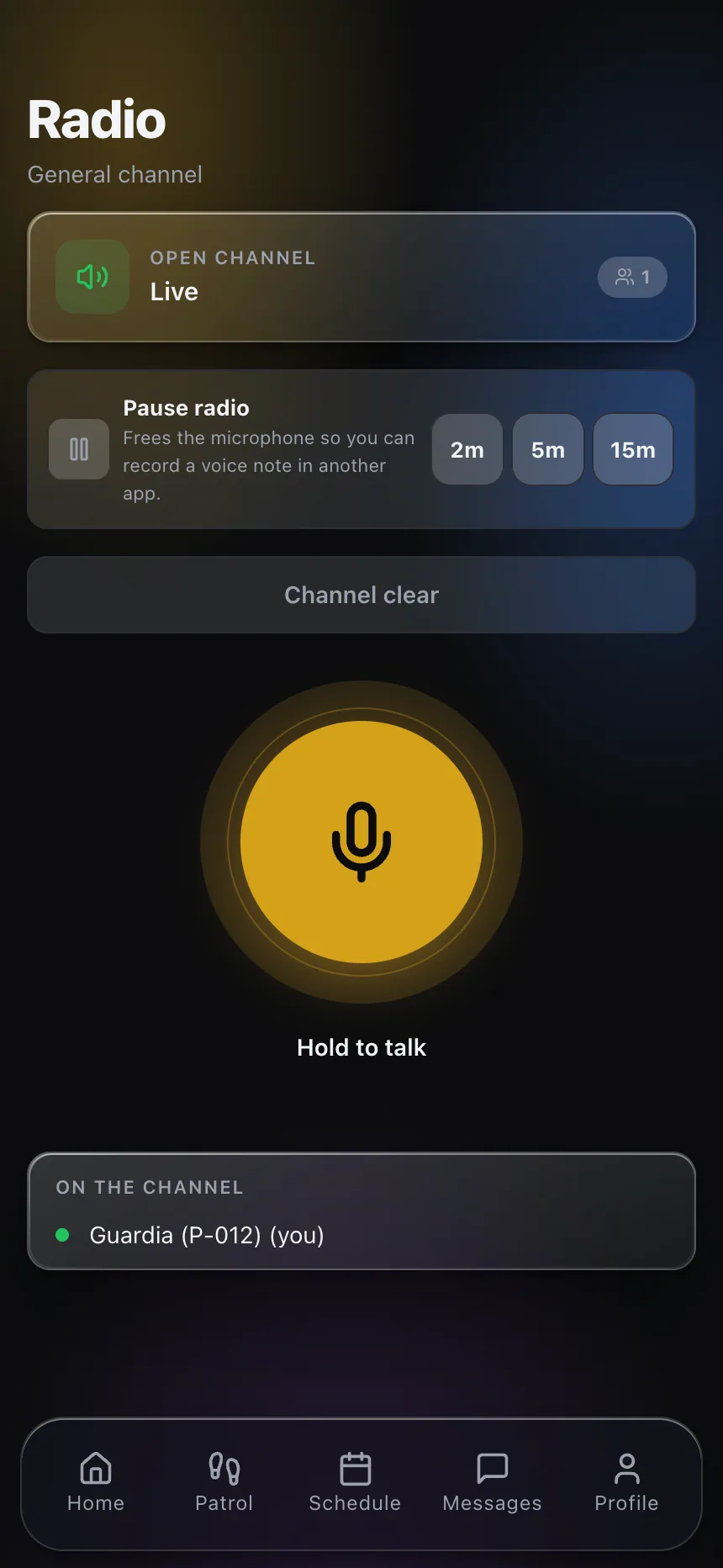
An officer who can call for a second unit, a supervisor or the client’s own staff without breaking eye contact or reaching for a phone has a real advantage. A push-to-talk channel that dispatch can hear does two things at once: it summons help, and it puts a witness on the conversation.
Officers also need to know, without hesitating, when a situation stops being theirs. Weapons, credible threats of violence, apparent medical or psychiatric emergencies, and anything involving a crime in progress belong to law enforcement and to 911. A panic activation that reaches a live dispatcher with the officer’s location attached is the right tool for the moment when talking has clearly stopped working — and the standing instruction should be that using it early is always preferable to using it late.
Where de-escalation training security programs break down
Skill comes from repetition, feedback and reinforcement, and all three live with the field supervisor.
Scenario practice, short and frequent. Ten minutes at shift briefing, run live, with a real script for the difficult person. The scenarios should come from your own accounts: the tenant who parks in the fire lane, the intoxicated patron at 0130, the terminated employee who came back for their belongings, the person who wants to film the officer and is deliberately provoking. Generic role-play does not transfer; the account’s actual recurring conflict does.
Read the reports for technique, not just outcome. An incident narrative shows how the officer engaged: whether they gave options, whether they withdrew, how long they stayed in it. That is coachable material sitting in your daily activity reports already.
Reward the disengagement. This is the cultural test. The first time an officer backs away from a confrontation and calls for support, the company’s reaction teaches everyone what is actually valued. If the response is “why didn’t you handle it,” no amount of training will overcome that.
Check the conditions, not only the people. Recurring conflict at a specific post is usually a design problem: unclear signage, a rule nobody communicated, a badge process that fails at shift change, an entrance that funnels frustrated people at one officer. Fix the condition and the number of hard contacts drops without anyone having to be better at talking.
The measure that matters
Do not try to measure de-escalation by counting anything. Measure it by asking supervisors a question after each difficult contact: did the officer have space, options and an exit? If the answer is yes and the situation still went physical, the training held and the circumstances did not. If the answer is no, you have found the specific thing to work on next week.
That question, asked consistently, will do more than any additional class. Skills survive when someone in authority keeps asking about them.
If you want to see how field reports, radio and alerts support officers during difficult contacts, explore CGuardPro or get in touch.