Security guard software
built for hospitals
A hospital never closes, and neither should the record of what your officers did inside it. Every round through the wards is verified checkpoint by checkpoint, every incident is filed with photos the moment it happens, and the facility's security director can see the service they contracted without picking up the phone.
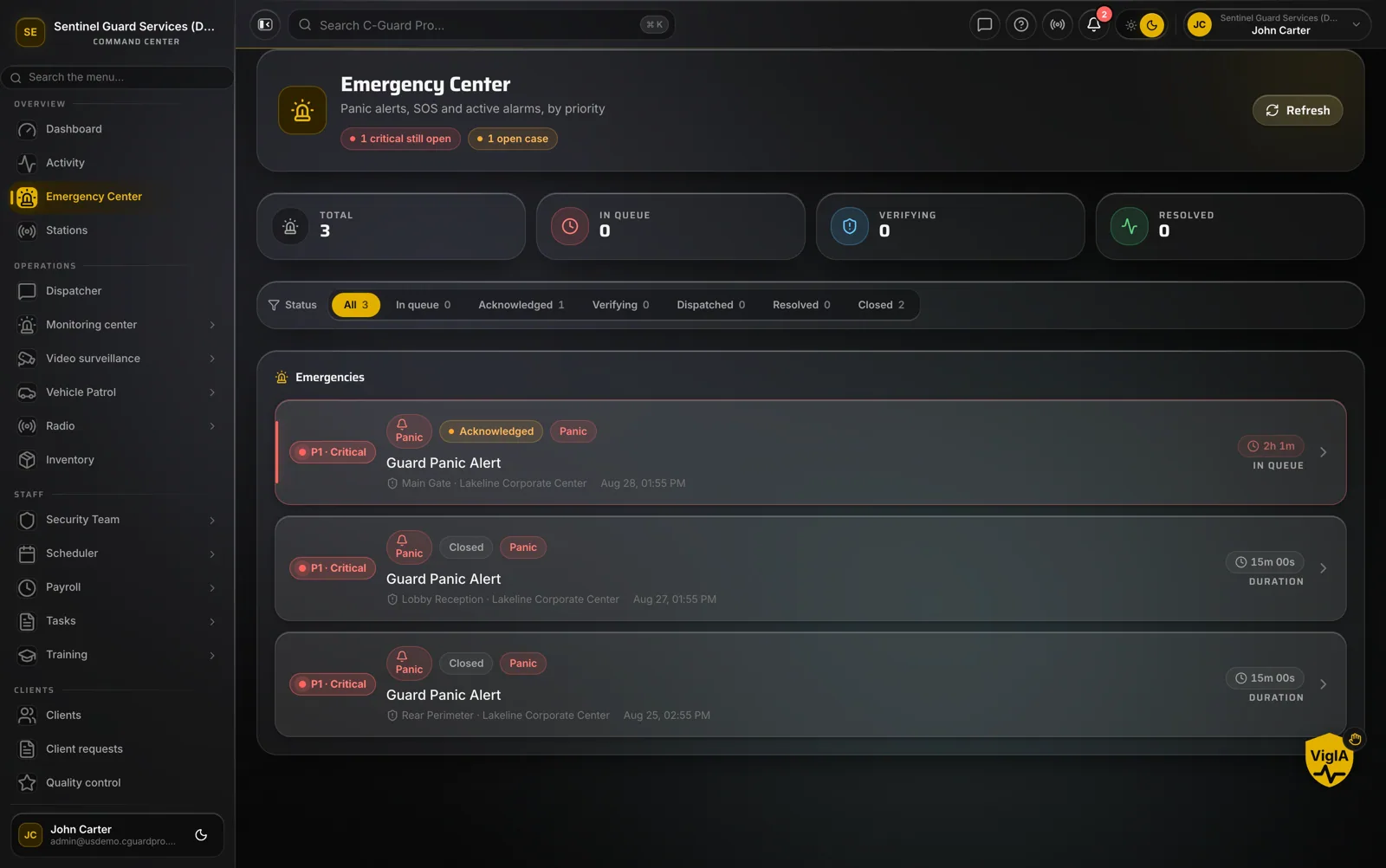
Real product screenshots
Why hospital contracts are the hardest to hold
Nobody can prove the night round happened
A sheet signed at the nurses' station proves a pen touched paper. When an administrator asks who walked the third floor at three in the morning, that is not an answer — and the contract is decided on answers like that.
Incidents get described, not documented
An aggressive visitor in the emergency department becomes a verbal account by the morning handover. With no time, no place, no photo and no named officer attached, it is one person's word against another's.
A gap at the emergency entrance is not an inconvenience
It is an open door. If the first you hear about an uncovered post is the client telling you, the argument is already lost.
How a hospital operation runs on CGuardPro
Checkpoints along the route that matters
QR codes at the entrances, the emergency department, the pharmacy corridor, the stairwells and the perimeter. The officer scans them with the phone already in their hand.
Attendance verified at every post
Officers clock in with a selfie and the phone's position, checked against the post, so the person on the emergency door is the person assigned to it.
Incidents filed where they happen
Aggression, a patient who has wandered off, a car blocking the ambulance bay — reported from the phone with photos, category and severity, and visible in dispatch straight away.
The facility sees its own service
The hospital's security director gets a portal limited to their site: the rounds completed, the reports filed and the incidents raised, with the times they really happened.
What the hospital actually gets
- Time, position and identified officer on every checkpoint scan
- Incident reports with photos, category and severity, filed from the floor
- Alerts when a round is missed or a post is left without an officer
- Panic button on every officer's phone, wired into your monitoring center
- Visitor and vehicle log for the entrances and the ambulance bay
- A full site history you can export when the facility audits the contract
Frequently asked questions
How do you prove a night round was actually walked? +
Each checkpoint scan carries the time, the phone's position and the identified officer, and it is verified when it reaches the system — a code scanned from somewhere else, or out of sequence, is not accepted. The round is then readable as a whole: what was covered, what was skipped and how long it took.
Will the app work in basements, service corridors and elevators? +
Yes. Scans, clock-ins, reports and photos are stored on the phone with their real time and position and upload themselves when coverage returns. The officer is never blocked by a dead spot.
What happens if a post is left uncovered mid-shift? +
The missing clock-in raises the alert itself, so dispatch sees the uncovered post instead of hearing about it from the hospital. From the same screen you can see who is available and reassign, and the officer you pick is notified in their app.
Can the hospital see the activity without calling our office? +
Yes. Their portal is limited to their own site and shows completed rounds, activity reports with photos and the incidents raised. Your internal operation and your other clients are invisible to them.
Do we have to install anything in the building? +
No. Checkpoints are printed QR codes — NFC tags if you prefer them — and officers use their own phones. There is nothing to wire into a building that already has enough cabling in it.
Can we keep different patrol rules for day and night? +
Yes. Frequency, tolerance and the hours a route applies are set per post, so the daytime pass through the wards and the night perimeter round are two different sets of rules on the same site.
See a hospital round, end to end
Book a demo and we walk one real route with you: the scan at the emergency entrance, the incident filed from the ward, and the report landing in the facility's portal.