A warehouse is the hardest common assignment in contract security, and it rarely gets treated that way. It looks simple from the outside — a big box, a fence, a gate — so it gets priced and staffed like a simple site. Then the officer arrives and finds forty dock doors, a trailer yard with no lighting past the third row, three shifts of employees, a constant flow of drivers who do not work for the client, and a building where you can stand in one corner and be genuinely unreachable by radio. Effective warehouse patrol is a design problem, and the design has to account for a facility that is working while you patrol it.
Understand the loss picture before designing the route
The threats at a distribution center are not the threats at an empty construction site, and routes copied from one to the other fail.
Product loss is mostly internal or internal-adjacent. Not always, but often enough that a route built entirely around the perimeter fence is solving the wrong problem. The classic mechanisms are familiar to anyone who has worked retail supply: product staged near a door it does not belong near, a pallet that leaves on a trailer it was not manifested to, a returns or damages area that becomes a laundry, an employee exit used to move small high-value items out by hand.
Trailers are the highest-value single target. A loaded trailer sitting in a yard is a shipping container’s worth of goods with wheels attached. Yard theft is a specialized crime with a specialized method — a tractor arrives, hooks a trailer, and leaves — and it takes minutes.
The yard and the dock are where people get hurt. Yard trucks moving in the dark, drivers walking between trailers, dock plates, trailer creep. A meaningful share of what your officers should be watching for is safety, not crime, and clients feel it directly.
Access control is a moving target. Drivers, temp labor, contractors, cleaning crews, vendors servicing equipment. On a busy dock the population of people on site who are not the client’s employees can be substantial, and the officer is usually the only person tracking them.
Route design for a working building
Dock doors: prove the length, not every door
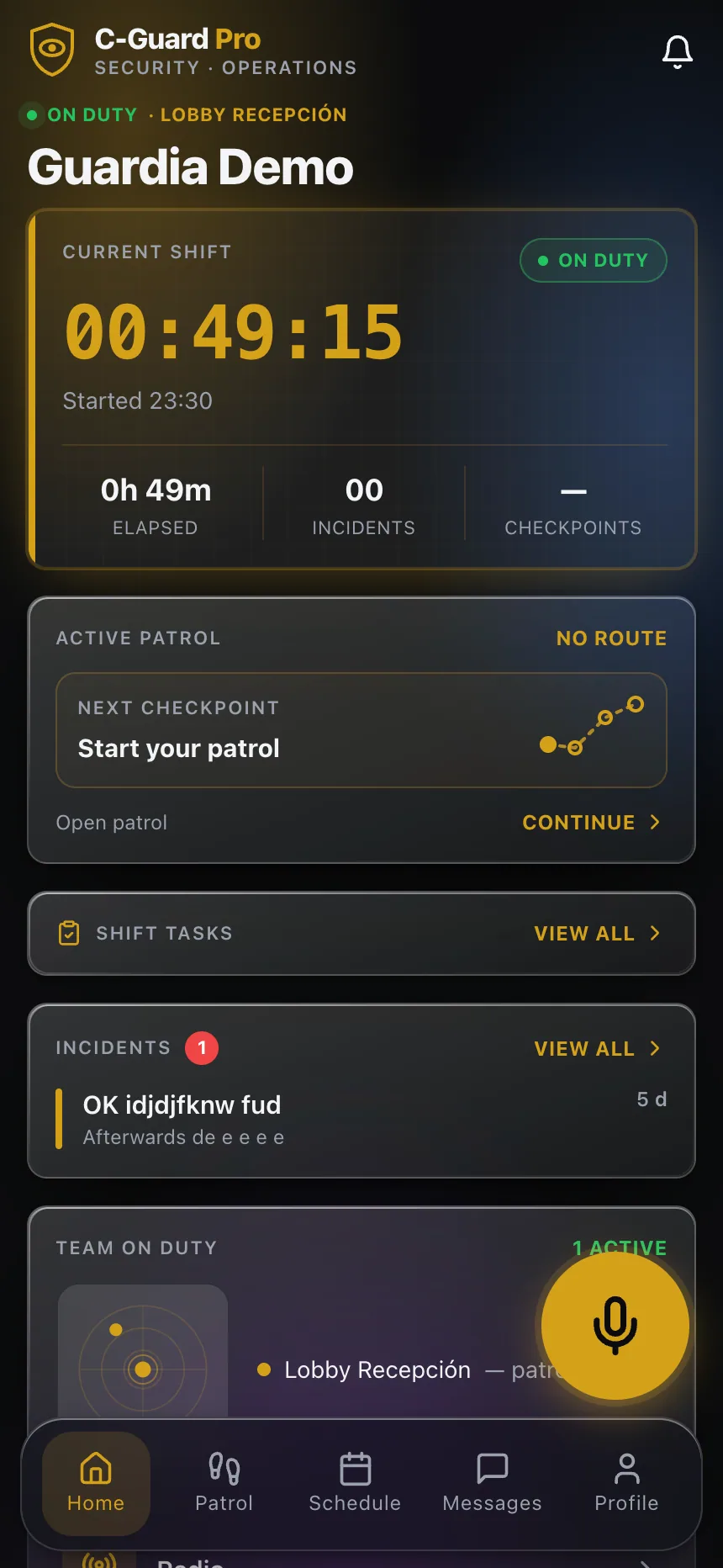
One checkpoint per dock door produces an unmanageable route and trains officers to walk the line scanning without looking. Group the doors into ranges and place checkpoints at the ends and middle, so completing the segment requires actually traveling it. Then define what the officer is checking as they walk: doors that should be closed and secured are; doors that are open have a trailer at them; nothing is staged in front of a door that should not be.
The last one is the highest-value observation on the whole site and the least likely to be in the post orders. Product staged by a door outside of an active load, especially near shift change, is worth a note every single time.
The trailer yard needs to be entered, not observed
A scan at the yard gate proves the officer reached the gate. Put checkpoints at the far end of the yard and along the rows, positioned so they cannot be plausibly reached from a vehicle at the entrance. Yard checks should include: trailer numbers present against what is expected, seals intact on loaded trailers, kingpin locks or glad-hand locks in place if the client uses them, landing gear down, and nothing parked in the fire lanes.
Seal checks deserve a specific note. If your officers are recording seal numbers, the record only matters if it is timestamped and attributable — a number written on a clipboard three hours later is not evidence of anything. Capturing it at the trailer, with a photo of the seal, is a different artifact entirely.
Interior: the areas nobody wants to visit
Returns and damages. The trash compactor and baler — a classic route for product to leave a building. Battery charging rooms and mechanical spaces, which are both a fire concern and a good place to hide things. Employee break areas and locker rooms, subject to whatever the client’s own policy and any applicable law permits; do not improvise here, get the boundaries in writing.
Mezzanines and racking aisles do not need dense checkpoints, but the route should include enough of them that an officer’s presence in the pick modules is not remarkable.
The employee exit at shift change
This is the single most important timing decision on the site, and it is worth planning the route around it. Presence at the employee exit during the shift change window is high-visibility, high-deterrence, and completely predictable in a way that is fine here — visible presence is the point.
The shift-change window
Shift change is when a warehouse is at its most permeable. The doors are propped, the parking lot is full, supervisors are handing off, the dock is busy with the last loads of one shift and the first of the next, and everyone is distracted.
Design for it explicitly:
- Officers should not be running a long interior tour during shift change. Bring them to the perimeter of the change — exits, parking lot, dock entrance.
- Do not schedule your own relief at the same time as the client’s shift change. This seems obvious and is violated constantly. If your officer is doing a post relief and pass-down at the same moment the client’s building turns over, nobody is watching either.
- If the client runs three shifts, that is three windows a day, and your route cadence should bend around all of them.
What the officer should be capturing, not just checking
The difference between a warehouse account you keep and one you lose on price is usually the quality of what your officers write down. Distribution operations run on exception reporting, and your officers see exceptions the client’s own staff walk past.
Worth capturing every time, with a photo and a location:
- Dock doors found open with no trailer.
- Product staged in an unusual place, especially near an exit or the compactor.
- Trailers in the yard with broken or missing seals, or trailers not on the yard list.
- Fire lane obstructions, blocked exits, chained emergency doors.
- Lighting failures in the yard and lot — these compound into both loss and injury exposure.
- Vehicles in employee lots at hours that do not match a shift.
- Any driver or contractor who could not be verified.
Filed as daily activity reports in the moment, these become a monthly exception list the client’s operations manager will genuinely read — which is a very different relationship than sending a scan log.
Communications and officer safety
Steel buildings eat radio and cellular signal. Before you commit to a communications plan, walk the building and find the dead zones — they are always the mechanical rooms, the freezer if there is one, and the far end of the racking. Then decide what happens when an officer is in one.
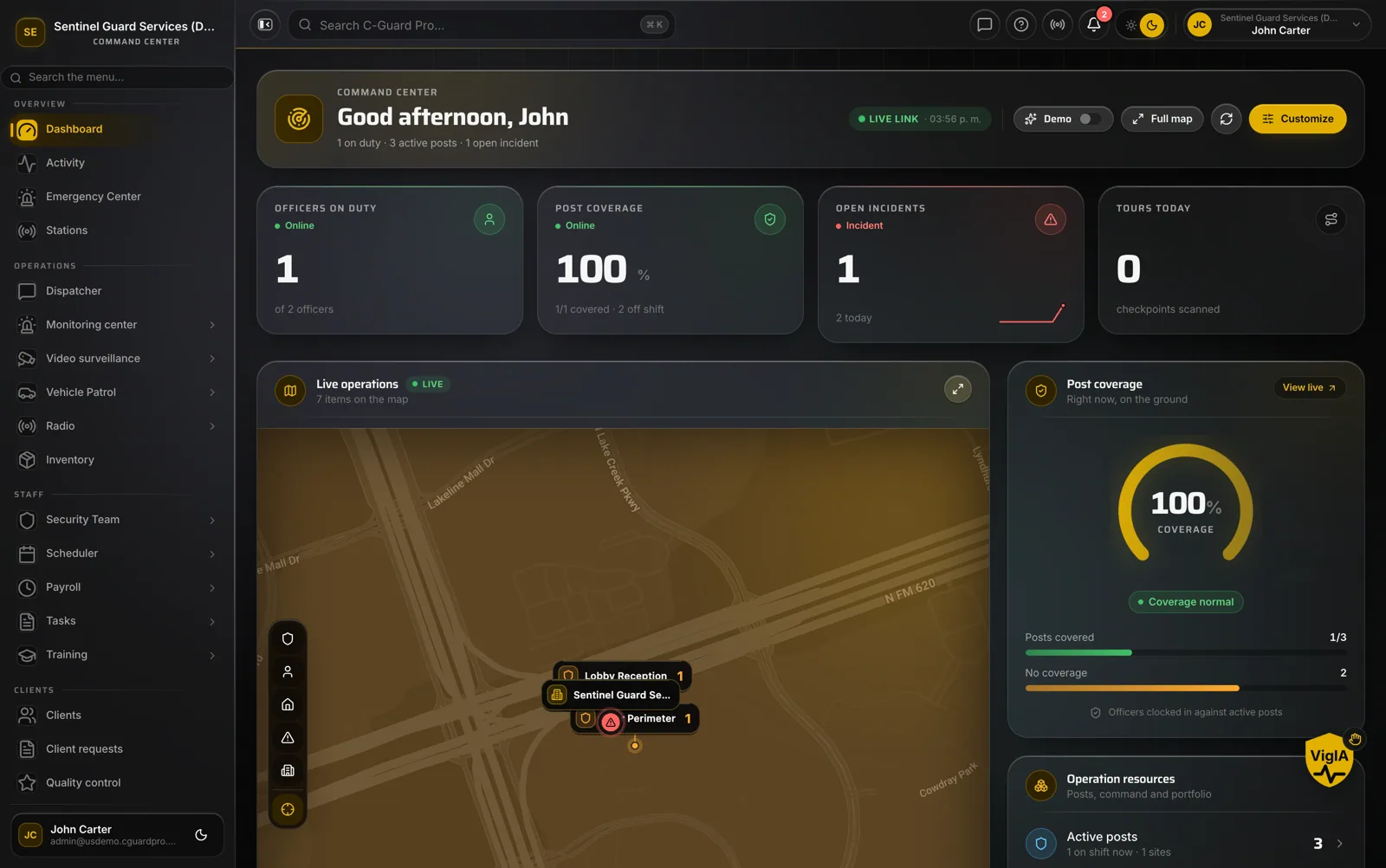
Two practical measures. First, a check-in cadence the officer is expected to meet, so an unanswered interval is itself a signal rather than something noticed an hour later. Push-to-talk over the mobile app works wherever the officer has coverage, which makes mapping the dead zones a prerequisite rather than an afterthought. Second, note in the post orders where an officer should go to reestablish contact, so nobody is wandering.
Yard work at night deserves its own line: high-visibility vest, awareness of yard truck traffic patterns, and a standing rule about never walking between trailers that are being moved.
The account-level habits that matter
Re-walk the route quarterly with the client’s operations lead. Warehouses change constantly — a new customer means new staging areas, seasonal peak means temp labor and trailers stacked in places that were empty in March. A route designed in a slow month is wrong by peak season.
Read the tour timing, not just completion. A yard check that consistently takes two minutes is not a yard check.
And keep the tour route definitions current in the system rather than in an officer’s head. On a site with turnover, the route that lives only in the head of the officer who has been there two years disappears the week they leave.
If you want to see how tours, field reports and dispatch fit together on a facility this size, explore CGuardPro or get in touch.