Ask three operations managers how many guard tour checkpoints a route should have and you will get three numbers, all defended with total confidence and none of them derived from anything. The honest answer is that the count is an output, not an input. You decide what the tour has to prove, how long the officer has, and what else the post demands — and the number falls out of that.
The tradeoff nobody explains
A tour with too few checkpoints proves nothing useful. Three points on a fifteen-acre industrial site tells a client that an officer touched three spots. It does not tell them the trailer yard was walked, and it will not help you in a dispute about the corner of the property where the fence was cut.
A tour with too many checkpoints causes a different failure, and it is the more common one. When a route has more points than the officer can reasonably cover in the time allotted, the officer does not slow down. The officer adapts. They walk faster, look less, batch the scans at the end, or quietly decide which three points are optional. You have not increased coverage — you have converted a patrol into a scanning errand and destroyed the thing you were trying to measure.
That second failure is invisible in the data. The tour completes. Every point is green. The client sees a perfect month. Nobody sees the officer jogging past the loading dock without looking at it.
So the sizing rule is: the number of checkpoints must leave enough slack that the officer’s attention, not their pace, is the limiting factor.
Start from what the tour has to prove
Before counting anything, write down the specific claims the tour exists to support. Not “we patrol the property” — actual claims, in the language a property manager or a claims adjuster would use.
For a distribution center that might be: every dock door was checked in a locked condition; the trailer yard was entered; the driver lounge was cleared; the two employee exits were observed near shift change.
For a Class A office tower: the loading dock roll-up was secured; each stairwell was traveled top to bottom at least once per shift; the garage lower level was swept; the after-hours access doors were verified.
Now each claim needs at least one checkpoint anchoring it. Some need two, because the claim is about a span rather than a spot — a stairwell is only meaningfully covered if the officer enters at one end and exits at the other, which is two points, and the time between them tells you whether they actually walked it.
That exercise usually produces a first draft count that is defensible, because every point traces back to something the client cares about.
Then divide by the clock, honestly
Take your draft count and walk the route yourself, at the pace you actually want the officer to move — the pace where they look into the corner, rattle the padlock, notice the door that is not sitting flush. Time it. Add time for the things that always happen: a tenant stops the officer to ask a question, a vehicle needs to be checked, a door is jammed.
Now compare that against the tour window. If the post requires three tours on a twelve-hour shift, and the site also needs a static presence at the lobby desk, the real time available per tour may be far less than the shift math suggests.
If the honest walk time exceeds the window, you have three options, in order of preference:
- Split the route. Two shorter tours covering different halves of the property, alternating, is almost always better than one rushed tour covering everything badly. Coverage over a shift is what matters, not coverage per lap.
- Reduce frequency, keep the points. A thorough tour twice a shift beats a superficial one four times, unless the client is buying visible deterrence at a fixed cadence — in which case say so and price it.
- Cut points. Do this last, and cut the ones that duplicate an adjacent point rather than the ones that are inconvenient. The inconvenient point is usually the one that matters.
Sizing by site type
These are shapes, not formulas. The count still comes from your own walk.
Single-building office or medical
Fewest points, tightly clustered. The value is in the vertical: stairwells, mechanical spaces, roof access, garage levels. Two points per stairwell (entry and exit), one per garage level, one at the loading dock, one at each after-hours entrance. Interior points can be sparse because the officer passes them naturally.
Warehouse and distribution
More points, driven by dock doors and the yard. Grouping dock doors into ranges rather than one point per door keeps the count manageable while still proving the officer traveled the length of the dock. The trailer yard needs at least two points at opposite ends so a single scan from the vehicle at the gate does not read as a yard sweep.
Retail, mixed-use and residential
Fewer fixed points, more discretion. The route matters less than presence at specific times — the parking structure after a shift change, the pool deck at closing. Here the checkpoint count should be modest and the tour schedule should carry the weight.
Large campus or multi-parcel industrial
The count grows, but so does the case for splitting into named routes: Perimeter, Interior, Yard. Each route gets its own checkpoint set and its own completion record, so an incomplete Yard tour is legible on its own instead of hiding inside a giant partial route.
Anti-patterns worth naming
The checkpoint that exists to catch the officer. Someone puts a point at the top of a rarely used stairwell purely to see who skips it. It works once. Then the force learns it is there, and all you have built is resentment plus a data point that measures compliance rather than security. Put points where the risk is, and let compliance follow.
The point nobody can reach. A checkpoint inside a tenant suite that is locked after 6 p.m. will be missed every single night shift. The officer is not failing; the route is wrong. Every missed point that has a structural explanation trains everyone to ignore missed points in general.
Counting points instead of reading tours. A supervisor who reviews “23 of 24 scanned” and moves on has learned nothing. The interesting data is the interval between scans. Four points hit within ninety seconds of each other on a route that takes twenty minutes to walk is a story. So is a fifty-minute gap in the middle of a tour — sometimes it means the officer was handling something and should have logged it, and sometimes it means something worse.
Review the count, on a schedule
A route sized correctly in March may be wrong in September. Tenants move, construction starts, a client adds a building, a fence line changes. Put a route review on the account calendar — quarterly is a reasonable default — and hand it to the field supervisor during a normal site visit rather than treating it as a project.
Two questions drive the review: is any point being missed repeatedly, and if so why; and has anything changed on this property that no checkpoint currently touches. Officers usually know the answer to the second one before management does, so ask them.
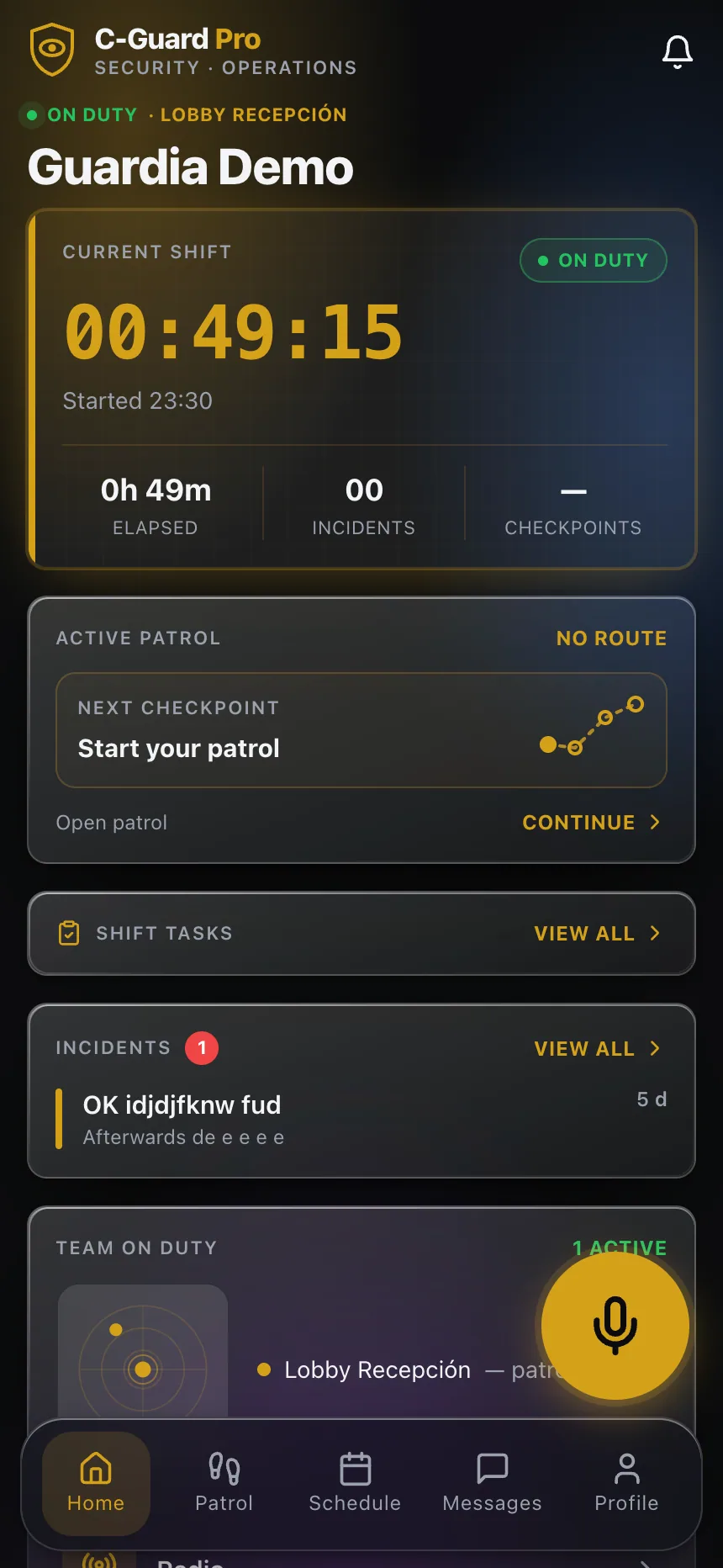
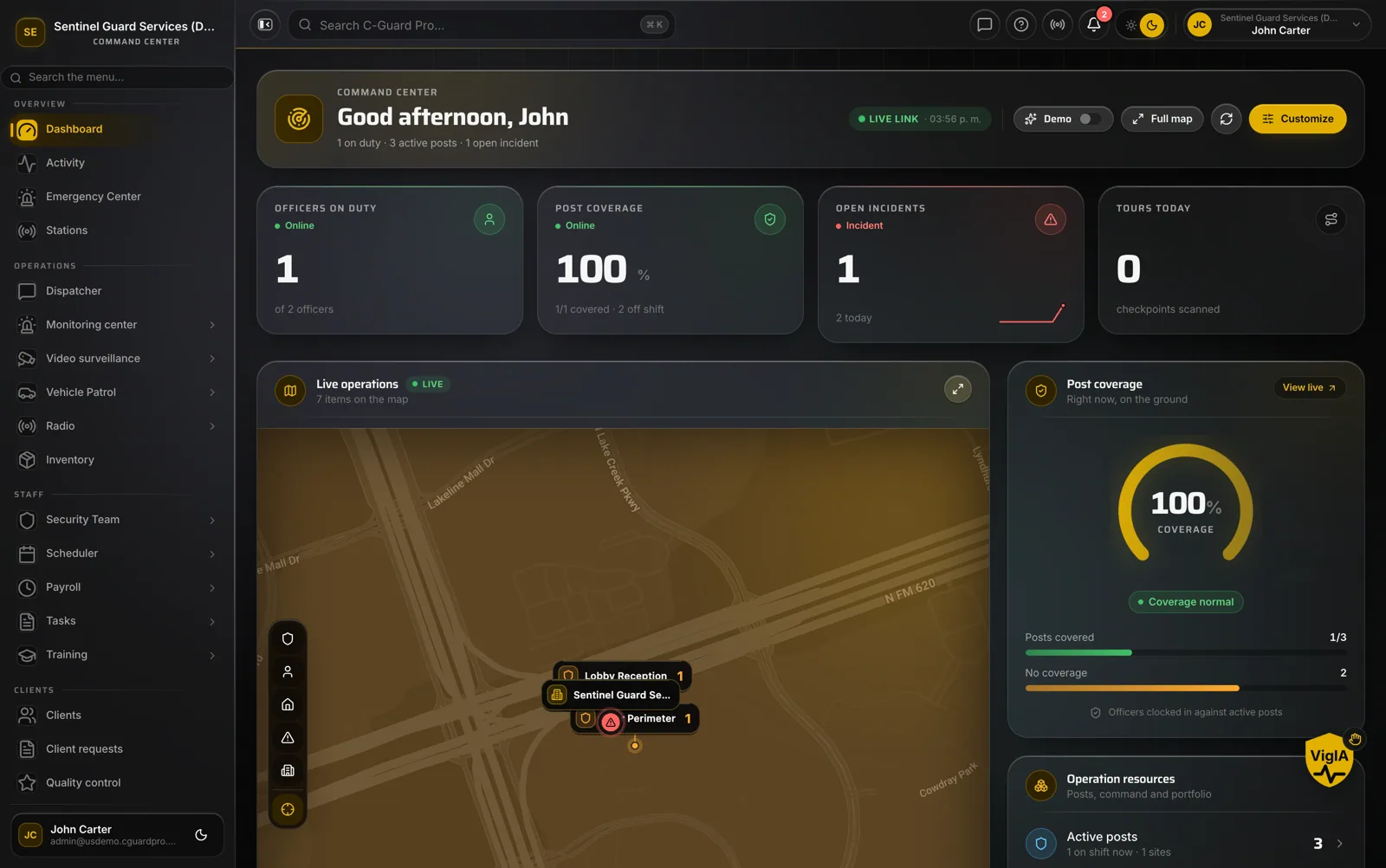
When routes and completion data live in the same system as tour scanning and GPS position, that review takes minutes rather than an afternoon of spreadsheets, and the resulting change is visible to the client in their portal without you having to explain it.
The short version
Count backwards from claims, divide by an honest walk, leave slack, and split before you rush. A route your officers can complete thoroughly, with a handful of well-placed guard tour checkpoints, will defend your work far better than a dense route everyone games.
If you want to see how routes, timing and completion records fit together, explore CGuardPro or get in touch.