Ask an owner what their biggest controllable cost problem is and almost nobody says uniforms. Ask the same owner how many complete uniform sets are currently in the possession of people who no longer work there, and the room goes quiet. Uniform equipment management is the classic small-leak problem: no single loss is worth chasing, every loss is invisible in isolation, and across a roster with normal turnover the total is real money that never appears as a line item anyone defends.
The shape of the leak
Uniform and equipment loss in a contract security company is not usually theft. It is drift.
An officer is hired, issued two shirts, two pairs of trousers, a duty belt, a jacket, a badge and a name tag. Three weeks later he is moved from a construction site to a corporate lobby and needs a blazer instead of a bomber. The bomber goes in the trunk of his car. Two months later he stops showing up, does not answer, and is separated as a no-call. Nobody knows what he had, because the issue record was a line in a spreadsheet that said “uniform issued.”
Multiply that across a year. Add radios, flashlights, high-visibility vests, rain gear, tablets and phones, gate remotes and site keys. Add the officers who are still employed but have quietly accumulated three shirts because it is easier to request a replacement than to explain a stain. Add the supply closet where nobody knows the count because the last inventory was taken by someone who has since left.
None of this requires bad actors. It requires only that nobody owns the record.
Why it gets worse as you grow
At twenty officers, the operations manager knows everyone and roughly what they have. At two hundred, that knowledge does not scale, and the informal system fails silently — you do not get an alarm, you get a slowly rising line in the supply budget that everyone attributes to growth.
There is also a compounding effect that is easy to miss. Uniform shortage causes scheduling failures. When an officer is dispatched to cover a callout at a site with a different uniform standard and does not have the right shirt, you either send him non-compliant, send someone else, or send nobody. All three cost more than the shirt.
Build the issue record around the person, not the closet
Most companies that try to fix this start with inventory management — counting what is in the supply room. That is the wrong end. Closet inventory tells you what is left, not who has what.
The durable record is per-officer: for each person on the roster, what was issued, when, in what size or serial, and its status. Issued, returned, replaced, written off, unaccounted.
Three details make the record actually work:
Serial or unique identifiers where they exist. Radios, body cameras, phones, tablets and gate remotes all have serials. Record them. An issue record that says “radio” is nearly useless when four officers hand back four radios and one of them is dead. An issue record that says which unit went to whom turns a dispute into a lookup.
Signature at issue, in a form you can retrieve. A paper acknowledgment in a personnel folder in a filing cabinet is technically a record and practically not one, because retrieving it at separation takes longer than anyone will spend. A digital acknowledgment attached to the officer’s profile is retrievable in seconds by whoever is processing the exit.
Condition and photos. A photo at issue and a photo at return kills the argument about whether the jacket came back torn. It also protects the officer, which is the framing that gets buy-in. Officers are not opposed to accountability; they are opposed to being blamed for damage they did not cause.
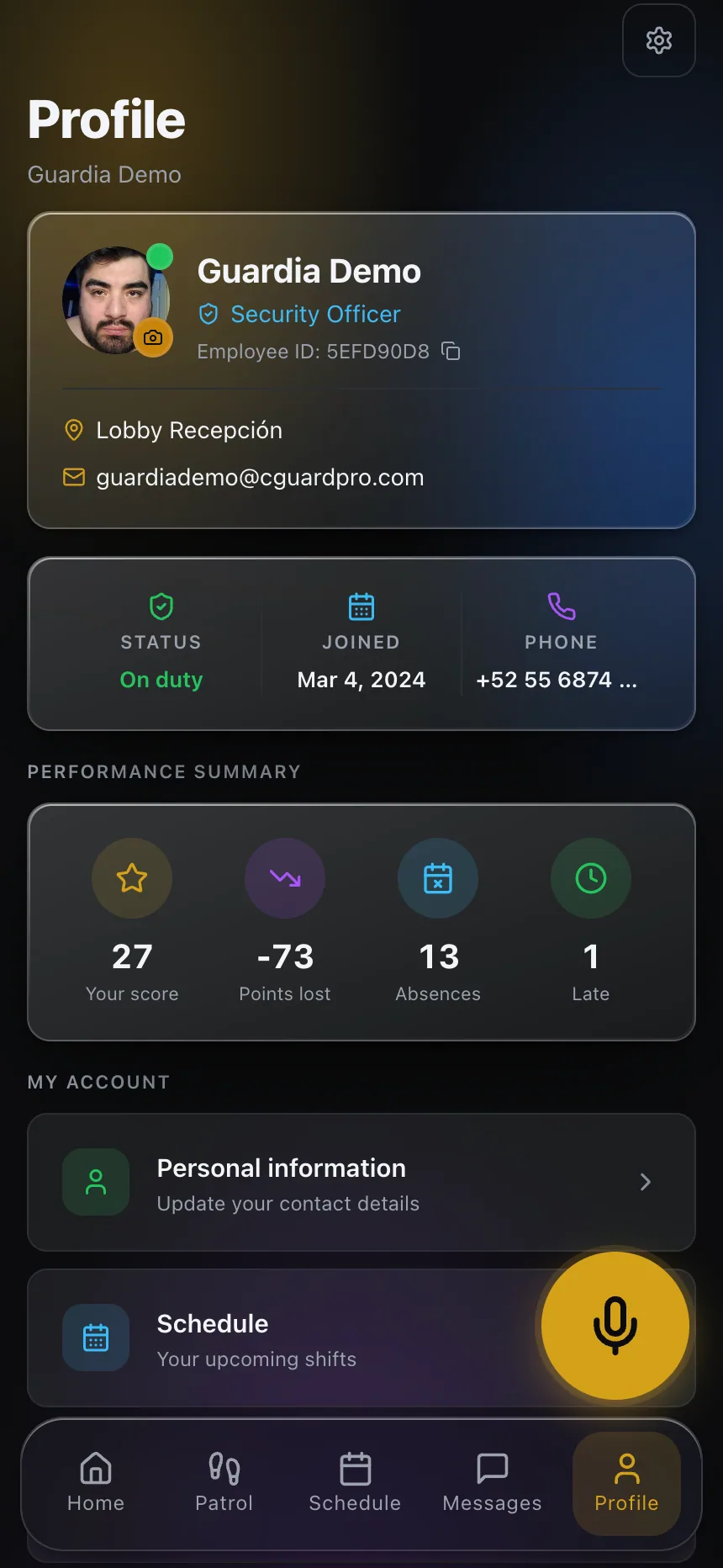
If your officers already carry a guard mobile app for clock-in and reporting, the issue record belongs on their profile where they can see it. That transparency does more for recovery than any policy memo. An officer who can open the app and see “1 duty jacket, issued March 4, outstanding” knows exactly what he owes. An officer who has no idea what the company thinks he has will assume the company does not know either — and will be right.
Deposits and deductions: proceed carefully
The obvious lever is money. Charge a deposit, or deduct the value of unreturned items from the final paycheck. Both are common in the industry, and both are legally sensitive.
Rules on payroll deductions for uniforms, equipment and deposits vary considerably by state, and some jurisdictions restrict or prohibit deductions that would take an employee below minimum wage for the period, or require written authorization in a specific form, or treat certain required apparel as a business expense the employer must bear. Federal wage and hour principles interact with state rules in ways that are not intuitive. This post is not legal advice. Before you build deductions into your offer letters or your final-pay process, verify the current requirements with your state labor agency and have employment counsel review the language.
What is safe to say operationally:
- Whatever your policy is, it has to be written, disclosed at hire, and applied consistently. Selective enforcement is how a small dispute becomes a claim.
- A deduction you cannot legally take is worse than no policy at all, because you will have to reverse it.
- Recovery rates depend far more on the quality of the record and the timing of the ask than on the size of the penalty.
That last point is the one worth internalizing. The reason companies fail to recover equipment is rarely that the officer refused. It is that nobody asked, or nobody asked until weeks after the person stopped caring.
Return at separation is a process, not an event
Separation in this industry is frequently not a scheduled exit interview. It is a no-show, a text message, a transfer to a competitor mid-week. The return process has to work for the messy case, not the tidy one.
Practical mechanics:
Trigger the return checklist the moment status changes. Whoever marks an officer inactive should immediately see the outstanding item list. Not a report that runs monthly — the list, at the moment of the change, on the same screen.
Make return locations convenient. If the only place to hand back a uniform is a corporate office open banker’s hours, on the far side of the metro from where the officer worked, you have designed a system that produces non-returns. Allow return at the site to a field supervisor, with the supervisor logging receipt and photographing the items.
Ask immediately and specifically. A message that says “please return your uniform” is easy to ignore. A message that lists the items, the dates issued and where to drop them is a different kind of ask. The record makes the specificity possible.
Close the loop even when recovery fails. Write it off explicitly, on the record, with a reason. Not to punish anyone, but because a write-off is the only way to distinguish an item that is genuinely lost from an item that is sitting in a supervisor’s trunk. Unclosed records make future inventories meaningless.
The reporting that makes it manageable
Once issue and return are recorded per officer, the operational questions become answerable, and they are the ones that actually change decisions:
- Which items are outstanding right now, and with whom?
- Which sites have the highest replacement rate, and is it a uniform standard problem or a supervision problem?
- Are replacement requests clustering around a particular supervisor, shift or hiring cohort?
- How much of what is in the closet is the wrong size for the roster you actually have?

That last question is a quiet cost most operators never quantify. A closet full of larges when your roster skews to XL is a purchase you will repeat. Sizes recorded per officer at issue give you a real distribution to buy against, and buying against a real distribution reduces both stockouts and dead stock — which is the actual budget win, bigger than the recovery.
Where this connects to everything else
The reason uniform equipment management drifts is that it lives in a different system from the roster. Personnel is in one place, scheduling in another, equipment in a spreadsheet on somebody’s desktop. When a person is added or removed in one place and not the others, the records diverge immediately and never reconverge.
Keeping the issue record on the officer’s own profile — the same record that holds their credentials, their assignments and their attendance history — is not a technology preference. It is the only arrangement in which a separation automatically raises the equipment question, because there is only one place where a person exists.
Start narrow. Take one honest inventory of what is outstanding, per person, and accept that the first pass will be ugly. Record everything issued from that day forward with a signature and a photo. Trigger a return checklist on every status change. Within one turnover cycle you will know whether you have a recovery problem, a purchasing problem or a supervision problem — and they are three different fixes.
If you want to see how officer records, assignments and field supervision fit together in one operation, explore CGuardPro or get in touch.