Every December, somewhere in every guard company, an operations manager is on the phone at 9 p.m. on Christmas Eve trying to find someone — anyone — willing to stand a post the next morning. It is entirely predictable. The date has been on the calendar since the last one ended. And yet holiday coverage planning is the thing that consistently gets started too late, because in October it feels like there is time and in December there isn’t.
The posts do not go away for the holidays. The retail account gets busier. The industrial site goes empty and becomes more attractive to break into. The residential property has a building full of people who left for the week. Meanwhile your officers have families, travel plans and the strongest possible motivation to be somewhere else.
Holiday coverage planning starts in October
Not because December is too late to make a schedule, but because everything that actually reduces the pain has a lead time measured in weeks.
Recruiting has lead time. If you are going to need extra bodies, they need to be hired, licensed, cleared by the client and trained on the site. That is not a two-week process, and the holidays are also the season when hiring slows down.
Client conversations have lead time. Property managers make their own holiday plans. Asking in November whether the lobby post is needed on Christmas Day gets an answer. Asking on December 22 gets voicemail.
Officers make plans early. The person who would happily have worked New Year’s Eve for premium pay bought a plane ticket in October, because nobody told them the option existed.
Volunteering only works with notice. This is the big one, and it is the difference between a holiday season you manage and one that manages you.
Volunteer first, always
Assigning holidays by rotation or seniority is common and it is the second-best option. The best is to ask first, early, and in writing.
Send the ask in October: here are the dates we need covered, here is the premium arrangement, tell us which you want. You will discover things you would never have guessed. Officers without family nearby often prefer to work — the money is better and the day is otherwise empty. Officers who observe different holidays are frequently glad to trade. Someone who dreads Thanksgiving with the in-laws would rather sit at a gate.
Collect the responses, fill what you can with volunteers, and you have reduced the problem to a much smaller set of unfilled dates before you have to make anyone unhappy.
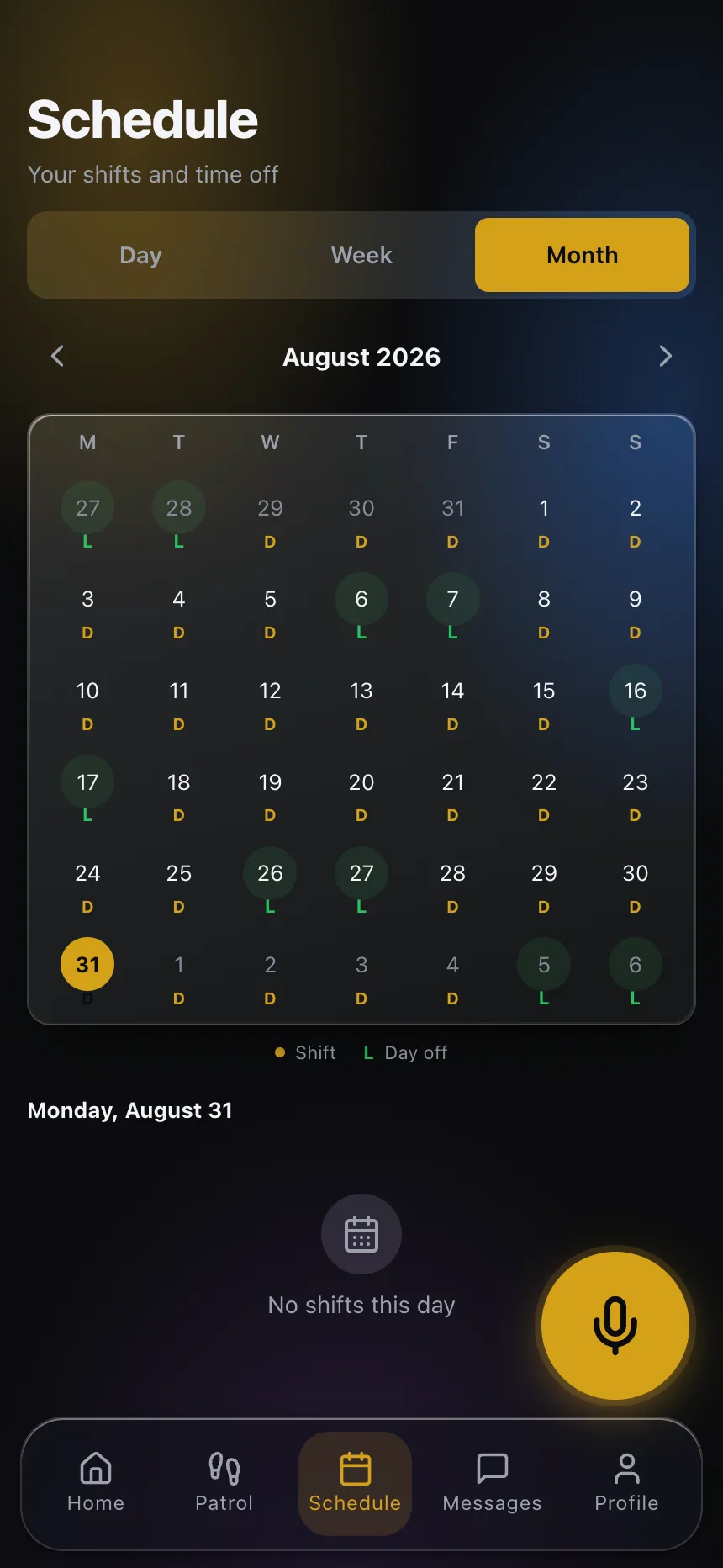
Publish the holiday schedule as soon as it is settled, on the officers’ phones rather than a break room wall. Two things happen. Officers get certainty early enough to plan around it, which materially reduces holiday callouts. And the small number of people who have a genuine conflict raise it in November, when you can still fix it, instead of the night before. Publishing far ahead is one of the few scheduling moves that costs nothing and pays immediately — a reason to run guard scheduling software that generates and pushes assignments rather than a file someone emails around.
Then fill the remainder with a rule you can defend. A documented rotation that spreads the burden across years — whoever worked Christmas last year gets first claim on being off this year — is fair, explicable, and survives being questioned. Whatever the rule is, write it down and apply it the same way every year. Perceived favoritism in holiday assignment does more damage to a guard force than the holidays themselves.
Decide the premium question deliberately
Whether you pay a differential for holiday work, which dates count, and how it interacts with overtime is a business decision with three inputs: what your obligations actually are, what your bill rates support, and what it costs to fill the post without it.
That last input is the one people skip. If a premium is what turns a coercive assignment into a volunteer one, it may be cheaper than the alternative — a resentful officer, a last-minute callout, and a supervisor standing the post.
Holiday pay obligations, premium requirements and how any premium interacts with overtime thresholds vary by state and by how your workforce is classified, and can be affected by contract terms and by any prevailing wage requirements on public-sector work. Confirm your specific obligations with payroll and employment counsel before setting policy. This is operational guidance, not legal advice.
Two practical notes regardless of the rules:
Name the exact dates. “Holidays” is not a policy. A list is. Include the observed-date question — does the premium apply on the date itself, the observed weekday, or both — because that ambiguity produces a payroll dispute every single year.
Define the shift boundary. A 6 p.m. to 6 a.m. shift on Christmas Eve is mostly Christmas Day. Decide whether premium follows the shift start, the hours actually worked on the date, or something else, and write it down before December.
The client conversations that belong in the contract
Holiday terms should not be an annual negotiation. They should be in the agreement.
Which dates are covered. Some clients close and want no coverage. Some close and want more coverage, because an empty building is a target. Some want a reduced footprint. Ask specifically, per account, in October, and get the answer in writing.
What the holiday bill rate is. If your pay obligations rise on a date and your bill rate does not, you are paying for the client’s holiday. Named dates, stated rate, in the contract.
How changes get requested. A client who calls on December 23 asking for an extra post has a legitimate request. Who on their side is authorized to make it, who on your side can approve it, and what it costs should already be settled.
What reduced coverage means. If a client cuts a post for the week, say plainly what that means — no officer on site, response limited to whatever remains. Get the acknowledgment. Empty properties over long holiday weekends are where incidents happen, and “we did not know the post was cut” is a conversation you never want to have in January.
Plan the holiday itself, not just the schedule
The schedule being filled is not the same as the day going well.
Staff dispatch heavier, not lighter. Callout probability is at its peak and your management bench is thinnest. Someone senior needs to be reachable and awake, and everyone should know who it is.
Build the callout list for those specific dates. Your normal list is full of people who are out of town. Ask in advance who is local and willing to be called, and treat that as a distinct roster.
Brief officers on what changes. Reduced building population, contractors with holiday access, deliveries at odd hours, decorations creating fire hazards, alarm systems in a different mode. Post orders that are accurate in June may not describe the site in late December.
Check in more, not less. Officers working a holiday post alone in an empty building are isolated in a way they are not in July. More frequent check-ins and a supervisor who calls are worth the effort.
Say thank you concretely. The people who covered your holidays are the people you need next year. Recognition, and remembering their preference when you build next October’s ask, costs nothing and compounds.
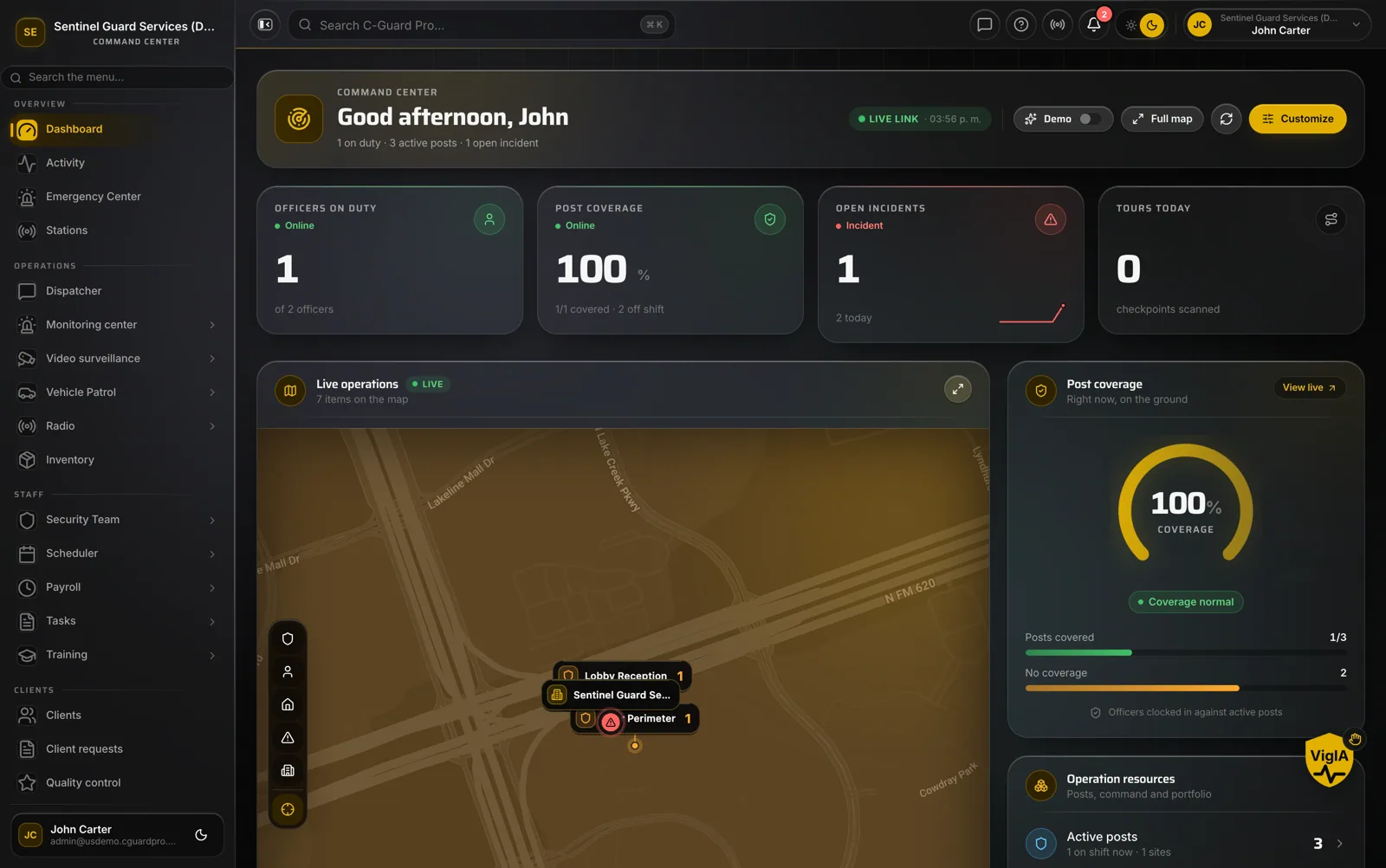
The pattern is the same every year, which means it is solvable every year. Ask early, publish early, put the terms in the contract, and go into December with the schedule already full. If you want to see how far-ahead scheduling and live coverage look in one system, explore CGuardPro or get in touch.