Most pay decisions in contract security get made in a hallway. An officer resigns, says a competitor offered more, and the owner adjusts — either matching for that one person or bumping a whole account and hoping the client absorbs it. Six months later the same conversation happens with a different officer, and nobody can say whether the company is paying above the local market, below it, or in a strange band that is generous on one account and uncompetitive on another.
Security guard pay benchmarking is the discipline of replacing that hallway with evidence. Not a formula that spits out a number — no such thing exists, and anyone selling one is guessing — but a repeatable way to see where you actually sit against comparable work in your market, so that pay changes are decisions instead of reactions.
This post deliberately contains no wage figures, no ranges and no percentages. Rates vary enormously by metro, by post type, by clearance and armed status, and they move. Publishing a number here would be worse than useless. What follows is where to look and how to read what you find.
Where to actually look
Public wage data
The U.S. Bureau of Labor Statistics publishes Occupational Employment and Wage Statistics covering security guards, broken down nationally, by state, and by metropolitan statistical area. It is free, it is methodologically serious, and it gives you a distribution rather than a single number, which matters — knowing where the middle of your metro sits and where the upper part of the range sits tells you far more than an average.
Its limits are real and you should know them. The data lags, because it is collected and published on a cycle. It groups all security guards together, so a hospital officer, an armed post and a construction gate all land in the same occupation. And it reflects all employers, including in-house corporate security departments that often pay differently from contract firms.
Your state workforce agency typically publishes its own occupational wage data, sometimes at a finer geographic grain than the federal metro level. If your accounts are concentrated in one county, that can be more useful than a metro-wide figure.
Live job postings in your own market
Public data tells you where the market has been. Job postings tell you where it is right now.
Once a month, pull the security officer postings in your metro from the major job boards and record what they say: the advertised rate or range, the post type, armed or unarmed, shift, whether a premium is offered for overnights or weekends, and whether the rate is a starting rate or a “up to” number. Do this consistently and within two quarters you have a picture nobody sold you.
Read postings skeptically. A wide advertised range usually means the bottom is the real starting rate, a rate available “after 90 days” is not the hiring rate, and national firms sometimes post a corporate range local branches do not honor.
Your own hiring funnel
The most accurate signal about your competitiveness is sitting in your own recruiting process, and almost nobody uses it.
Track, for every candidate: what they were making at their last security job, what they asked for, and — for anyone who declined an offer — what they went to instead if they will tell you. Track the same for resignations. An officer leaving for a competitor is giving you a live market quote if you ask the question directly and without defensiveness.
Add one operational metric: time to fill. If your open positions take progressively longer to fill while nothing else about your process changed, that is the market telling you something before any published dataset will.
Client bill rates
Pay benchmarking that ignores the revenue side produces decisions you cannot execute. What competitors charge for comparable work in your market bounds what any of you can pay, because the gap between pay rate and bill rate has to cover taxes, insurance, uniforms, supervision, administration and margin.
You learn bill rates from lost bids, from client contacts who share what they were quoted, and from public procurement solicitations and awards, which are frequently published for government and institutional work. That last source is the most underused: public bid tabulations are real, verifiable market data, and they cost nothing to read.
Comparing like for like
This is where benchmarking usually fails. Two rates that look comparable often describe entirely different jobs.
Before you compare anything, define the comparison unit precisely:
Post type. A quiet overnight lobby, a busy hospital emergency department, a construction gate, a retail loss prevention post and a data center access desk are different jobs with different labor markets. Comparing across them produces nonsense.
Armed or unarmed. These are separate markets with separate licensing, separate insurance costs and separate candidate pools. Never blend them.
Shift and days. Overnight, weekend and holiday work often carries a premium. A rate quoted without saying which shift it applies to is incomplete.
Credential requirements. Additional cards, certifications, clearances, driving requirements, or specific training raise the floor because they shrink the pool.
Guaranteed hours. A post offering consistent full-time hours competes differently from one offering variable part-time work. Officers compare weekly earnings, not hourly rates, and a lower hourly rate with reliable 40 hours can beat a higher rate with unpredictable ones.
Employment classification. Compare employee positions with employee positions. Arrangements that classify officers as contractors carry legal exposure that varies by state and by the facts of the relationship; talk to counsel rather than treating such postings as comparable market data. Nothing in this post is legal advice.
Note also that some contracts — federal service contracts in particular, and certain state or municipal work — may carry prevailing wage or fringe benefit obligations set by law or by the contract itself. Whether any such requirement applies to a given piece of work depends on the contract and the jurisdiction. Verify with the contracting authority and your own counsel before you assume anything about those posts.
Why total package matters more than the hourly headline
Officers compare hourly rates because that is the number on the posting. They experience the total package, and that is what determines whether they stay.
The components that actually move retention include: how consistent the weekly hours are, whether overtime is available and how it is distributed, health coverage and what it actually costs the officer per paycheck, paid time off, whether uniforms and equipment are provided or deducted, whether training time is paid, how far the commute is, shift differentials, pay frequency, and whether pay is correct every single period.
That last one is easy to underrate. An officer whose paycheck is short by a few hours and takes two weeks to resolve has effectively taken a pay cut plus an insult, and a competitor who pays accurately at the same rate is now the better job. Pay accuracy is a retention lever that costs nothing but discipline, and it rests directly on clean time and attendance records — verified clock-ins with location, not a handwritten sheet reconciled from memory.
Turning benchmarks into decisions
Benchmarking is only worth doing if it changes something. Three decisions it should inform:
Where to raise, not whether. Almost no company can raise every rate at once. Benchmarking by post type and shift tells you which posts are furthest below market — usually the overnight and weekend posts, which is also where your callouts and turnover concentrate. Fix the outliers first.
What to renegotiate. A post you cannot staff at the current bill rate is a commercial conversation with the client, not a recruiting problem. Walking into that conversation with public wage data for the metro and your own time-to-fill history is far stronger than asserting that the market moved.
Whether the margin math still works. Pay is one input to margin; overtime, unbilled hours and turnover cost are others, and they interact. A rate increase that reduces overtime and turnover can be cheaper than the status quo. You cannot evaluate that without knowing your actual hours — scheduled versus worked, straight time versus overtime, by account.
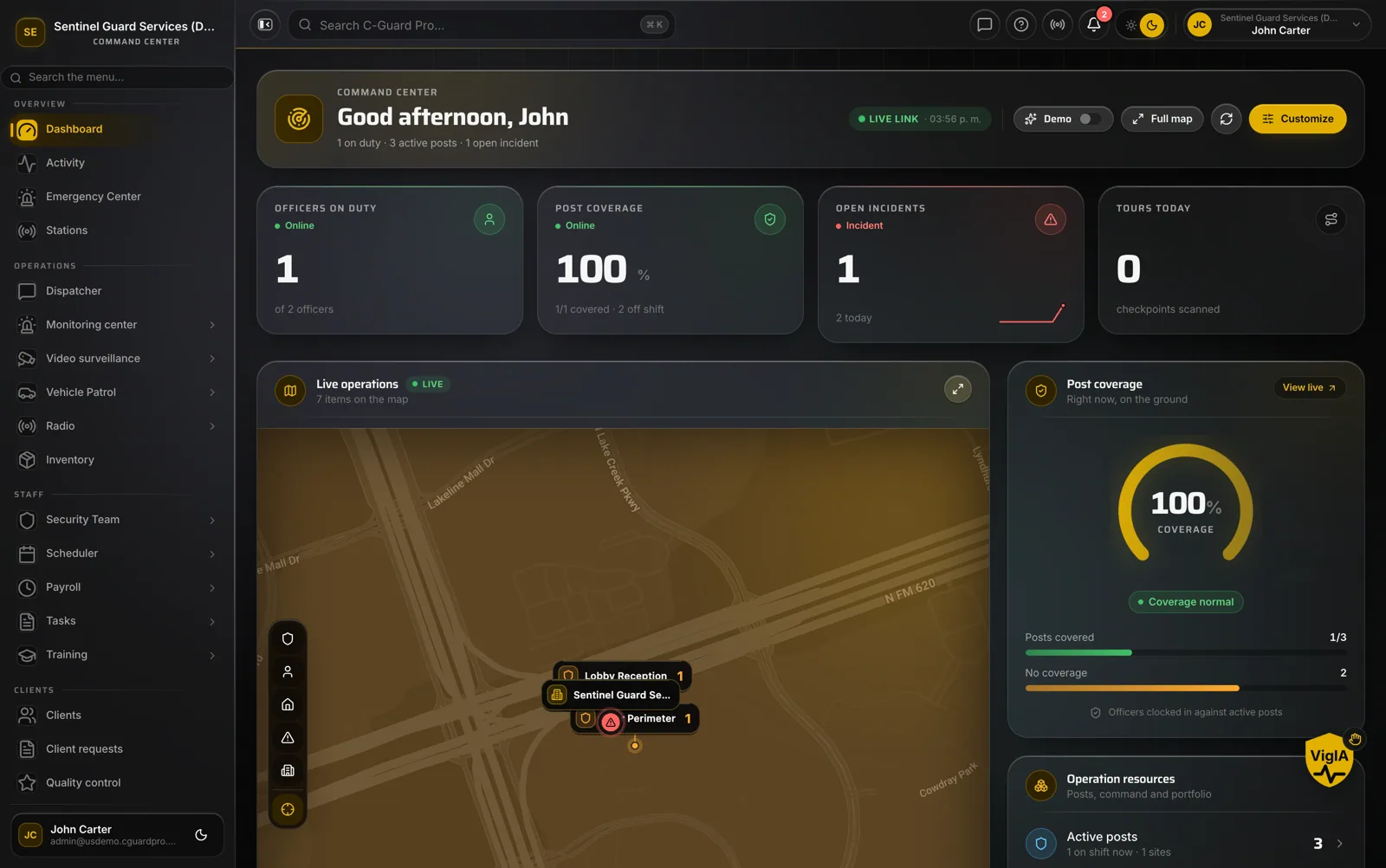
That kind of visibility comes from the schedule and hours data you already generate every week. Most companies have it; few have ever looked at it alongside a wage benchmark.
Do it on a cadence
Benchmark on a schedule — quarterly is enough for most markets — rather than in response to a resignation. A resignation is the worst possible moment to evaluate pay: the sample size is one and the emotional stake is high. Write down what you found and what you decided. Two years of that record beats any consultant’s report, because it is about your posts, in your metro, with your candidates.
If you want to see how hours, schedules and officer records come together so pay decisions rest on real data, explore CGuardPro or get in touch.