The callout is the defining operational event of the contract security business. A phone rings at 10:40 p.m., an officer is not going to make the graveyard shift, and someone now has to produce a qualified body at a specific gate by 11:00. Everything else in the company — margin, client satisfaction, supervisor time, the owner’s sleep — bends around how often that call happens and how well it gets handled.
Reducing guard callouts is usually treated as a discipline problem: write them up, track occurrences, terminate at a threshold. That approach does reduce callouts, in the same way that firing everyone reduces payroll. The officers who call out most are frequently the officers who are hardest to replace, and a policy that removes them without addressing why they called out just resets the clock on the same problem with a new hire.
Callouts are a symptom. Four causes produce most of them, and three of the four are inside your control.
Cause one: the schedule is unpredictable
This is the biggest one and the least discussed.
Officers arrange their lives around their schedules — childcare, a second job, school, a spouse’s shifts, a ride from a relative. When the schedule changes with two days’ notice, some fraction of those arrangements break. The officer does not experience this as “the company changed my schedule.” They experience it as “I cannot get childcare on Thursday,” and Thursday becomes a callout.
Unpredictability compounds. An officer whose schedule has changed three weeks running stops making arrangements at all, because arrangements keep getting wasted. They start treating each week as provisional, which makes them easier to poach, less committed to any particular shift, and more likely to take a better offer for one day rather than protect a schedule they do not trust.
The fix is not glamorous. It is publishing the schedule further out and then honoring it. Every last-minute change you make trains the force that the published schedule is a suggestion, and you pay for that training later in callouts you cannot trace back to the cause.
Two specific practices help disproportionately:
Stabilize the pattern, not just the hours. An officer working 40 hours a week on a different combination of days each week is on an unstable schedule even though the total is constant. Fixed patterns — set days, consistent shift, whether that is 8s five days or 12s on a 4-on 4-off or Panama rotation — are worth real retention.
Separate “open shifts” from “your shifts.” When officers can see the full schedule, know which shifts are theirs, and pick up extra shifts voluntarily, coverage improves and resentment falls. Being assigned an extra shift you did not agree to is one of the fastest ways to produce a callout on that shift.
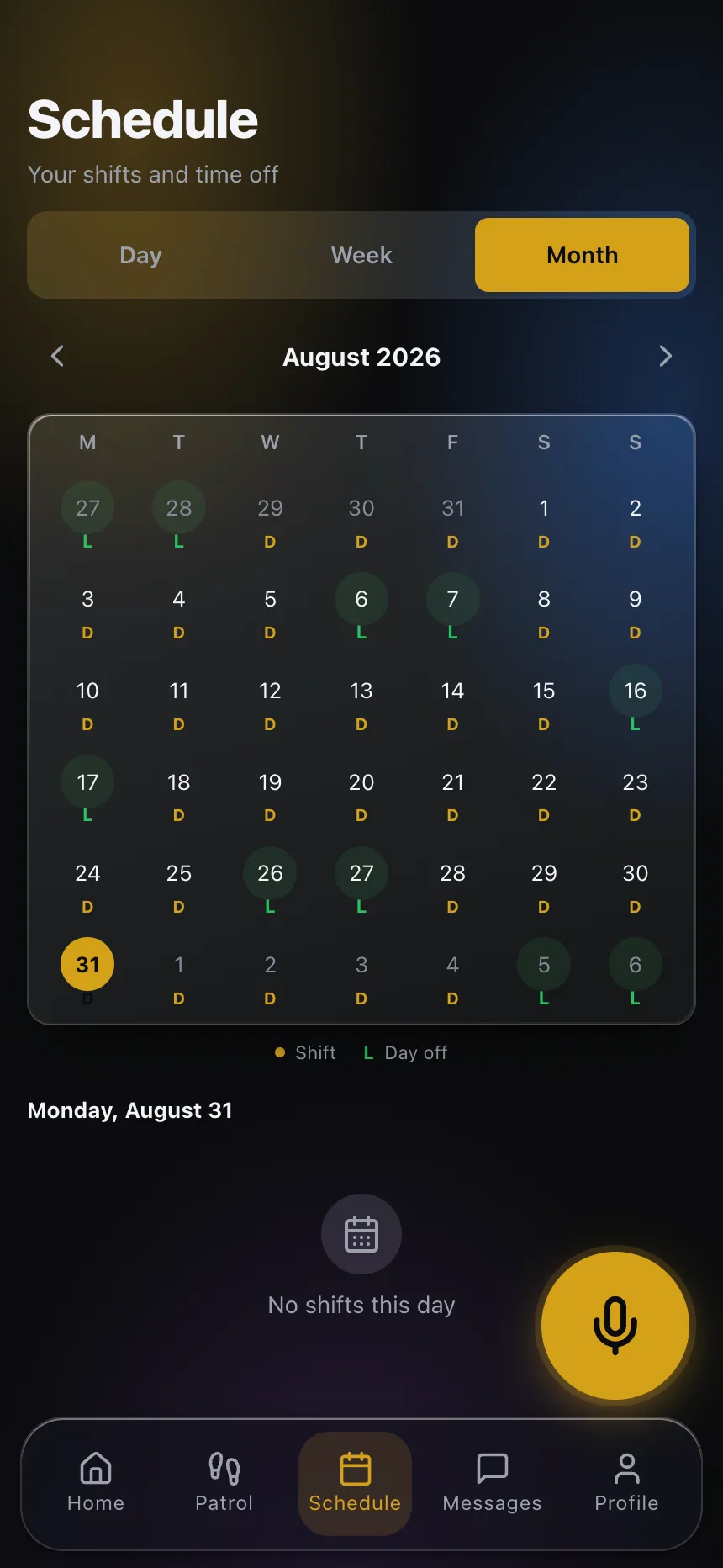
Visibility is a prerequisite. If the schedule lives in a spreadsheet the officer has to text someone to see, then every change is a surprise. If it is in the officer’s phone and updates when it changes, the officer at least gets to react early rather than at 10:40 p.m. Getting the schedule out of the office and into the force is one of the highest-return things a scheduling system does, and it has nothing to do with automation.
Cause two: the commute is too long
Commute distance is the most under-weighted variable in guard staffing. Recruiters place an officer at whichever post is open, and the post is forty minutes away in traffic, and everyone considers the placement a success because the officer accepted it.
Long commutes convert every minor life friction into a callout. A car problem, a bus that does not come, a rainstorm, a shift that ends late and eats into sleep before the next one. On a short commute those are inconveniences. On a long one they are the reason the shift did not get covered.
The unglamorous fix is to treat commute as a hard placement factor, not a preference. Ask on hiring, record it, and prefer a post the officer can reliably reach over a post that pays slightly better on paper. When a new account opens, look at where your existing force lives before you decide who to place there. And when an officer’s callouts start clustering — particularly on the first shift after a day off, or when weather is bad — check the commute before you check the attitude.
Cause three: post fit
Not every officer is right for every post, and the mismatch shows up as attendance long before anyone frames it as fit.
An officer with strong customer-facing skills posted alone on an overnight construction gate with nobody to talk to for twelve hours will be miserable, and misery expresses itself as marginal attendance. An officer who is quiet and prefers routine, placed on a busy hospital lobby with constant conflict, will burn out. An officer who wants to be busy on a post where nothing ever happens will disengage.
The signal is usually visible in the work. An officer whose reports are thorough on one post and thin on another is telling you something. A pattern of callouts concentrated at a single site, rather than spread across the officer’s schedule, is a post problem masquerading as a person problem.
Moving an officer to a better-fitting post is cheaper than replacing them, and it takes a supervisor who knows both the officer and the accounts well enough to see the mismatch. That is a real argument for supervision ratios, not an argument about paperwork.
Cause four: nobody at the company knows them
The single strongest predictor of whether an officer calls in or drags themselves to the post is whether they feel accountable to a specific person.
An officer who knows their supervisor by name, has been visited on post, has been asked how they are doing, and knows exactly which colleague will be stuck covering their shift will show up for shifts they would otherwise skip. An officer who has never met anyone from the company since orientation, whose entire relationship with the employer is a schedule text and a pay statement, has nothing holding them there but the money — and the money can be matched down the street.
This is why field supervision and callout rates are directly connected, and why cutting supervision to save cost tends to produce a coverage crisis two quarters later. The relationship is the retention mechanism.
Measure the callouts you already have
Before changing anything, look at the pattern. Most companies have never actually analyzed their callouts, because callouts get handled and forgotten rather than recorded.
Record every one with four fields: officer, post, shift, and reason as stated. Then, once a quarter, look at how they cluster.
- By post. One site producing a disproportionate share means the problem is the site, the client contact, or the shift structure there.
- By shift. Graveyard callouts concentrated on the first night back after days off point at a rest and rotation problem, not an attitude problem.
- By tenure. Callouts concentrated in the first thirty days mean onboarding is failing and the officer never got attached to the job.
- By officer. Only after the first three. If a specific officer is an outlier across posts and shifts, that is now genuinely an individual conversation — and you will have it with real evidence.
Reliable time and attendance records make this analysis possible without a separate tracking effort, because late starts and no-shows are already in the data. Lateness, in particular, is worth watching — chronic lateness on a specific post-and-shift combination usually precedes callouts on it.
What actually works, in order
Publish schedules further out and stop changing them. Place officers within a commute they can survive. Move mismatched officers instead of documenting them. Make sure every officer has a supervisor who has stood on their post and knows their name. Build a callout list that is deep enough that filling a hole does not require punishing whoever answers first.
Then, and only then, enforce an attendance policy — because at that point a callout genuinely is about the individual, and both you and the officer know it.
If you want to see how schedules, attendance records and post assignments fit together in one operation, explore CGuardPro or get in touch.