Almost every guard company that runs exit interviews gets the same answer, over and over: “I found something that pays more.” It is a polite, safe, unarguable reason, and it is very often not the real one. The officer is protecting a reference, avoiding an argument on their last day, and telling the company the thing least likely to produce a conversation they do not want to have.
Companies that take that answer at face value conclude they have a pay problem, raise rates, and watch turnover stay roughly where it was. The security guard exit interview is worth doing, but only if you design it to get past that first answer — and only if you read the results in batches rather than one at a time.
Why the standard exit interview produces nothing
Three structural problems make most exit interviews useless.
The wrong person asks. If the departing officer’s supervisor conducts the interview, and the supervisor is a reason they are leaving, you will never hear it. This is extremely common in guard work, where the supervisor relationship is the officer’s main connection to the company.
The wrong moment. An interview conducted during the final shift, with the officer turning in a uniform and thinking about final pay, is rushed and transactional. The officer’s incentive is to leave without friction.
The wrong questions. “Why are you leaving?” invites the rehearsed answer. Open-ended questions about “your experience with the company” invite generalities. Neither produces anything you can act on.
A fourth problem is subtler: many companies only interview the officers who resign properly. The officer who stopped showing up, the one who ghosted after two weeks, the one terminated for attendance — those separations often carry the most diagnostic information and get no interview at all.
Design that gets real answers
Ask someone outside the officer’s chain. Anyone will do as long as they are not the supervisor or the scheduler the officer has been arguing with. In a small company that might be the owner; in a larger one, someone from the office. What matters is that the officer does not feel they are being asked to critique the person in front of them.
Ask after the fact, not on the last shift. A short call a week or two after separation, once the final paycheck has landed and the officer has started somewhere else, gets substantially more candor. They have nothing left to lose and often something to compare against.
Offer more than one channel. Some people will say things in a form that they will not say on a phone call, and vice versa. A short written form plus an optional call catches both types.
Keep it short. Five to eight questions. Anything longer gets abandoned, and the last questions — usually the important ones — go unanswered.
Say what you will do with it. “We use these to fix things; nothing here affects your reference” is worth stating explicitly. It costs nothing and changes what you hear.
One legal note: what you can ask, what you must do about final pay, how you handle references, and what obligations attach to a separation vary by state and by circumstance. Coordinate your process with counsel. Nothing here is legal advice.
The questions that actually surface reasons
Skip “why are you leaving.” Ask questions that are specific, behavioral and anchored in time.
“When did you first start thinking about leaving?” This is the single most valuable question in the set. The answer is almost never recent. An officer who says “about four months ago, after the schedule changed” has just told you the causal event and given you a window in which you could have intervened. The stated reason for leaving is usually the last straw; this question finds the first one.
“What happened that week?” Follow the previous answer directly. This is where you get the schedule change, the argument with the client contact, the paycheck that was short, the request for a post transfer that got no response.
“What would have had to change for you to stay?” Better than “why are you leaving” because it forces a specific and often modest answer. Frequently it is not pay. It is a different shift, a closer post, or a supervisor returning a phone call.
“Was there a point where you asked us for something and didn’t get an answer?” Almost always yes. Unanswered requests are a leading cause of departure and they are entirely invisible to management, because nobody logs a request that got ignored.
“How was the first thirty days?” Even for a two-year officer. Onboarding failures set a tone that persists, and if a pattern emerges here you have found something you can fix cheaply.
“Would you work here again, on a different post or shift?” Answers sort your departures into recoverable and not. Officers who say yes belong in a rehire list, and rehires are the cheapest hires there are.
“What is the new job giving you that this one didn’t?” Asked a week or two later, this is where “more money” turns into “the shift is fixed,” “it’s ten minutes from my house,” or “they told me my schedule a month out.”
The pattern that appears when you read a quarter together
Individual exit interviews are anecdotes. Read one at a time, they produce defensive explanations — that officer was always difficult, that account is a hard account, that supervisor was having a bad month. Every single one gets explained away, which is why companies can run exit interviews for years and change nothing.
The value appears when you sit down with a quarter of them at once and sort them along four axes.
By post. If a disproportionate share of your separations come from one or two sites, you do not have a turnover problem — you have a site problem. Usually it is the client contact, the physical conditions, the shift structure, or a post that is genuinely intolerable and that everyone has quietly accepted.
By shift. Overnight and weekend concentration points at rest, rotation and supervision coverage, not at the individuals.
By tenure. A cluster inside the first thirty to sixty days is an onboarding and placement failure. A cluster at the one-year mark is usually about the absence of any next step. Different causes, different fixes, and averaging them together hides both.
By supervisor. The uncomfortable one, and the reason the interview cannot be conducted by the supervisor. If separations cluster under one person, that is information you need regardless of how well that supervisor performs on every other measure.
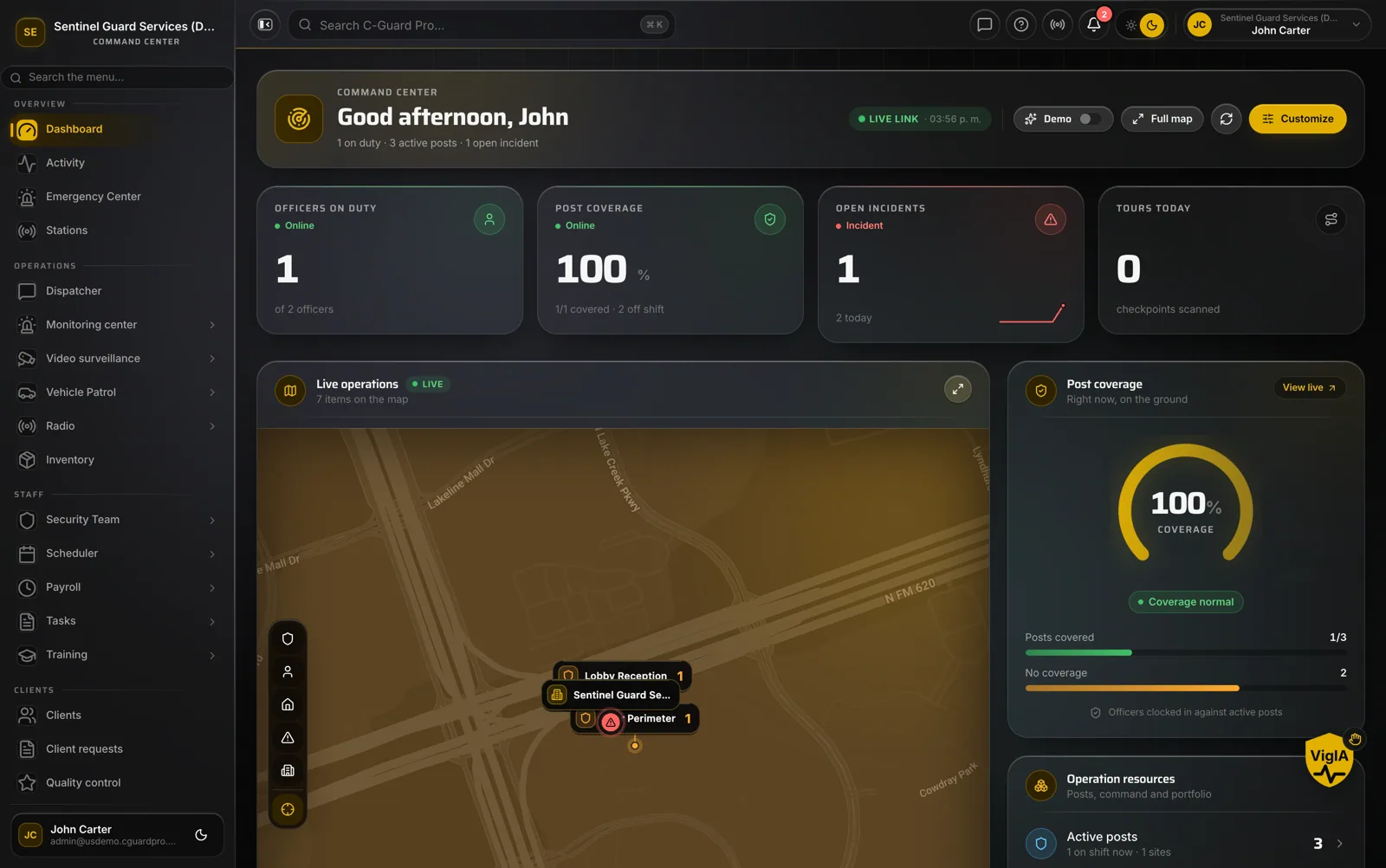
Cross-reference what you hear against what you already have. An officer who says the schedule was unpredictable can be checked against how many times their shifts actually changed. An officer who says they were always short on hours can be checked against their worked hours. This is where operational records earn their keep beyond payroll — scheduling history and hours data turn an exit interview from an opinion into a verifiable account of what happened.
Occasionally the data contradicts the officer, and that is useful too. If three departing officers from one account all say the schedule was chaotic and the record shows it was stable, then the problem is communication — the schedule was fine and nobody could see it.
Turn findings into one change per quarter
The failure mode of exit interview programs is that they produce a document nobody acts on. The discipline that prevents it is deliberately small: each quarter, pick one thing the interviews surfaced and change it. Not five things. One.
If the pattern is unanswered requests, build a rule that every officer request gets a response within a set number of days, and check it. If the pattern is a single site, go work the post yourself for a shift and find out what is happening there. If the pattern is thirty-day departures, rebuild onboarding for the two accounts where it is worst.
Then, at the next quarterly review, check whether that specific pattern got smaller. That loop — collect, batch, pick one, verify — is the entire program. Everything else is note-taking.
The interview you should also run
One more, and it costs almost nothing: the stay interview. The same questions, asked of officers who are still here, particularly the ones you would be sorriest to lose. “When was the last time you thought about leaving? What was going on?”
An exit interview tells you what you already lost. A stay interview tells you what you are about to.
If you want to see how schedules, hours and officer records come together so turnover patterns are visible before they become separations, explore CGuardPro or get in touch.