Ask a new officer what your company makes on him and he will do the arithmetic out loud: the client pays this, I get that, the difference is profit. Ask an owner who has been through a bad year and you will get a different answer — that the difference between bill rate vs pay rate is not profit at all, it is a budget, and profit is whatever survives after everything charged against that budget gets paid.
Understanding what lives in the spread is the difference between an owner who prices with confidence and one who is perpetually surprised.
The spread is a budget, not a margin
Between what the client pays for an hour and what the officer receives for that hour sits every cost of the officer existing, every cost of the company existing, and the risk that the hour costs more than planned. Profit is the residual.
Written as a list, the spread has to fund:
Costs that ride directly on the wage. Employer payroll taxes, workers’ compensation premium, unemployment insurance. These are calculated off payroll, so they rise automatically whenever pay rises. They are also unavoidable and non-negotiable, which makes them the most reliable and least interesting part of the spread.
Costs of employing this officer. Benefits and any employer contribution. Paid time off, sick leave and holiday premium where applicable. Uniforms and replacements. Licensing, background screening and permits. Training hours, which are paid and produce no billable hours. Recruiting cost per hire.
Costs of running the account. Field supervision — salary, vehicle, fuel, time on the road. Account management. Dispatch coverage, including overnight. Reporting and client meetings. Equipment and software the officer uses on post.
Costs of running the company. General liability, auto and any professional liability coverage. Office. Payroll processing, accounting, legal. Sales and bid preparation. The owner’s compensation, which belongs here whether or not it is currently being taken.
Coverage risk. The reason the spread has to be wider than a simple sum of the above: not every hour costs what it was supposed to cost.
Only after all of that is funded is there margin.
The costs owners forget
Nobody forgets payroll taxes. The costs that quietly consume spreads are the ones that do not show up on any timesheet for the account.
Non-billable paid time. Orientation. Site-specific training. Mandatory refresher hours, which vary by state and license type — verify what applies to you with your regulator, as requirements differ by jurisdiction. Time spent at a badging appointment. Time spent in a client-required induction. All paid, none billed.
Turnover. Each replacement means recruiting spend, screening, uniforms, and another round of paid training. High-turnover posts pay these costs repeatedly for the same single position. Turnover is not an HR line item; it is a direct charge against the spread on the account where it happens.
Supervisor windshield time. A site an hour outside your normal territory consumes supervision at a completely different rate than one twenty minutes away. Most companies price both the same.
Scope creep. The extra walkthrough the client asked for. The special event nobody wrote a change order for. The officer who now also handles deliveries. Each accretion consumes hours the rate never priced.
Slow payment. An account that pays late is an account you are financing. Payroll goes out weekly or biweekly regardless of when the client’s check clears. The cost of that float is real and it lands on the spread.
Under-recovered overtime and premium. The big one, and it deserves its own section.
Coverage risk: why the spread must be wider than the arithmetic
A continuously covered post has to be filled every hour it exists. Officers call out sick, quit mid-schedule, take leave, and occasionally simply stop showing up. Those hours still get worked, but not always at base cost.
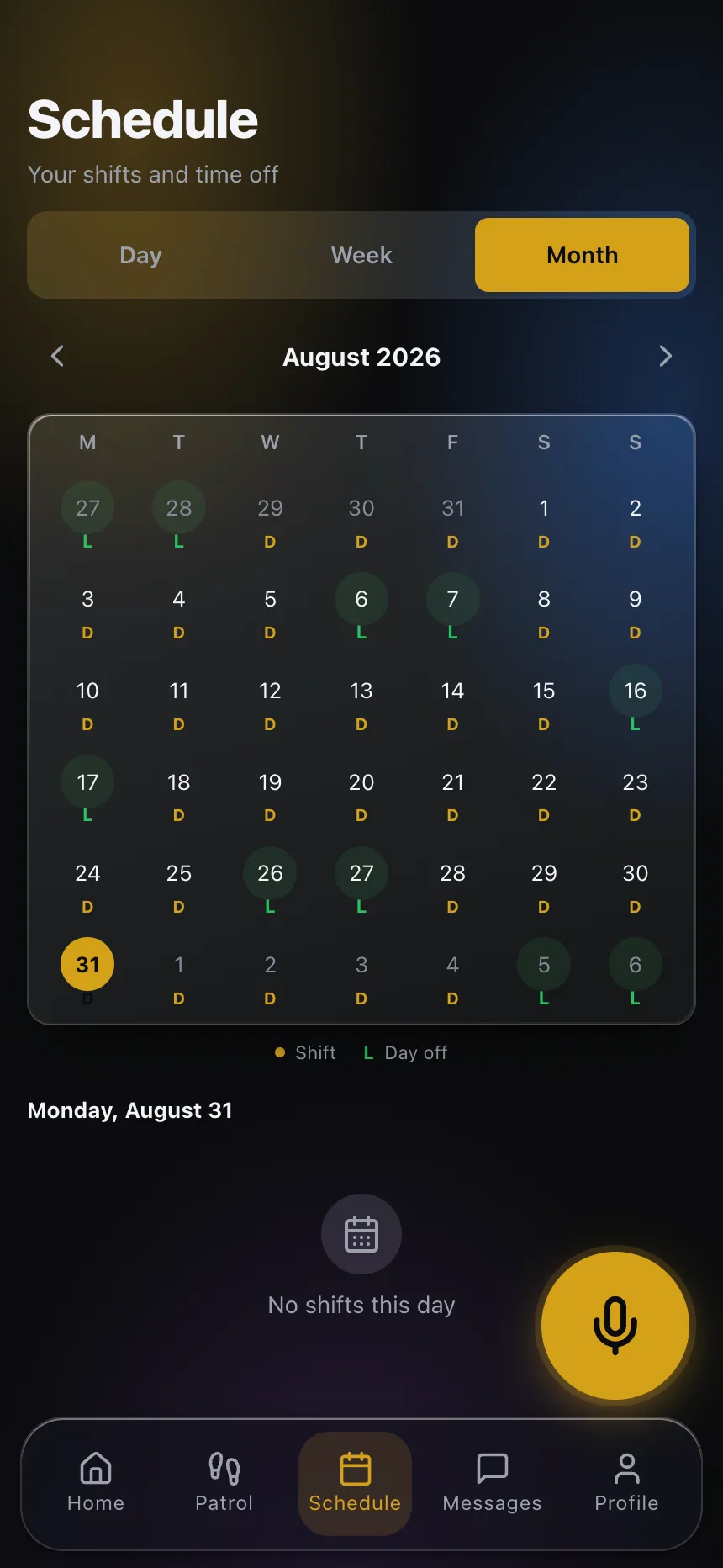
Uncovered hours get filled three ways, and every one of them is more expensive than the plan:
- An existing officer picks up beyond the weekly threshold and the hours carry an overtime premium — wage-and-hour rules on when premium applies vary and should be confirmed with your payroll provider and counsel
- The field supervisor stands the post, which costs supervisory salary and removes supervision from every other account that day
- Someone gets a premium or incentive to come in on short notice
The bill rate almost never changes when this happens. The cost does. That gap is coverage risk, and it is the single largest reason accounts that looked profitable in the model turn out not to be.
The important consequence: coverage risk is not a fixed industry cost. It is a measure of how well you schedule. A company that builds schedules with real relief depth, tracks availability, and fills callouts from a known pool absorbs far less premium cost than one that scrambles by phone every time. Two companies with identical bill rates and identical pay rates can have completely different profitability for this reason alone. Getting scheduling right is not an administrative convenience; it is a direct lever on the spread.
Why a small pay increase changes the whole contract
This is the mechanic most owners understand intuitively but underestimate in magnitude.
Raise an officer’s hourly pay and four things move at once:
- The wage itself rises by the increase.
- Wage-driven burden rises with it — payroll taxes and workers’ comp are calculated on payroll, so they scale automatically.
- Premium hours cost more, because overtime is a multiple of the base rate. Every hour of coverage risk on that post inflates by the same multiple.
- Any wage-linked benefit accrual rises with it.
Meanwhile, most of the other things the spread funds — uniforms, licensing, supervision, insurance beyond comp, G&A — do not move at all.
The result is that the total cost increase of a pay raise is meaningfully larger than the raise itself, and it is concentrated on posts with the most premium hours. A raise on a well-covered daytime post costs close to the raise plus burden. The same raise on a chronically short overnight post costs considerably more, because it multiplies through every premium hour you are already paying.
Two practical conclusions follow.
First: never quote a pay increase to a client as a bill rate increase of the same size. If your escalation language passes through only the wage, you have absorbed the burden increase and the premium inflation yourself. Escalation clauses should either be stated as a rate change that accounts for burden, or written so that a wage-driven cost change can be recalculated properly.
Second: fixing coverage is often cheaper than the raise it substitutes for. If a post is chronically short and running on premium hours, some of the money currently being spent on premium is available to fund a pay rate that makes the post staffable. That is not a trick — it is the same money moving from the expensive way to fill an hour to the cheap way.
The spread you can defend
Clients occasionally ask what your margin is, usually in a procurement conversation designed to compress it. The best answer is not a number; it is a description of what the spread buys them.
Supervision they can name and reach. Relief depth so their post gets covered when someone calls out. Training that goes beyond the minimum. Insurance that actually indemnifies them. Reporting they can look at without asking. Officers paid enough to still be there next quarter.
A competitor with a materially thinner spread is not being more efficient. They are choosing which of those items to underfund, and the buyer will find out which one within a year. You do not have to say that about the competitor. You only have to make your own list concrete enough that the comparison happens in the buyer’s head.
Watching the spread in practice
A rate model is a forecast; the spread is a fact you can only measure after the hours are worked. Per account, per period, compare:
- Hours scheduled against hours actually worked
- Straight time against premium hours
- Supervisor hours consumed by that account
- Non-billable paid hours attributable to it
- Days from invoice to payment
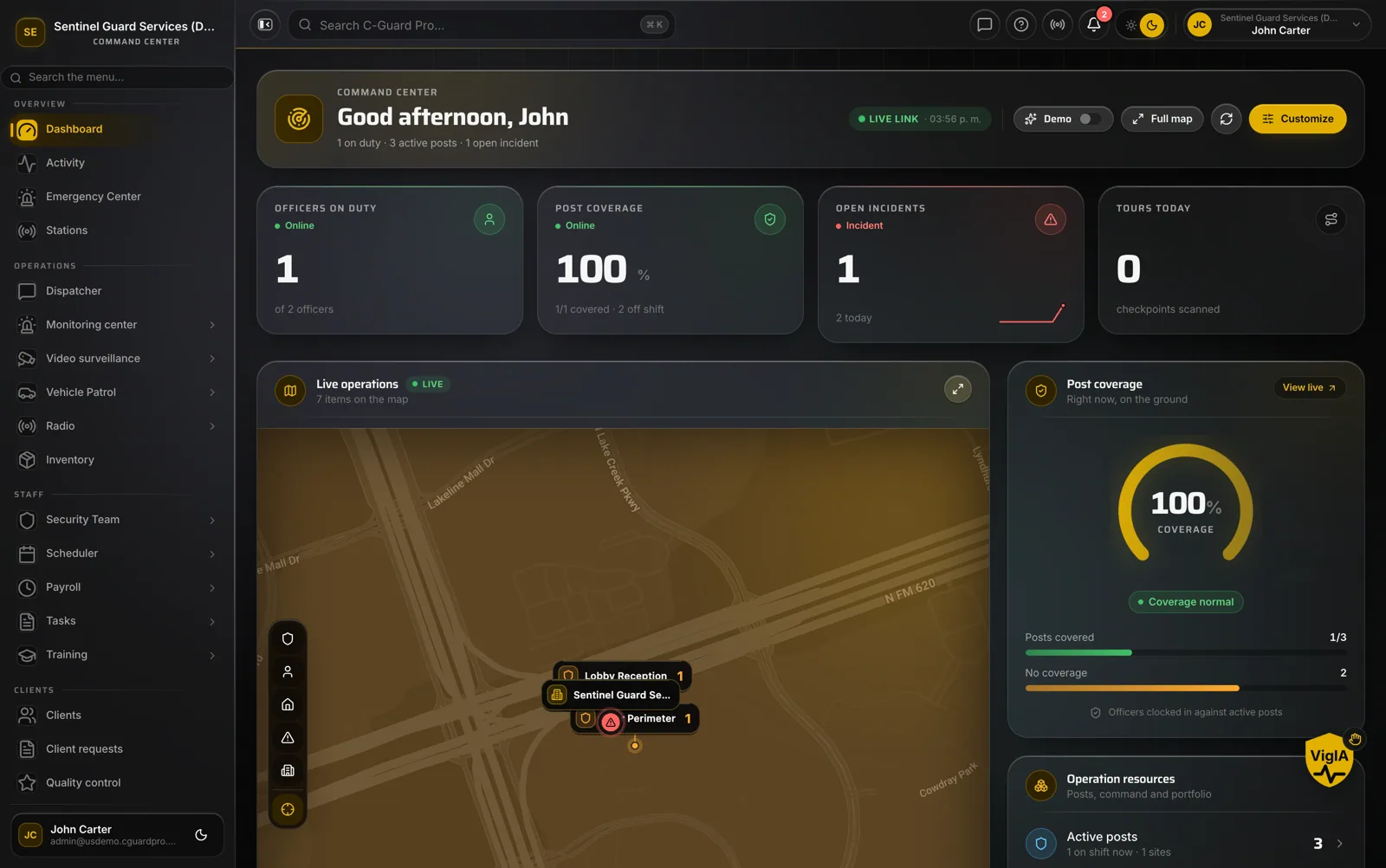
That comparison depends entirely on hours being captured as they happened. Estimated timesheets, rounded punches and hours reconstructed after the fact will show you a spread that does not exist. Verified time and attendance from the post, matched against the schedule, is what turns the spread from a theory into something you can manage.
Bill rate vs pay rate is the most-discussed number in contract security and the most misunderstood. The gap is not what you make. It is what you have to spend before you make anything — and knowing precisely what is inside it is what lets you raise pay without losing the account, or hold your price without losing the argument.
If you want to see scheduled hours, verified time and account activity in one place, explore CGuardPro or get in touch.