Public agencies buy a great deal of guard service. School districts, transit authorities, municipal buildings, county facilities, housing authorities, ports, federal buildings and military installations all contract it out, usually on multi-year terms, usually paying on time. For a contract security company that has outgrown its first handful of commercial accounts, government security contracts are the obvious next tier — and they are where a lot of otherwise well-run companies burn a year of effort and win nothing.
The reason is almost never guard quality. It is that public procurement rewards a completely different competence than commercial sales: administrative precision, sustained over months, on a schedule you do not control.
This article is general orientation, not legal advice. Requirements for government security contracts differ by agency and by level of government, they change over time, and they are frequently specific to the individual solicitation. Verify everything with the contracting officer named in the solicitation, with your state or local procurement office, and with your own attorney and insurance broker before you commit to anything.
Government security contracts are three different businesses
“Government work” is really three different markets that happen to share a name.
Local. Cities, counties, school districts, housing authorities, transit agencies, special districts. Solicitations are posted on the agency’s own procurement site or a regional bid portal. Registration is usually straightforward. The buyer is often reachable by phone before the bid, and pre-bid site walks are common and worth attending. This is where most security companies should start.
State. Departments and agencies, often purchasing through statewide term contracts or master agreements. Getting onto the vehicle is frequently the whole game — once you are on it, agencies can order from you without a fresh competition, but the vehicle itself may only open periodically.
Federal. A different universe of registration systems, contract vehicles, socioeconomic set-asides, and clause flow-downs. The administrative overhead is real, and the compliance obligations attach to your payroll, your hiring and your recordkeeping, not just to your proposal.
Do not attempt all three at once. Each has its own registration, its own portal, its own vocabulary, and its own rhythm.
The registration and eligibility layer
Before you can bid, you generally have to exist in the buyer’s system. The specifics vary by jurisdiction, but the shape is consistent:
- Vendor registration with the agency or the jurisdiction’s central procurement office, usually free or low cost and usually requiring tax identification, ownership information and business licensing.
- Federal registration in the government’s contractor registration system, with a unique entity identifier, before you can be awarded federal work.
- State security licensing for the company itself and for every officer you will deploy — in Texas, that is administered by the Texas Department of Licensing and Regulation (TDLR), and every state has its own regulator with its own categories, application process and renewal cycle. Confirm current requirements directly with the regulator; do not rely on a summary, including this one.
- Socioeconomic certifications where applicable — small business, service-disabled veteran-owned, minority- or woman-owned, HUBZone, and the state and local analogues. These are certifications with real eligibility criteria and real application processes; they are not self-declared, and misrepresenting one is a serious matter.
- Insurance at the limits the solicitation specifies, with the right endorsements and the agency named correctly as additional insured. Get your broker involved early, because raising limits or adding coverage lines takes time and changes your cost basis.
None of this is difficult. All of it takes longer than you think, and none of it can be done in the two weeks between seeing a solicitation and its due date. Companies that win public work were registered months before the bid they won.
Wage determinations and the labor math
The single largest difference between commercial and public guard work is that on many government service contracts, the wage you pay is not entirely your decision.
Federal service contracts commonly carry wage determinations that establish minimum hourly rates and fringe benefit obligations by labor category and geographic area. Many states and localities have their own prevailing wage or living wage requirements that apply to their contracts. Which regime applies, at what rates, to which classifications, and with what fringe treatment is determined by the specific solicitation and the applicable determination attached to it — and those change.
The practical consequences for a bidder:
Read the attached determination before you price anything. The classification the agency assigns to the work drives your labor cost, and the classification is not always the one you would have chosen.
Fringe obligations are part of the cost, not a rounding error. How you satisfy them — cash in lieu, a bona fide benefit plan, or a combination — has cost and administrative consequences.
Rates can be revised during a multi-year contract. Understand the price adjustment mechanism in the solicitation before you sign a term you cannot escape.
Certified payroll or equivalent reporting may be required, on a defined cadence, in a defined format, for the life of the contract.
Get this wrong and you either bid a rate you cannot deliver on or you bid above the field and lose. Neither outcome improves with volume. This is exactly the kind of question to put to the contracting officer in writing during the question period — public procurement gives you a formal channel to ask, and answers issued as an amendment bind the agency.
The paperwork discipline the work demands
Once you win, government work is administratively heavier than commercial work in a specific way: you must be able to prove things, months or years later, from records created at the time.
Expect to substantiate, on demand and often on audit:
- That every officer assigned held a current license or registration on every date worked.
- That required training was completed before deployment, with documentation.
- Exactly who worked which post, for which hours, on which dates — matching what you invoiced.
- That background screening and any agency-specific clearance or badging was completed.
- Patrol and inspection activity in the form the contract specifies.
- Incident reports on the required schedule and in the required format.
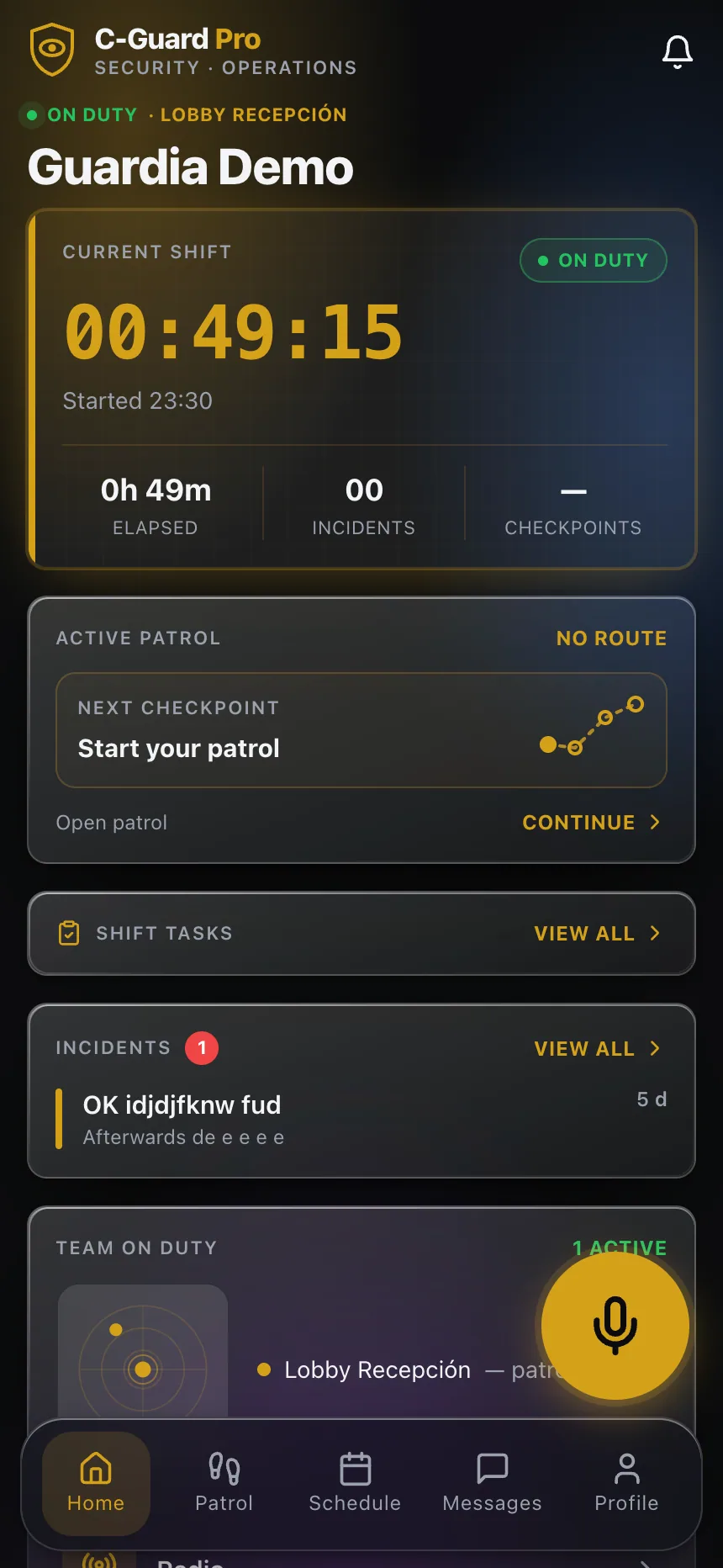
This is where paper operations fail. Not dramatically — gradually. A sign-in binder goes missing after a supervisor change. A license expires and nobody catches it because renewals live in someone’s inbox. An invoice is questioned and the hours cannot be reconciled to any contemporaneous record.
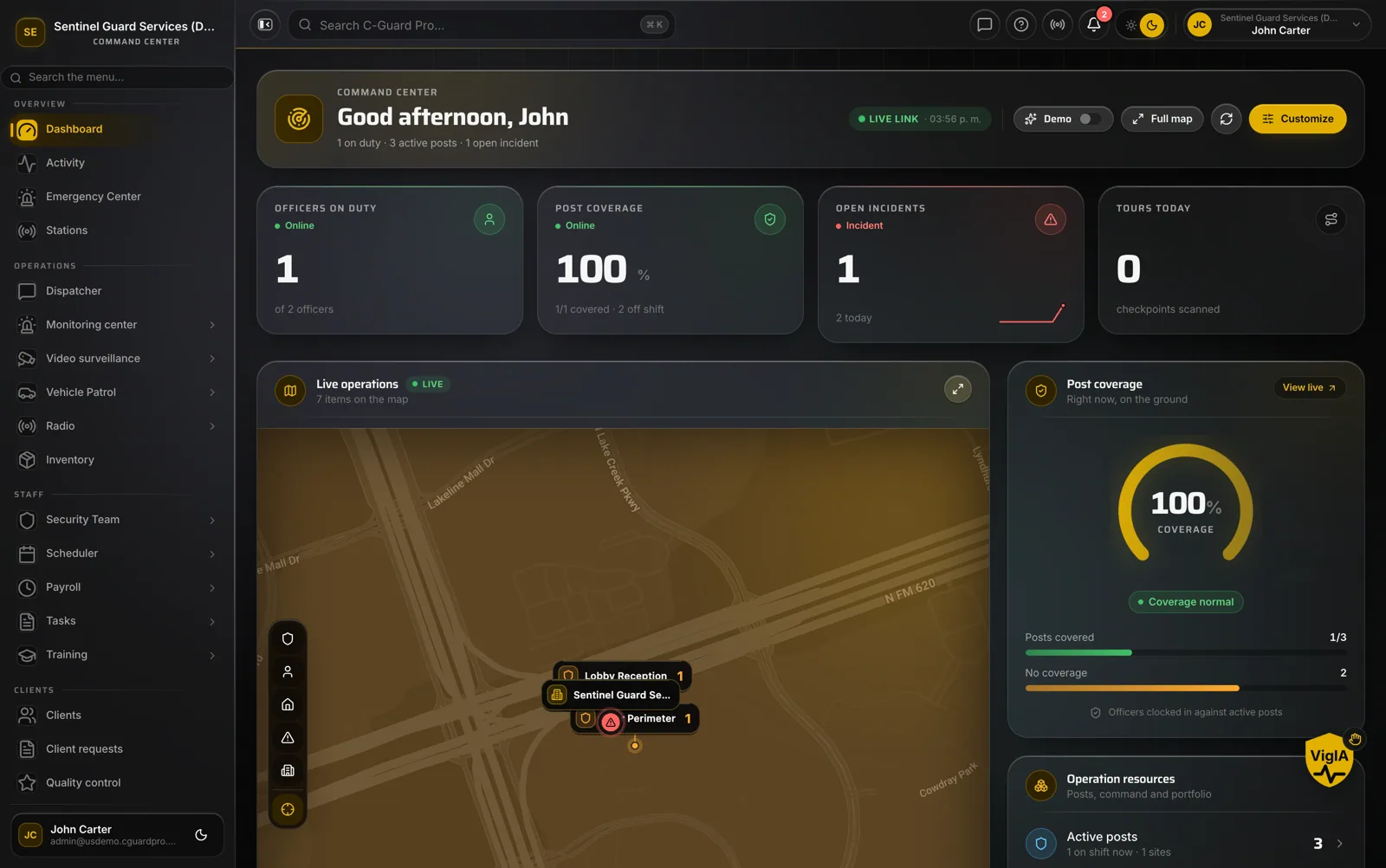
A verified attendance record — clock-ins tied to the post and the officer — and structured, timestamped daily activity reports turn an audit from a crisis into a query. Credential expiry tracking that warns you in advance turns a potential contract violation into a routine reminder. None of this is exotic; it is simply the difference between a record that exists and a record you have to reconstruct.
How to actually approach the first bid
Pick one agency and learn it. Attend their pre-bid meetings even for work you will not bid. Public procurement is unusually transparent — bid tabulations, incumbent identities and often the awarded pricing are matters of public record. Read them.
Bid something you can plainly staff. The fastest way to lose a public client permanently is to win work you cannot fill and default on coverage in month two.
Follow the instructions literally. Public solicitations are frequently decided on responsiveness before anyone evaluates quality. Wrong format, missing form, late submission, unsigned addendum acknowledgment — these are not technicalities to a procurement officer; they are the rules that keep the process defensible.
Ask questions during the question period, in writing. Every question you do not ask becomes a risk you priced blindly.
Expect to lose the first few. Incumbents have a real advantage. Persistence in a single agency compounds; scattering across ten does not.
Government contracts reward companies that treat administration as an operational function rather than an afterthought. If your records are clean and your credentials are current as a matter of routine, public work is stable, long-term and worth building toward.
If you want to see how a defensible operational record comes together, explore CGuardPro or get in touch.