A client asks whether your officers carry man-down protection. The honest answer is more interesting than yes or no, because a man down alarm does not detect a man down. It detects a pattern of movement — or the absence of one — and infers the rest. Understanding that gap is the difference between a feature that saves an officer on a solo overnight and a feature that trains your dispatcher to ignore alerts within a month.
What a man down alarm actually measures
Nearly every man-down implementation, whether it runs on a dedicated device or on the officer’s phone, works from the same accelerometer and gyroscope data that counts steps and rotates a screen. From that stream, three detections are commonly derived.
Tilt. The device has moved from roughly vertical to roughly horizontal and stayed there past a threshold. The inference is that a person carrying it vertically on their body is now lying down.
No-motion. The device has registered no meaningful movement for a set period. The inference is that the person carrying it is not moving.
Impact or free-fall. A sharp acceleration spike, or a brief period of near-zero acceleration consistent with falling, often followed by an impact signature. The inference is a fall.
Almost all of them run a pre-alarm: the device buzzes, vibrates or beeps and gives the officer a short window to cancel before it escalates. That cancel window is the single most important design element in the whole system, because it is what keeps ordinary life from reaching dispatch as an emergency.
The inference gap, stated plainly
The sensor knows about the device. It does not know about the person. That produces two categories of error, and they are not symmetric.
False positives. The device says down, the officer is fine. An officer sits in a patrol vehicle for forty minutes on a slow yard check and the no-motion timer expires. A phone slides out of a pocket onto the seat. A gate guard leans back in a chair. On a twelve-hour shift these accumulate.
False negatives. The officer is down, the device says nothing. An officer collapses into a seated position against a wall — never horizontal, so no tilt. An officer is unconscious in a vehicle, which was already producing motion the algorithm reads as normal. A device left in a jacket on the back of a chair keeps reporting nothing wrong for hours. An officer is conscious but pinned or restrained, moving enough to satisfy the motion check and completely unable to call for help.
False negatives are the dangerous ones and they are the ones nobody tests. Companies validate a man-down system by dropping a phone on the floor and watching the alert fire. That validates the easy case. The failure cases are the seated collapse, the device-not-on-body case, and the officer whose situation does not look like a fall.
Why false alarms are the real program risk
An operation can absorb a system that occasionally misses. It cannot absorb a system that cries wolf, because the response degrades invisibly.
Watch how it happens. Week one, every man-down alert gets a radio call and a supervisor drive-out. Week two, the dispatcher recognizes that all six alerts so far have been the same officer in the same truck at the same hour, and starts calling first and waiting a little longer. Week four, the alert arrives and the dispatcher clears it without calling, because it is obviously the truck again. Week six, the alert is real.
Nobody made a decision to stop responding. The threshold drifted, one reasonable judgment at a time. This is the standard life cycle of an alarm with a poor signal-to-noise ratio, and it is why tuning matters more than sensitivity.
Tuning that actually helps: lengthen no-motion windows on posts where sitting still is a normal part of the job, and shorten them on posts where it is not. Suspend or relax no-motion detection while the officer is driving, which most systems can infer. Give the officer an explicit, easy way to declare a stationary period — a break, a report-writing session at the desk — rather than making them cancel a pre-alarm every twenty minutes. And track false alarms by post, because a single post generating most of them is a configuration problem.
The response protocol is the product
When the alert fires, what happens?
Write it as a sequence with a clock and named owners, and make each step short.
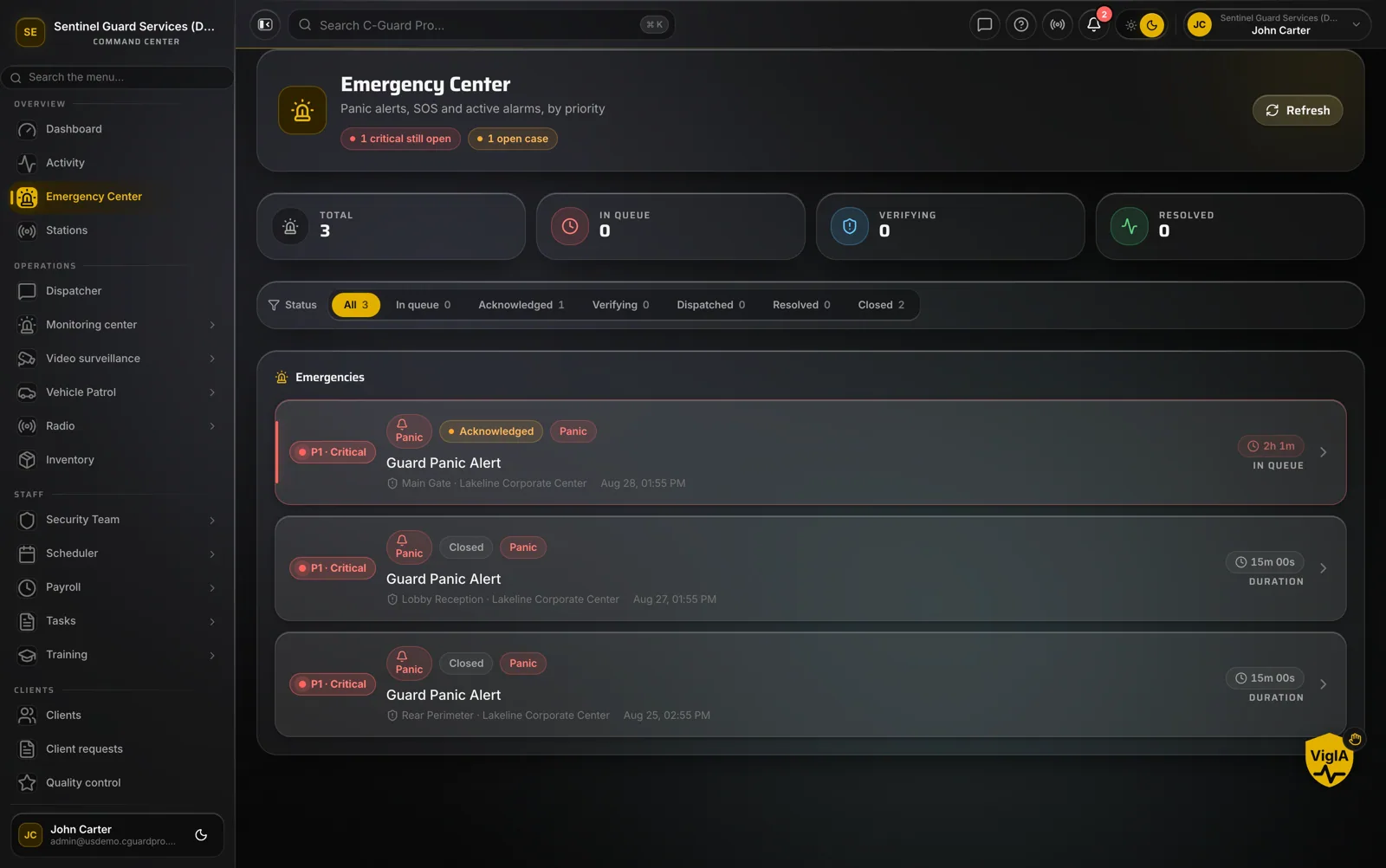
Seconds 0–30. The alert reaches a live person, not a queue. That person has the officer’s identity, post, and last known location on the same screen. First action is a voice attempt — radio before phone, because radio is faster and does not require the officer to have a free hand.
30 seconds to two minutes. No voice response means a second attempt on the alternate channel and a check of every other signal available: has the officer scanned a checkpoint recently, sent a report, moved at all. Absence of any recent activity raises confidence that the alert is real; a scan thirty seconds ago lowers it.
Two to five minutes. Physical response is dispatched. Whoever is closest with authority to enter the site: the field supervisor, another officer, the client’s on-site staff if the site has any. This has to be a standing assignment with a name attached, not a scramble to find someone awake.
If the responder cannot make contact or finds the officer down. 911, immediately, with the location and whatever is known about the officer’s condition. Then the client contact. Then the internal notification chain.
The sensor bought you the first thirty seconds. Everything after that is your operation. A man down alarm attached to a slow, undefined, unrehearsed response is worse than no alarm, because it creates the belief that the officer is covered.
What has to be true around the sensor
A man-down feature only functions inside a working operational stack. A few things have to be in place before the detection is worth anything.
Location. The alert has to carry a position. Without it, the response is a search, and on a large campus or a rural site a search costs the time the officer does not have. Location tied to the officer’s activity means the responder starts at the last known point. Be realistic about accuracy indoors — a position that says “north warehouse” beats nothing and is not the same as a floor and a room number.
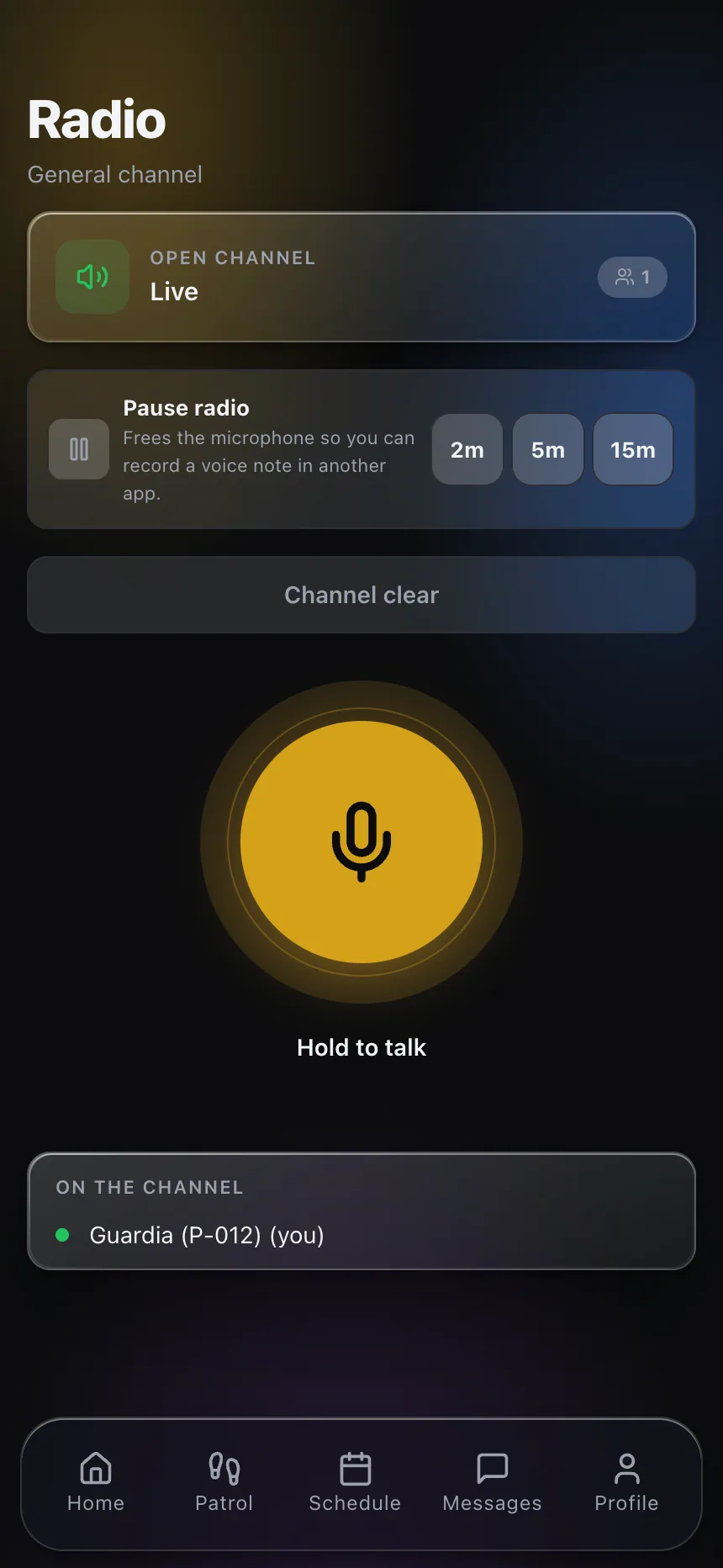
A voice channel. The fastest resolution of a man-down alert is the officer answering it. Anything that adds seconds to that — unlocking a phone, finding an app, waiting for a call to connect — costs you in the exact window that matters. A push-to-talk channel that is always live is the difference between confirming in five seconds and escalating for five minutes.
A manual alternative. Automatic detection should never be the only path. Officers who are conscious and in trouble need a deliberate panic activation they can trigger without an obvious motion. In practice the manual alert resolves far more real situations than the automatic one, because most emergencies on a post involve a person who is aware and able to act.
Battery. Motion sensing, location and a live channel across a twelve is a genuine power draw. An officer whose device died at hour nine has no man-down protection and, worse, an operation that believes they do.
Setting client expectations honestly
Clients like hearing “man-down protection” in a proposal, and it is fair to offer. It is not fair to let them believe it guarantees anything.
Describe it the way it works: automated detection that raises an alert on likely falls and prolonged stillness, backed by a defined response with a target time to voice contact and a target time to physical response. Those targets are the commitment worth making, because they are the part you control. The sensor is a trigger. The response is the service.
Test it like you mean it
Schedule unannounced tests, and test the hard cases, not the easy one. A seated collapse. A device on a desk with the officer elsewhere. An alert at 0400 on a weekend when the on-call supervisor is the only person awake. Measure two numbers each time: seconds to voice attempt, and minutes to a person physically on scene.
Those two numbers are your man-down program. The hardware only starts the clock.
If you want to see how alerts, location and live radio come together in one operation, explore CGuardPro or get in touch.